


Malian Minister of Foreign Affairs and International Cooperation Abdoulaye Diop on Tuesday appealed for international intervention in Libya to combat the spread of terrorism in the Sahel region of Africa and to restore a central government.
“As long as a solution is not found to the Libyan crisis, almost everything that we are doing in Mali and throughout the Sahel, more broadly speaking, will continue to be threatened,” Diop told the UN Security Council.
Widespread militia violence has plunged Libya into chaos less than four years after a NATO-backed uprising toppled and killed former Libyan leader Muammar Qaddafi.
The internationally recognized government was forced to the city of Tobruk after militias seized the capital, Tripoli, over the summer last year and set up a rival government.
Diop reiterated an appeal from leaders of Sahel communities for the Security Council and the African Union to set up an international force “to neutralize the armed groups,” but also to promote national reconciliation and set up stable institutions.
He highlighted the link between the onset of a crisis in Mali in 2012 and the civil war in Libya, which resulted in many Malians who were part of the Libyan army returning home with arms and ammunition which destabilized the nation.
Northern Mali fell under the control of ethnic Tuareg separatists and Muslim extremists after a military coup in 2012. A French-led intervention in 2013 scattered the extremists, but new bursts of violence have erupted.
In Libya, the situation is compounded by terrorists in the south who have declared allegiance to the Islamic State extremist group, “which is a source of great concern to all of us,” Diop said.
“Unless we help the Libyans to have a state structure, to have a security apparatus which is able to control these terrorist organizations, it will be just an illusion to think that we can have security and stability in the Sahel,” he said.
UN Undersecretary-General for Peacekeeping Operations Herve Ladsous told the council that the security situation in northern Mali remains “extremely volatile” and “very dire,” with almost daily attacks.
Since July 2013, when the UN took over peacekeeping in Mali from an African-led force, 33 peacekeepers have died and 109 have been injured, Ladsous said, adding: “No other mission in contemporary times has been so costly in terms of bloodshed.”
Diop said Mali’s president is committed to achieving a peace agreement “that would be lasting and comprehensive.”
Diop repeated his call for an intervention brigade, like the one established in the Democratic Republic of the Congo, with robust rules of engagement and resources to fight extremists in Mali.
Malian, French and UN forces are working to tackle the terrorist threat, while Algeria and Niger are securing their borders, he said
“The weak link remains... Libya, where something needs to be done,” Diop said.
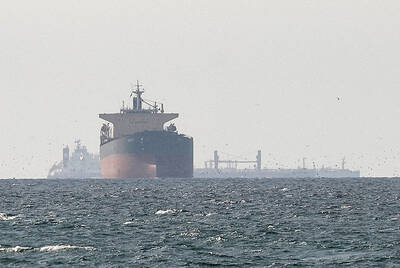
A ship that appears to be taking on the identity of a scrapped gas carrier exited the Strait of Hormuz on Friday, showing how strategies to get through the waterway are evolving as the Middle East war progresses. The vessel identifying as liquefied natural gas (LNG) carrier Jamal left the Strait on Friday morning, ship-tracking data show. However, the same tanker was also recorded as having beached at an Indian demolition yard in October last year, where it is being broken up, according to market participants and port agent’s reports. The ship claiming to be Jamal is likely a zombie vessel that
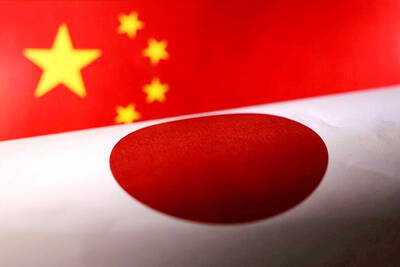
Japan is to downgrade its description of ties with China from “one of its most important” in an annual diplomatic report, according to a draft reviewed by Reuters, as relations with Beijing worsen. This year’s Diplomatic Bluebook, which Japanese Prime Minister Sanae Takaichi’s government is expected to approve next month, would instead describe China as an important neighbor and the relationship as “strategic” and “mutually beneficial.” The draft cites a series of confrontations with Beijing over the past year, including export controls on rare earths, radar lock-ons targeting Japanese military aircraft and increased pressure around Taiwan. The shift in tone underscores a deterioration
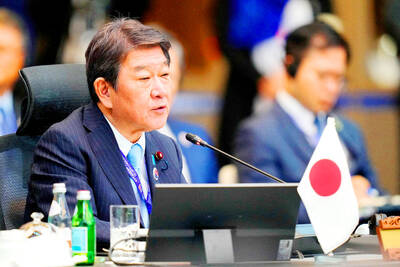
LAW CONSTRAINTS: The US has been pressing allies to send warships to open the Strait, but Tokyo’s military actions are limited under its postwar pacifist constitution Japan could consider deploying its military for minesweeping in the Strait of Hormuz if a ceasefire is reached in the war on Iran, Japanese Minister of Foreign Affairs Toshimitsu Motegi said yesterday. “If there were to be a complete ceasefire, hypothetically speaking, then things like minesweeping could come up,” Motegi said. “This is purely hypothetical, but if a ceasefire were established and naval mines were creating an obstacle, then I think that would be something to consider.” Japan’s military actions are limited under its postwar pacifist constitution, but 2015 security legislation allows Tokyo to use its Self-Defense Forces overseas if an attack,

German Chancellor Friedrich Merz’s conservative Christian Democratic Union (CDU) yesterday faced a regional election battle in Rhineland-Palatinate, now held by the center-left Social Democratic Party (SPD). Merz’s CDU has enjoyed a narrow poll lead over the SPD — their coalition partners at the national level — who have ruled the mid-sized state for 35 years. Polling third is the far-right Alternative for Germany (AfD), which spells a greater threat to the two centrist parties in several state elections in September in the country’s ex-communist east. The picturesque state of Rhineland-Palatinate, bordering France, Belgium and Luxembourg and with a population of about 4 million,


 RSS
RSS