


Suspected of being a spy or a China sympathizer, nine-year-old Indian-born Monica Liu and her family were loaded into railway cars for a detention camp in India’s Rajasthan desert.
Liu was one of about 3,000 people of Chinese descent, most of them Indian citizens, rounded up and held at the fenced camp without trial after India’s month-long border war with China in 1962.
During her five years in the Deoli camp, built in the 1800s by the British, Liu remembers the heat, lack of schooling and the sound of her mother crying “from morning till night.”

Photo: AFP
However, her strongest memories are of her family’s desperation once they were finally freed without charge by India’s government.
“We didn’t have a single penny,” Liu said in the eastern city of Kolkata, recalling sleeping in a bus shelter with her siblings and parents.
India’s Chinese community, whose ancestors flocked to Kolkata and the northeast to do business, bore the brunt of India’s humiliating war with China — fought 52 years ago this month.
Over the decades, the two Asian giants have taken steps to heal their festering distrust, a legacy of the war over their 3,225km-long border.
However, tensions remain, with Chinese President Xi Jinping’s (習近平) visit to New Delhi in September to meet Prime Minister Narendra Modi overshadowed by a troop stand-off along their border.
The dwindling Chinese community, strongest in Kolkata, has long stayed quiet about the injustice that some of them have suffered, fearful of drawing attention.
Only a handful are prepared to speak out — and want the government to admit its treatment of them during that time was a mistake.
“The wounds haven’t healed. The suffering has to be acknowledged first for the wounds to be healed. This has never happened,” Kolkata-based Indian Chinese Association president Paul Chung (鍾河芳) said. “We didn’t carry guns, we didn’t do anything. We were sleeping in our houses, then all of a sudden the police would come at 12 o’clock at night.”
Liu, who now runs a string of Chinese restaurants in Kolkata, said she does not have time to dwell on the past — but her anger remains.
“We were working hard. We were not politicians, we were not spies,” Liu said of her family which was rounded up in the northeast city of Shillong.
“We don’t have any connection with the government of China, so why should we suffer?” she said, seated at a table in her restaurant named “Beijing.”
Past Indian governments have justified the camp on national security grounds, and journalist S.N.M. Abdi said officials consider the case closed.
“I don’t foresee a formal apology or even an official explanation for what happened,” said Abdi, who is writing a book on the Deoli detainees. “It’s a closed chapter for both governments.”
Most of the 3,000 detainees accepted deportation to China, and were the first to be released.
However, several hundred who wanted to stay in India, or feared China’s communist rulers, languished in the camp for years.
They eventually returned to their homes in India to discover property and belongings confiscated, auctioned or looted.
During the years of discrimination that followed, many others left, along with younger generations searching for better study and job prospects in Canada, the US and Australia.
The community was once tens of thousands strong, after Chinese arrived in India from the 1700s as traders or carpenters and to set up sugar refineries and tanneries.
According to Chung, it now numbers about 4,000, most of them in Kolkata, which was hit hard in 2002 when a court ordered the city’s tanneries, largely Chinese-run, to move out for pollution reasons.
A daily Chinese-language newspaper is still printed there and temples have been restored.
Plans have been mooted to revamp Kolkata’s Chinatown and preserve its heritage, but nothing has been finalized.
Above a Chinese spicy sauce factory, 76-year-old Jenny Lu recalls her fear when officials came knocking. She grabbed her baby daughter, two-year-old son, nappies and a pillow before being loaded onto the train in Shillong for Deoli in 1962.
“’We are protecting you, that’s why we are taking you’,” she said authorities told her.
Although she resented being held, Lu said her four years in the camp were not all bad. She chuckles as she recalls a security official’s pet puppies disappearing one by one, snatched by hungry detainees.
“Chinese people love to eat dogs,” said Lu, two of whose children were born in the camp.
However, her face sobers as she describes how she, her husband and family eventually returned to Shillong to discover their home and business gone.
“We had to start from scratch again,” she said.
Her husband borrowed heavily from loan sharks to buy a sewing machine to start making shoes, while Lu, a hairdresser, took back a few old clients.
Liu also recalls her mother working tirelessly after their release, making and selling momos (dumplings) on the streets of Shillong before they moved to Kolkata.
“It was a very difficult, very unbelievable life,” Liu said.

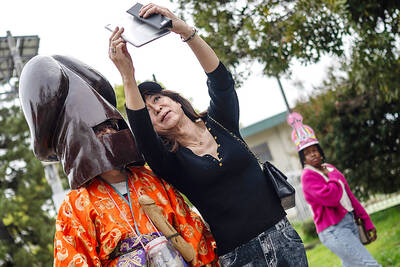
Showcasing phallus-shaped portable shrines and pink penis candies, Japan’s annual fertility festival yesterday teemed with tourists, couples and families elated by its open display of sex. The spring Kanamara Matsuri near Tokyo features colorfully dressed worshipers carrying a trio of giant phallic-shaped objects as they parade through the street with glee. The festival, as legend has it, honors a local blacksmith in the Edo Period (1603-1868) who forged an iron dildo to break the teeth of a sharp-toothed demon inhabiting a woman’s vagina that had been castrating young men on their wedding nights. A 1m black steel phallus sits in the courtyard of
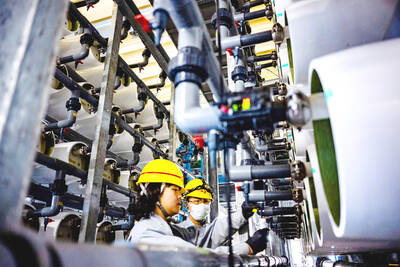
HIGH HOPES: The power source is expected to have a future, as it is not dependent on the weather or light, and could be useful for places with large desalination facilities A Japanese water plant is harnessing the natural process of osmosis to generate renewable energy that could one day become a common power source. The possibility of generating power from osmosis — when water molecules pass from a less salty solution to a more salty one — has long been known. However, actually generating energy from that has proved more complicated, in part due the difficulty of designing the membrane through which the molecules pass. Engineers in Fukuoka, Japan, and their private partners think they might have cracked it, and have opened what is only the world’s second osmotic power plant. It generates

JAN. 1 CLAUSE: As military service is voluntary, applications for permission to stay abroad for over three months for men up to age 45 must, in principle, be granted A little-noticed clause in sweeping changes to Germany’s military service policy has triggered an uproar after it emerged that the law requires men aged up to 45 to get permission from the armed forces before any significant stay abroad, even in peacetime. The legislation, which went into effect on Jan. 1 aims to bolster the military and demands all 18-year-old men fill out a questionnaire to gauge their suitability to serve in the armed forces, but stops short of conscription. If the “modernized” model fails to pull in enough recruits, parliament will be compelled to discuss the reintroduction of compulsory service, German

Hundreds of Filipinos and tourists flocked to a sun-bleached field north of Manila yesterday, on Good Friday, to witness one of the country’s most blood-soaked displays of religious fervor, undeterred by rising fuel prices. Scores of bare-chested flagellants with covered faces walked barefoot through the dusty streets of Pampanga Province’s San Fernando as they flogged their backs with bamboo whips in the scorching heat. Agence France-Presse (AFP) journalists said they saw devotees deliberately puncturing their skin with glass shards attached to a small wooden paddle to ensure their bleeding during the ritual, a way to atone for sins and seek miracles from


 RSS
RSS