


Mexican authorities announced on Friday the arrest of the “maximum leader” of a drug gang accused of colluding with crooked police in the disappearance of 43 college students.
Attorney General Jesus Murillo Karam said the arrest of the Guerreros Unidos gang kingpin Sidronio Casarrubias would open a “new line of investigation that can quickly and more easily get us closer to the truth” in the case.
The announcement came hours after thousands of protesters marched in Acapulco to demand the safe return of the 43 young men, who went missing in the southern state of Guerrero three weeks ago.
Tomas Zeron, director of investigations in the prosecutor’s office, said Casarrubias was arrested on Thursday at a police checkpoint on a highway between Mexico City and the nearby city of Toluca.
The announcement came three days after authorities said another Guerreros Unidos leader, Benjamin Mondragon, killed himself when federal police surrounded him in the central state of Morelos.
Authorities say the gang worked hand-in-hand with corrupt municipal officers in a night of violence in the city of Iguala on Sept. 26 that left six people dead and the 43 aspiring teachers missing.
Iguala’s officers shot at the students’ buses and then handed them to their counterparts in the neighboring town of Cocula, who delivered the 43 young men to the Guerreros Unidos, according to authorities.
Casarrubias denied ordering the attack on the students, but was informed when it happened and did nothing to stop it, Murillo Karam said.
A total of 36 municipal officers have been arrested in the case, along with 17 Guerreros Unidos members and their boss, he said.
The attorney general said investigators are still analyzing the contents of three mass graves found near Iguala, after declaring last week that 28 bodies in one pit did not belong to the students.
More than 1,200 security forces are looking for the college students around Iguala.
The mass disappearance has sparked international and national outrage, with protests held across Mexico last week and a new demonstration in the Pacific resort city of Acapulco on Friday.
Chanting “they took them alive, we want them back alive,” thousands of students, teachers and farmers also called for the resignation of Guerrero Governor Angel Aguirre over his handling of the case.
“We are angry because this is not an isolated event. Many of us are parents and we see very ugly things in this country that we want to fight,” 34-year-old teacher Magdalena Catalan said.
Many of the protesters wore masks in the latest demonstration over the mass disappearance.
“We are enraged against the government. It’s going to be a month [since the disappearance] and we have seen nothing,” a machete-wielding farmer said.
The US embassy issued an “emergency message” urging its citizens to stay away from the demonstration.
However, the protest was peaceful, unlike a demonstration in Guerrero’s capital on Monday that ended with students torching part of the state government’s headquarters.
The protesters have threatened to seize all 81 municipal offices in Guerrero to pressure authorities to find the students.
They took over a fifth town hall on Friday while Acapulco’s government closed its offices as a precaution.
Aircraft, horse-mounted police and divers have been looking for the 43 missing in several towns around Iguala, 200km south of Mexico City.

A humanoid robot that won a half-marathon race for robots in Beijing on Sunday ran faster than the human world record in a show of China’s technological leaps. The winner from Honor, a Chinese smartphone maker, completed the 21km race in 50 minutes and 26 seconds, said a WeChat post by the Beijing Economic-Technological Development Area, also known as Beijing E-Town, where the race began. That was faster than the human world record holder, Ugandan Jacob Kiplimo, who finished the same distance in about 57 minutes in March at the Lisbon road race. The performance by the robot marked a significant step forward

Four contenders are squaring up to succeed Antonio Guterres as secretary-general of the UN, which faces unprecedented global instability, wars and its own crushing budget crisis. Chile’s Michelle Bachelet, Argentina’s Rafael Grossi, Costa Rica’s Rebeca Grynspan and Senegal’s Macky Sall are each to face grillings by 193 member states and non-governmental organizations for three hours today and tomorrow. It is only the second time the UN has held a public question-and-answer, a format created in 2016 to boost transparency. Ultimately the five permanent members of the UN’s top body, the Security Council, hold the power, wielding vetoes over who leads the

An earthquake registering a preliminary magnitude of 7.7 off northern Japan on Monday prompted a short-lived tsunami alert and the advisory of a higher risk of a possible mega-quake for coastal areas there. The Cabinet Office and the Japan Meteorological Agency said there was a 1% chance for a mega-quake, compared to a 0.1% chance during normal times, in the next week or so following the powerful quake near the Chishima and Japan trenches. Officials said the advisory was not a quake prediction but urged residents in 182 towns along the northeastern coasts to raise their preparedness while continuing their daily lives. Prime
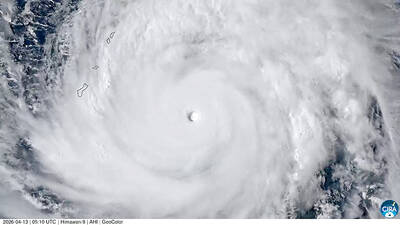
HAZARDOUS CONDITION: The typhoon’s sheer size, with winds extending 443km from its center, slowed down the ability of responders to help communities, an official said The US Coast Guard was searching for six people after losing contact with their disabled boat off the coast of Guam following Typhoon Sinlaku. The crew of the 44m dry cargo vessel, the US-registered Mariana, on Wednesday notified the coast guard that the boat had lost its starboard engine and needed assistance, Petty Officer 3rd Class Avery Tibbets said yesterday. The coast guard set up a one-hour communication schedule with the vessel, but lost contact on Thursday. A Coast Guard HC-130 Hercules aircraft was launched to search for the six people on board, but it had to return to Guam because of


 RSS
RSS