


Half of North America’s bird species, from common backyard visitors like the Baltimore oriole and the rufous hummingbird to wilderness dwellers such as the common loon and bald eagle, are under threat from climate change and many could become extinct, a study said.
If present trends continue, 314 species face dramatic declines in population as warmer temperatures push birds out of their traditional ranges. Ten states and Washington could lose their state birds, the study said.
“It is hard to imagine that we are not going to lose some of these birds permanently,” said Gary Langham, head scientist for the National Audubon Society and leader of the seven-year study. “The scale of disruption we are projecting means that many familiar sounds, and many familiar birds that people may see in their backyards and on their walks, that help them define a place for them, may no longer be there.”
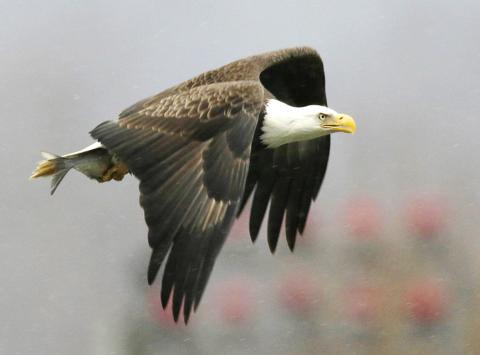
Photo: Reuters
The findings are much bleaker than a US government report in 2010 on the fate of North America’s birds, which suggested ocean and Arctic birds would be the most vulnerable to climate change. An updated version of that report was due out yesterday.
The Audubon researchers said that on present trends, 126 of the 588 bird species in the study would lose more than half of their traditional ranges and would go into decline by mid-century. Another 188 species would lose their range by 2080.
Maryland would lose the Baltimore oriole, the mascot for the baseball team as well as the state bird, which would no longer be able to breed in the mid-Atlantic. Louisiana’s brown pelican is under threat and Minnesota would lose the common loon, its state bird, which would be unable to survive in the continental US. Idaho, Mississippi, New Hampshire, Nevada, Pennsylvania, Utah, Vermont and Washington DC would also lose their state birds, the study said.
The bald eagle, once considered a success story for US conservation, could lose 75 percent of its range by 2080. Some birds, such as the trumpeter swan, would lose virtually all of their range toward the end of the century, the study said.
The study said 274 birds would maintain or increase their ranges under climate change. However, even if the birds find room to expand, they could face renewed competition from other species, as well as new predators.
The researchers drew on more than a century of observations from birdwatchers, as well as a 40-year historical record from the US Geological Survey, combining the data with 17 climate models.
Audubon chief executive David Yarnold described the findings as a “call to action.”
The group is calling for reductions in carbon dioxide emissions, as well as measures to preserve habitats and give the birds a better chance of survival.
Langham said that the study did not take into account other factors associated with climate change such as rising sea levels, which can flood marshes and other bird habitats with saltwater; drought, which can kill off insects and other food sources; or extreme storms.
As a result, it was likely to be a conservative assessment of the threats facing birdlife, he said.

Through the noise of rushing papers and whirring belts at a print factory in Kyoto, two creators watch their photo essay come to life in broadsheet form — part of an effort to win new audiences in the age of artificial intelligence (AI). Despite the decline of the publishing industry, self-publication and handmade “zine” magazines are growing in popularity in Japan, reflecting the nation’s enduring love of paper in the digital era. While speaking to Agence France-Presse at the plant, his hands black with ink, one of the creators, Kazuma Obara, said: “I think [paper] is a medium that engages all five

‘ABSURD MISTAKE’: The election commission said that there had been a failure to anticipate turnout after 14 polling stations ran short of ballot papers South Korean riot police yesterday cleared protesters from a Seoul polling station after a 35-hour blockade sparked by a shortage of ballot papers during local elections earlier this week. Wednesday’s election was the first nationwide vote since South Korean President Lee Jae-myung took office following the ouster of Yoon Suk-yeol over his short-lived martial law declaration. Lee’s ruling Democratic Party swept most races, but failed to flip the crucial Seoul mayoral seat. The South Korean National Election Commission apologized, blaming a failure to anticipate turnout after 14 polling stations in Seoul ran short of ballot papers. Some polling stations stayed open until 10pm to

France experienced its hottest spring on record, the French weather service said on Tuesday, after an exceptional early heat wave that also broke highs for the season in England and Wales. Meteo-France said the average nationwide temperature over March to May was 13.8°C — about 1.7°C above the norm, and surpassing records set in 2011 and 2020. “The warmest spring since records began in 1900,” it said in a bulletin. All three months were warmer than average, but the onset of an “unprecedented heatwave” late last month pushed the mercury to highs typically seen at the height of the summer. “Our country had never

A Sherpa guide was found crawling to base camp on Mount Everest a week after he went missing and was reunited with his family, who had given up hope he would return. Dawa Sherpa was last seen on Friday last week descending the mountain, but he did not reach base camp even though his client did. The pair were among the last climbers on the mountain as the climbing season came to an end and the route was dismantled. Dawa was located by a cleaning crew on Thursday morning as he was crawling down the snowy slopes around the Khumbu Icefall, just above


 RSS
RSS