


When attackers from China’s minority Uighurs killed 37 people in a July rampage in far western Xinjiang, police responded by gunning down at least 59 of them. When three Uighurs allegedly killed a top state-appointed Muslim cleric, police shot dead two of them. When security forces led a raid on 10 suspected Uighur terrorists, they fatally shot all but one.
The incidents are part of a pattern raising concerns that Chinese police are excessively using deadly force in their bid to prevent more attacks by Uighur militants, who have killed dozens of civilians in train stations and other public places over the past few years.
In some cities, patrolling SWAT units have already been authorized to shoot dead suspected terrorists without warning.
An Associated Press review of articles by the Xinhua news agency and other state media has found that at least 323 people have died in Xinjiang-related violence since April last year, when the unrest began to escalate.
Nearly half of those deaths were inflicted by police — in most cases, by gunning down alleged perpetrators who are usually reported as having been armed with knives, axes and, occasionally, vaguely defined explosives.
Beijing’s tight controls and monopoly on the narrative make it difficult to independently assess if the lethal action has been justified. And Chinese authorities prevent most reporting by foreign journalists inside Xinjiang, making it nearly impossible to confirm the state media numbers.
Uighur exile groups and the US-government funded broadcaster Radio Free Asia (RFA) report far more violent incidents than Chinese state media do, and in some cases, higher death tolls and police shootings of Uighur protesters, but those reports are similarly hard to verify.
To understand just how tough it can be to determine whether China’s hand is being forced — or whether officials are recklessly lashing out at those who resist them — consider this recent series of confrontations in Xinjiang: On Aug. 1, police cornered a group of alleged terrorists in an abandoned house and shot nine of them dead, arresting one.
In June, police gunned down 13 “mobsters” who allegedly attacked a local police station. In April, checkpoint police fatally shot a teenage Uighur motorcyclist after he allegedly attempted to grab their guns.
In many cases, the government’s accounts of violence are wildly divergent from overseas reports.
Of the June incident, Uighur exiles said Uighur residents were simply protesting outside the police station when police fired at them and their truck, setting off a fire. In the teenager’s case, RFA reported that he had been shot after running a red light.
Who is to say what really happened?
Xinjiang authorities operate with a “deeply disturbing” lack of accountability, said Sophie Richardson, China director at Human Rights Watch.
“If the use of force is justified, the Chinese government should be allowing independent, credible experts to review the evidence,” she said. “It should be making that evidence public.”
FEW PROTECTIONS
Meanwhile, experts in policing, terrorism and human rights point to several aspects of the authorities’ crackdown that make it all too easy for security forces to open fire unnecessarily.
China does not have comprehensive laws defining terrorism and how authorities should respond. The Chinese leaders’ use of war-like rhetoric risks inflaming patriotic fervor instead of clear-headed rationality in the security forces. Above all, the ongoing “strike hard” campaign prioritizes tough, swift action over legal protections.
“Under the terms of the ‘strike hard’ campaign, they can dispense with the usual considerations about legality,” said Willy Lam (林和立), an expert on Chinese politics at the Chinese University of Hong Kong. “They don’t have scruples about shooting to kill suspects and they appear to be using disproportionately heavy force and firepower.”
The trend has alarmed overseas Uighur activists, who say many innocent Uighurs may have been killed.
“The use of force by the Chinese security against Uighurs is really like it’s against foreign enemies,” said Alim Seytoff, president of the Uyghur American Association in Washington. “The extrajudicial use of lethal force is rampant.”
The Chinese Ministry of Public Security and police in Xinjiang did not respond to faxed requests for comment.
CONFLICTING TALLIES
Though the death tally culled from state media is virtually impossible to independently confirm, and some foreign media have cited higher tolls, the figures still provide a sketch of the human cost of the unrest that has rocked the region over the past 17 months. Chinese Communist Party Secretary-General and President Xi Jinping (習近平), head of the new national security commission, has staked his political prestige on stemming the turbulence, but it has been challenging.
“They have been a lot more aggressive in using military-grade equipment to combat the terrorists and underground groups, and also summary executions,” Lam said. “I think the major reason is that Xi Jinping thinks that unless they use extraordinary or draconian methods, they cannot solve the problem quickly, and the Uighur problem has proven to be one of the major policy failures of [his] administration.”
Elsewhere in China, police rarely use firearms to quell violence or mass unrest, preferring to deploy tear gas, water cannons and riot police with truncheons and shields. Although the anti-terror campaign is being carried out by SWAT and paramilitary police, the operation more closely resembles war than policing.
“It’s exactly the opposite of a criminal case. In a criminal case, we say we only get the guy if they’re guilty. Otherwise, if there’s a slight bit of doubt, let them go,” said Kam Wong, an expert on Chinese police at Xavier University in Cincinnati, Ohio. “In the case of terrorists, even when in doubt, we will get them.”
“In China, terrorists are to be treated as a contradiction between enemies and not contradictions amongst the people. They are afforded very few protections under the law,” Wong said.
APPEAL TO PATRIOTISM
In that sense, China’s counterterrorism effort bears similarities to the US’ anti-terror practices post-Sept. 11, 2001, including assertions that deadly military force against terrorists — even if US citizens — might outweigh their constitutional rights, he said.
Xi has cast the campaign in patriotic, militaristic terms, in one instance evoking the memory of a Ming-era Chinese military leader who fought Japanese pirates.
“Sweat more in peacetime so you will bleed less in wartime,” Xi said in a pep talk to Xinjiang police during a high-profile tour in April.
Special police units in cities such as Beijing and Guangzhou have recently been authorized to fire without warning at suspected terrorists engaged in violence.
Xiamen and Jiangsu Province went a step further — saying SWAT officers were allowed to shoot dead such alleged perpetrators. The government has not specified how threats are to be assessed.
Xi has called for a “people’s war” — an effort to mobilize the public to act as informants, with rewards in some instances.
However, without a counterterrorism law in place, “and with emotions running high, the people would act like vigilantes,” Wong said.
Public information tends to be based on personal prejudice, racial profiling and ethnic animosities, making it unreliable and of dubious use, with innocent people likely to be implicated, Wong added.
Part of the problem might be Xi’s choice of words, saying he wants terrorists to be like “rats scurrying across the street, chased by all the people.”
“They’re using rhetoric that’s very dehumanizing toward people,” said William Nee, Amnesty International’s China researcher.
“It encourages an atmosphere in which excessive use of force is condoned,” Nee said.
Catching terror suspects alive is a better approach anyway, because then you can interrogate them, said Raffaello Pantucci, a London-based terrorism researcher at the Royal United Services Institute, a defense think tank.
“You can find out who their networks are, you can find out more information and you can then investigate that,” he said. “That’s counterterrorism practice 101.”
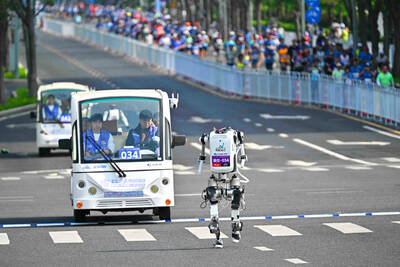
A humanoid robot that won a half-marathon race for robots in Beijing on Sunday ran faster than the human world record in a show of China’s technological leaps. The winner from Honor, a Chinese smartphone maker, completed the 21km race in 50 minutes and 26 seconds, said a WeChat post by the Beijing Economic-Technological Development Area, also known as Beijing E-Town, where the race began. That was faster than the human world record holder, Ugandan Jacob Kiplimo, who finished the same distance in about 57 minutes in March at the Lisbon road race. The performance by the robot marked a significant step forward

Four contenders are squaring up to succeed Antonio Guterres as secretary-general of the UN, which faces unprecedented global instability, wars and its own crushing budget crisis. Chile’s Michelle Bachelet, Argentina’s Rafael Grossi, Costa Rica’s Rebeca Grynspan and Senegal’s Macky Sall are each to face grillings by 193 member states and non-governmental organizations for three hours today and tomorrow. It is only the second time the UN has held a public question-and-answer, a format created in 2016 to boost transparency. Ultimately the five permanent members of the UN’s top body, the Security Council, hold the power, wielding vetoes over who leads the
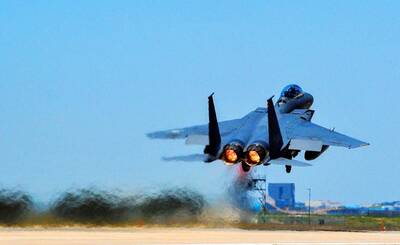
South Korea’s air force yesterday apologized for a 2021 midair collision involving two fighter jets, a day after auditors said the pilots were taking selfies and filming during the flight and held them responsible for the accident. “We sincerely apologize to the public for the concern caused by the accident that occurred in 2021,” an air force spokesman told a news conference, adding that one of the pilots involved had been suspended from flying duties, received severe disciplinary action and has since left the military. The apology followed a report released on Wednesday by the South Korean Board of Audit and Inspection,
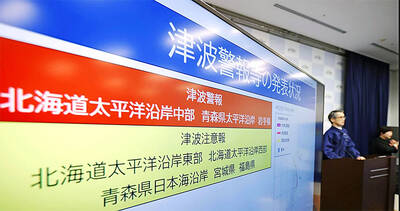
An earthquake registering a preliminary magnitude of 7.7 off northern Japan on Monday prompted a short-lived tsunami alert and the advisory of a higher risk of a possible mega-quake for coastal areas there. The Cabinet Office and the Japan Meteorological Agency said there was a 1% chance for a mega-quake, compared to a 0.1% chance during normal times, in the next week or so following the powerful quake near the Chishima and Japan trenches. Officials said the advisory was not a quake prediction but urged residents in 182 towns along the northeastern coasts to raise their preparedness while continuing their daily lives. Prime


 RSS
RSS