


Trapped since officials placed them in quarantine two weeks ago, the residents of Dolo Town are becoming increasingly resentful over their incarceration in Liberia’s open-air “Ebola jail.”
About 17,000 increasingly hungry residents in the settlement close to the international airport are forced to line up for rations of rice while soldiers corral them at gunpoint.
The streets are almost empty as residents observe measures in a bid to halt a severe outbreak of a virus that has killed about 2,000 west Africans, half in Liberia.

Photo: AFP
Dolo Town, 75km east of the capital, Monrovia, was locked down on Aug. 20, at the same time as West Point, a slum in the capital. While the West Point lockdown caused riots, people have largely accepted the measures to contain them in Dolo Town, but their patience is wearing thin.
“I am used to going out every day to hustle for my family to eat. Now look at me, sitting here like a kid, looking at my wife and children all day,” carpenter Jallah Freeman, 56, tells reporters as he sits in front of his house. “I am tired. I am fed up with this quarantine. We beg the government to lift this thing.”
Most of the working-age inhabitants of Dolo Town are employed at a nearby plantation owned by US tire maker Firestone, the largest natural rubber operation in the world, covering almost 500km2.
“We have not been going to work. We will not be able to go until the quarantine is lifted. It is regrettable, but what can we do? We want to be free. We are in jail,” Firestone employee Mohamed Fofana said.
Firestone contained a possible outbreak when an employee’s wife became infected in April and has its own hospital with an isolated Ebola treatment ward. The company has scaled back production.
At Dolo Town’s market, women sit at stalls selling pepper, oil, some fish, salt and fruit. People wander from stall to stall, searching for food among the dwindling stocks.
“They don’t allow us to go anywhere. We are only allowed to go and stand at the [checkpoint] and family members from elsewhere can come there to bring us food and other things we need,” stallholder Kebeh Morris said.
“We can see the trucks bringing the food, but not everyone is getting it for now. Like us: We don’t even have a ticket yet, so we don’t know when we will get the food. Until then, we have to rely on our family members out there to bring us food,” Morris added.
By the beginning of last month, 30 people had died in Dolo Town, at the rate of at least three a day.
About 90 percent of the victims were churchgoers who began showing symptoms after returning from burying a congregant. The church is based in the southern part of town, an enclave for the ethnic Bassa people.
Soldiers have barricaded the entry road into the town and they patrol its periphery throughout the day. Troops can also be seen with their weapons walking the streets and supervising burials.
Despite the lockdown, despite the death which stalks Dolo Town, many of the inhabitants interviewed by reporters are skeptical that they are in an Ebola hotspot.
“Since the government quarantined this place for about two weeks now, they have not taken any sick person from here. We have not seen any case yet,” Reginald Logan said.
Monrovia resident Nathaniel Kangar had come to visit his parents when he found himself trapped by the quarantine order.
“I want to obey the government’s order so I am here. I agree that the virus exists, but I don’t agree with the process that is going on in Dolo Town. When they come and get someone based on symptoms like vomiting or hiccups, they will not come back to tell us what was the result of the testing.”
Others, though, are in no doubt.
At a cemetery among homes in the Bassa area, a heavy tropical downpour begins as a local government vehicle brings in two Ebola victims wrapped in body bags, just a few meters from homes where children are playing.
“We have to put stop to this. They can’t bring Ebola bodies and come bury them here just like that,” shouts Samuel Paygar, a 61-year-old resident of a nearby house.
“They are putting us in danger. The next time they come, we will stop them,” he said.


PHISHING: The con might appear convincing, as the scam e-mails can coincide with genuine messages from Apple saying you have run out of storage For a while you have been getting messages from Apple saying “your iCloud storage is full.” They say you have exceeded your storage plan, so documents are no longer being backed up, and photos you take are not being uploaded. You have been resisting Apple’s efforts to get you to pay a minimum of £0.99 (US$1.33) a month for more storage, but it seems that you cannot keep putting off the inevitable: You have received an e-mail which says your iCloud account has been blocked, and your photos and videos would be deleted very soon. To keep them you need

For two decades, researchers observed members of the Ngogo chimpanzee group of Kibale National Park in Uganda spend their days eating fruits and leaves, resting, traveling and grooming in their tropical rainforest abode, but this stable community then fractured and descended into years of deadly violence. The researchers are now describing the first clearly documented example of a group of wild chimpanzees splitting into two separate factions, with one launching a series of coordinated attacks against the other. Adult males and infants were targeted, with 28 deaths. “Biting, pounding the victim with their hands, dragging them, kicking them — mostly adult males,
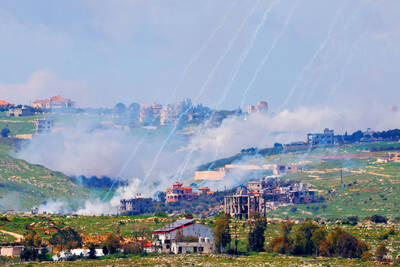
The Israeli military has demolished entire villages as part of its invasion of south Lebanon, rigging homes with explosives and razing them to the ground in massive remote detonations. The Guardian reviewed three videos posted by the Israeli military and on social media, which showed Israel carrying out mass detonations in the villages of Taybeh, Naqoura and Deir Seryan along the Israel-Lebanon border. Lebanese media has reported more mass detonations in other border villages, but satellite imagery was not readily available to verify these claims. The demolitions came after Israeli Minister of Defense Israel Katz called for the destruction of

SUPERFAN: The Japanese PM played keyboard in a Deep Purple tribute band in middle school and then switched to drums at university, she told the British rock band Legendary British rock band Deep Purple yesterday made Japanese Prime Minister Sanae Takaichi’s day with a brief visit to their high-profile superfan as they returned to the nation they first toured more than half a century ago. Takaichi’s reputation as an amateur drummer, and a fan of hard rock and heavy metal has been well documented, and she has referred to Deep Purple as one of her favorite bands along with the likes of Black Sabbath and Iron Maiden. “You are my god,” a giddy Takaichi said in English to Deep Purple drummer Ian Paice, presenting him with a set of made-in-Japan


 RSS
RSS