


The man who hopes to unseat Colombian President Juan Manuel Santos did not mince his words in the final televised debate ahead of today’s election, telling his rival: “It’s not possible to respect you. You don’t have the stature,” as he stood close enough to Santos to land a punch — and looked as if he wanted to.
“Calm down, calm down,” Santos urged Oscar Ivan Zuluaga, putting his palms up at his lectern.
Colombia’s nastiest presidential campaign in years has focused largely on a single issue: Santos’ prescription for ending the nation’s half-century-old guerrilla conflict.
The US-educated incumbent says peace is near after 18 months of slow-going talks in Cuba that he had hoped to wrap up months ago. Zuluaga, a former minister of finance running for the Democratic Center coalition and who never misses a chance to remind voters of his small-town roots, accuses Santos of selling Colombia out to an insurgency already on the ropes.
The hand-picked candidate of former Colombian president Alvaro Uribe, who remains a powerful political player, Zuluaga won the most votes among the five candidates in the election’s first round on May 25.
Zuluaga has set what appear to be impossible conditions for continued peace talks if he wins: The rebels must halt all military activity and some would essentially have to agree to jail time.
With the country’s enduring conflict claiming more than 200,000 lives and stunting economic growth, outsiders might think the peacemaker would have an edge, but this is Colombia, where “peace is a strange land,” said political analyst Leon Valencia, a former rebel with Colombia’s No. 2 rebel band, the National Liberation Army.
The prospect of a peace accord has divided the country, with most opinion polls calling the race a dead heat. Uribe and Zuluaga say the peace Santos is negotiating would mean “terrorist murderers” entering the Colombian Congress, while Santos denies he would let war criminals to go unpunished.
The irony is that Santos, first as Uribe’s minister of defense and then in his first two years as president, wielded a US-backed military to badly weaken the Revolutionary Armed Forces of Colombia (FARC), killing its top leaders and flattening jungle camps with airstrikes.
The only Colombian who can take as much credit for withering FARC is Uribe himself, who took Santos’ talks as a personal affront and has been wielding Twitter like a Gatling gun against Santos.
Zuluaga’s foes say he is nothing more than a puppet of Uribe, who was elected to the Colombian Senate in March and for whom he served as finance minister.
Yet Valencia said that far from caring about Uribe’s hold on Zuluaga, the candidate’s backers “like that he is a puppet and not someone who is going to betray Uribe like Santos did.”
This week, Santos won key endorsements and may have regained some momentum. He got the backing of 80 top business leaders and announced exploratory talks with the National Liberation Army. The US and EU already back his negotiations with the FARC.
On Friday, the brother the FARC commander whose 2011 killing was ordered by Santos publicly endorsed the president and forgave him for the death of Guillermo Leon Saenz, better known by his nom de guerre Alfonso Cano.
Santos is opposed by Colombia’s cattle ranchers and palm oil plantation owners, beneficiaries of a deal Uribe made with far-right paramilitaries that dismantled their militias. Large landholders had by then consolidated control over territory that the militias had largely rid of rebels, while driving at least 3 million poor locals off the lands. They dislike Santos’ peace pact because it would facilitate the return of stolen lands.
One problem for Santos is that the FARC talks have dragged on and that Colombians rank other issues as more important. A Gallup poll early this month found that less than 5 percent of respondents think the FARC will be the next president’s main problem.
Spreading the benefits of a growing economy is more important to many Colombians.
Today’s election is not really about Zuluaga and Santos, political scientist Marcela Prieto said, “It is about who fears Uribe versus who fears the FARC.”

Kouri Richins, a Utah mother who published a children’s book about grief after the death of her husband is to serve a life sentence for his murder without the possibility of parole, a judge ruled on Wednesday. Richins was convicted in March of aggravated murder for lacing a cocktail given to her husband, Eric Richins, with five times the lethal dose of fentanyl at their home near Park City in 2022. A jury also found her guilty of four other felonies, including insurance fraud, forgery and attempted murder for trying to poison her husband weeks earlier on Feb. 14, 2022, with a
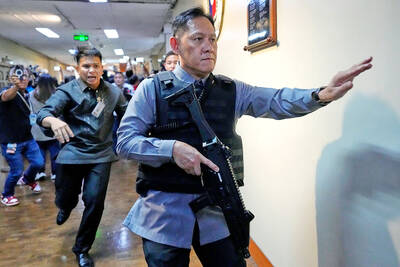
DELA ROSA CASE: The whereabouts of the senator, who is wanted by the ICC, was unclear, while President Marcos faces a political test over the senate situation Philippine authorities yesterday were seeking confirmation of reports that a top politician wanted by the International Criminal Court (ICC) had fled, a day after gunfire rang out at the Philippine Senate where he had taken refuge fearing his arrest. Senator Ronald “Bato” dela Rosa, the former national police chief and top enforcer of former Philippine president Rodrigo Duterte’s “war on drugs,” has been under Senate protection and is wanted for crimes against humanity, the same charges Duterte is accused of. “Several sources confirmed that the senator, Senator Bato, is no longer in the Senate premises, but we are still getting confirmation,” Presidential
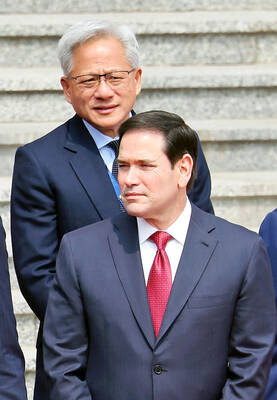
HELP DENIED? The US Department of State said that the Cuban leadership refuses to allow the US to provide aid to Cubans, ‘who are in desperate need of assistance’ US Secretary of State Marco Rubio on Wednesday said that Cuba’s leadership must change, as Washington renewed an offer of US$100 million in aid if the communist nation agrees to cooperate. Cuba has been suffering severe economic tumult led by an energy shortage that plunged 65 percent of the country into darkness on Tuesday. Cuba’s leaders have blamed US sanctions, but Rubio, a Cuban American and critic of the government established by Fidel Castro, said the system was to blame, including corruption by the military. “It’s a broken, nonfunctional economy, and it’s impossible to change it. I wish it were different,” he told
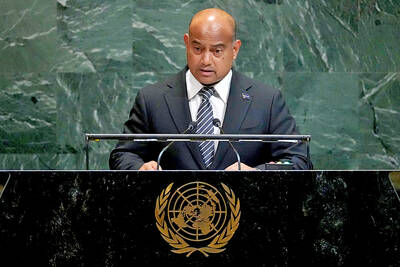
Nauru said it would hold a referendum to change its official name, described as a colonial relic from a time when “foreign tongues” mangled the native language. Nauru would change its name to Naoero to “more faithfully honor our nation’s heritage, our language and our identity,” Nauruan President David Adeang said in a statement on Tuesday. The Pacific island nation’s native language is Dorerin Naoero, which is spoken by the vast majority of its approximately 10,000 inhabitants. “Nauru emerged because Naoero could not be properly pronounced by foreign tongues, and was changed not by our choice, but for convenience,” the government said in


 RSS
RSS