


In junta-ruled Thailand, the simple act of reading in public has become an act of resistance.
On Saturday evening in Bangkok, a week-and-a-half after the army seized power in a coup, about a dozen people gathered in the middle of a busy, elevated walkway connecting several of the capital’s most luxurious shopping malls.
As pedestrians trundled past, the protesters sat down, pulled out book titles such as George Orwell’s Nineteen Eighty-Four and began to read.
In a country where the army has vowed to crack down on anti-coup protesters demanding elections and a return to civilian rule, in a place where you can be detained for simply holding something that says “Peace Please” in the wrong part of town, the small gathering was an act of defiance — a quiet demonstration against the army’s May 22 seizure of power and the repression that has accompanied it.
“People are angry about this coup, but they can’t express it,” said a human rights activist who asked to be identified only by her nickname, Mook, for fear of being detained.
“So we were looking for an alternative way to resist, a way that is not confrontational... And one of those ways is reading,” she said.
Their defiance, if you can call it that, is found in the titles they chose. Among them: Unarmed Insurrection , The Politics of Despotic Paternalism, The Power of Non-Violent Means.
The junta has banned political gatherings of five people or more. However it is unclear what laws, if any, such low-key protests could be breaking.
The coup, Thailand’s second in eight years, deposed an elected government that had insisted for months that the nation’s fragile democracy was under attack from protesters, the courts and, finally, the army. The leader of the junta, General Prayuth Chan-ocha, says the military had to intervene to restore order after half a year of debilitating protests that had crippled the former government and triggered sporadic violence which killed 28 people and injured more than 800.
Since taking over, the military has made clear it will tolerate no dissent and has launched a major campaign to silence critics and censor media. The junta has warned all citizens against doing anything that might incite conflict and the list of targets has been long.
At least 14 partisan TV networks have been shut down along with nearly 3,000 unlicensed community radio stations. Independent international TV channels such as CNN and BBC have been blocked along with more than 300 Web sites, including New York-based Human Rights Watch’s Thailand page. Journalists and academics have been summoned by the army. Activists have fled.
A sudden interruption of access to Facebook on Wednesday fueled widespread speculation that the nation’s new rulers were testing their censorship power; the junta, though, insisted it was merely a technical glitch.
Kasama Na Nagara, who works in the financial sector, said about 20 people were participating in the book readings. Saturday marked the third day that the group had organized such a protest. They have been careful to avoid soldiers.
On Friday, the group was supposed to gather on another walkway where they had conducted a reading a day earlier. However, when troops showed up, they called it off.
Human rights organizations are deeply concerned over how far the clampdown will go. Some people have begun using encrypted chat apps on their smartphones, for fear of being monitored, and at least one major bookstore in Bangkok, Kinokuniya, has pulled from its shelves political titles that could be deemed controversial.
So far, Orwell’s Nineteen Eighty-Four, in which authorities operating under the aegis of “Big Brother” fit homes with cameras to monitor the intimate details of people’s personal lives, is not among them.
“But we have Big Brother watching us now ... it has become too risky to speak out. It’s sad. But it’s safer to be silent in Thailand right now,” Kasama said.
Thousands of troops deployed in multiple locations across Bangkok yesterday to stop expected protests by a separate group of anti-coup protesters, raising fears of possible violence if the soldiers crack down. Authorities closed several elevated “Skytrain” stations to try to prevent large groups from gathering.
So far, the other anti-coup protests have been relatively small. As many as 1,000 people marched through Bangkok and scuffled with troops several times last week, though no injuries have been reported.
Those protesters carried hand-made signs and banners with messages like “No dictatorship” and “Pro-Democracy” and “Anti-Coup.” Some have shown up with masks of prominent political figures to conceal their faces and black tape across their mouths to protest the increasing repression.

An American scientist convicted of lying to US authorities about payments from China while he was at Harvard University has rebuilt his research lab in Shenzhen, China, to pursue technology the Chinese government has identified as a national priority: embedding electronics into the human brain. Charles Lieber, 67, is among the world’s leading researchers in brain-computer interfaces. The technology has shown promise in treating conditions such as amyotrophic lateral sclerosis and restoring movement in paralyzed people. It also has potential military applications: Scientists at the Chinese People’s Liberation Army have investigated brain interfaces as a way to engineer super soldiers by boosting
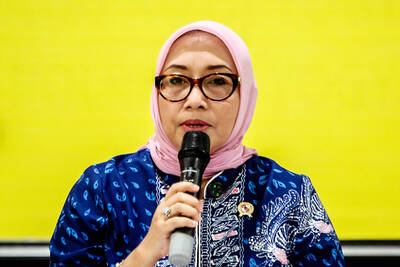
Indonesian police have arrested 13 people after shocking images of alleged abuse against small children at a daycare center went viral, sparking outrage across the nation, officials said on Monday. Police on Friday last week raided Little Aresha, a daycare center in Yogyakarta on Java island, following a report from a former employee. CCTV footage circulating on social media showed children, most younger than two, lying on the floor wearing only diapers, their hands and feet bound with rags. The police have confirmed that the footage is authentic. Police said they also found 20 children crammed into a room just 3m by 3m. “So
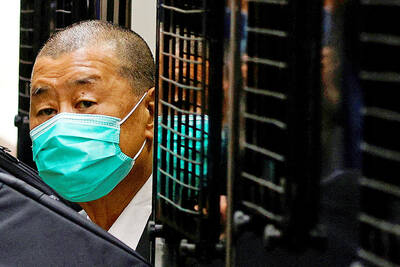
Jailed media entrepreneur Jimmy Lai (黎智英) has been awarded Deutsche Welle’s (DW) freedom of speech award for his contribution to Hong Kong’s pro-democracy movement. The German public broadcaster on Thursday said Lai would be presented in absentia with the 12th iteration of the award on June 23 at the DW Global Media Forum in Bonn. Deutsche Welle director-general Barbara Massing praised the 78-year-old founder of the now-shuttered news outlet Apple Daily for standing “unwaveringly for press freedom in Hong Kong at great personal risk.” “With Apple Daily, he gave journalists a platform for free reporting and a voice to the democracy movement in
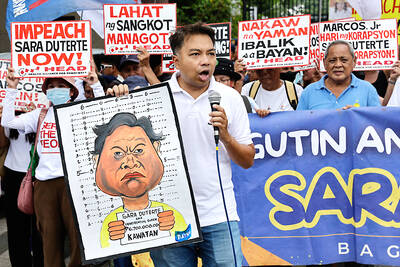
PHILIPPINE COMMITTEE: The head of the committee that made the decision said: ‘If there is nothing to hide, there is no reason to hide, there is no reason to obstruct’ A Philippine congressional committee on Wednesday ruled that there was “probable cause” to impeach Philippine Vice President Sara Duterte after hearing allegations of unexplained wealth, misuse of state funds and threats to have the president assassinated. The unanimous decision of the 53-member committee in the Philippine House of Representatives sends the two impeachment complaints to deliberations and voting by the entire lower chamber, which has more than 300 lawmakers. The complaints centered on Duterte’s alleged illegal use and mishandling of intelligence funds from the vice president’s office, and from her time as education secretary under Philippine President Ferdinand Marcos Jr. Duterte and the


 RSS
RSS