


Highly secretive US military researchers say that in the next few months they will unveil new advances toward developing a brain implant that could one day restore a wounded soldier’s memory.
The Defense Advanced Research Projects Agency (DARPA) is forging ahead with a four-year plan to build a sophisticated memory stimulator, as part of US President Barack Obama’s US$100 million initiative to better understand the human brain.
The science has never been done before and raises ethical questions about whether the human mind should be manipulated in the name of staving off war injuries or managing the aging brain.
Some say those who could benefit include the 5 million US citizens with Alzheimer’s disease and the nearly 300,000 US military men and women who have sustained traumatic brain injuries in Iraq and Afghanistan.
“If you have been injured in the line of duty and you can’t remember your family, we want to be able to restore those kinds of functions,” DARPA program manager Justin Sanchez said this week at a conference in Washington convened by the Center for Brain Health at the University of Texas.
“We think that we can develop neuroprosthetic devices that can directly interface with the hippocampus and can restore the first type of memories we are looking at, the declarative memories,” he said.
Declarative memories are recollections of people, events, facts and figures and no research has ever shown they can be put back once they are lost.
What researchers have been able to do so far is help reduce tremors in people with Parkinson’s disease, cut back on seizures among epileptics and even boost memory in some Alzheimer’s patients through deep brain stimulation.
Those devices were inspired by cardiac pacemakers and pulse electricity into the brain much like a steady drum beat, but they do not work for everyone.
Experts say a much more nuanced approach is needed when it comes to restoring memory.
“Memory is patterns and connections,” said Robert Hampson, an associate professor at Wake Forest University. “For us to come up with a memory prosthetic, we would actually have to have something that delivers specific patterns.”
Hampson said that he could not comment specifically on DARPA’s plans.
Hampson’s research on rodents and monkeys has shown that neurons in the hippocampus — the part of the brain that processes memory — fire differently when they see red or blue, or a picture of a face versus a type of food.
Hampson and colleagues have been able to extend the animals’ short-term, working memory using brain prosthetics to stimulate the hippocampus.
They could coax a drugged monkey into performing closer to norms at a memory task, and confuse it by manipulating the signal so that it would choose the opposite image of what it remembered.
According to Hampson, to restore a human’s specific memory, scientists would have to know the precise pattern for that memory. Instead, scientists in the field think they could improve a person’s memory by simply helping the brain work more like it used to before the injury.
“The idea is to restore a function back to normal or near normal of the memory processing areas of the brain so that the person can access their formed memories, and so that they can form new memories as needed,” Hampson said.
It is easy to see how manipulating memories in people could open up an ethical minefield, said Arthur Caplan, a medical ethicist at New York University’s Langone Medical Center.
“When you fool around with the brain you are fooling around with personal identity,” said Caplan, who advises DARPA on matters of synthetic biology, but not neuroscience. “The cost of altering the mind is you risk losing sense of self, and that is a new kind of risk we never faced.”
When it comes to soldiers, the potential for erasing memories or inserting new ones could interfere with combat techniques, make warriors more violent and less conscientious, or even thwart investigations into war crimes, he said.
“If I could take a pill or put a helmet on and have some memories wiped out, maybe I don’t have to live with the consequences of what I do,” Caplan said.
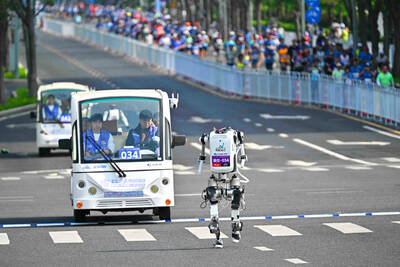
A humanoid robot that won a half-marathon race for robots in Beijing on Sunday ran faster than the human world record in a show of China’s technological leaps. The winner from Honor, a Chinese smartphone maker, completed the 21km race in 50 minutes and 26 seconds, said a WeChat post by the Beijing Economic-Technological Development Area, also known as Beijing E-Town, where the race began. That was faster than the human world record holder, Ugandan Jacob Kiplimo, who finished the same distance in about 57 minutes in March at the Lisbon road race. The performance by the robot marked a significant step forward

Four contenders are squaring up to succeed Antonio Guterres as secretary-general of the UN, which faces unprecedented global instability, wars and its own crushing budget crisis. Chile’s Michelle Bachelet, Argentina’s Rafael Grossi, Costa Rica’s Rebeca Grynspan and Senegal’s Macky Sall are each to face grillings by 193 member states and non-governmental organizations for three hours today and tomorrow. It is only the second time the UN has held a public question-and-answer, a format created in 2016 to boost transparency. Ultimately the five permanent members of the UN’s top body, the Security Council, hold the power, wielding vetoes over who leads the

South Korea’s air force yesterday apologized for a 2021 midair collision involving two fighter jets, a day after auditors said the pilots were taking selfies and filming during the flight and held them responsible for the accident. “We sincerely apologize to the public for the concern caused by the accident that occurred in 2021,” an air force spokesman told a news conference, adding that one of the pilots involved had been suspended from flying duties, received severe disciplinary action and has since left the military. The apology followed a report released on Wednesday by the South Korean Board of Audit and Inspection,

An earthquake registering a preliminary magnitude of 7.7 off northern Japan on Monday prompted a short-lived tsunami alert and the advisory of a higher risk of a possible mega-quake for coastal areas there. The Cabinet Office and the Japan Meteorological Agency said there was a 1% chance for a mega-quake, compared to a 0.1% chance during normal times, in the next week or so following the powerful quake near the Chishima and Japan trenches. Officials said the advisory was not a quake prediction but urged residents in 182 towns along the northeastern coasts to raise their preparedness while continuing their daily lives. Prime


 RSS
RSS