


The international terrorist threat is evolving as al-Qaeda-linked groups and other militants become increasingly violent and Syria spawns a new generation of global terrorists, the US warned on Wednesday.
The US Department of State’s Country Reports on Terrorism 2013 showed that the number of attacks worldwide rose last year to more than 9,700, rising about 43 percent from the 6,700 seen in 2012.
Yet officials cautioned that even though about 17,800 people were killed in these attacks — up from 11,000 in 2012 — most of the strikes were smaller and more localized than in previous years.
US counterterrorism efforts to combat al-Qaeda (AQ) have “degraded” the group’s core leadership, but “subsequently, 2013 saw the rise of increasingly aggressive and autonomous AQ affiliates and like-minded groups in the Middle East and Africa,” the report said.
Al-Qaeda’s leadership was also struggling “to maintain discipline within the AQ network and communicate guidance to its affiliated groups,” US Counterterrorism Coordinator Tina Kaidanow said.
Orders by al-Qaeda leader Ayman al-Zawahiri to minimize collateral damage “were routinely disobeyed,” such as in the attack carried out by Somalia-based extremists al-Shabaab on the Westgate Mall in Nairobi last year.
Syria’s civil war has proved a fertile breeding ground for thousands of foreign fighters, particularly from North Africa, the Gulf and Europe to join the uprising against Syrian President Bashar al-Assad. They have flourished amid the chaos as money flows from the Gulf to Sunni terror groups, particularly those operating in Syria.
Yet al-Assad has also been aided by Shiite militia, such as the Lebanon-based Hezbollah group, which is funded and supported by Iran.
Many governments are “becoming increasingly concerned that individuals with violent extremist ties and battlefield experience will return to their home countries or elsewhere to commit terrorist acts,” the report said, adding that this has fueled growing “concern about the creation of a new generation of globally committed terrorists, similar to what resulted from the influx of violent extremists to Afghanistan in the 1980s.”
The decline of the al-Qaeda leadership and its inability to finance terror activities has encouraged groups to turn to alternative sources of income, including a lucrative spate of kidnappings.
Extremist violence last year was also increasingly marked by “sectarian motives,” which the US said was a “worrisome trend.”
Cuba, Iran, Syria and Sudan remained on last year’s list of state sponsors of terrorism, although the report said there was no sign that Havana “provided weapons or paramilitary training to terrorist groups.”
Africa “experienced significant levels of terrorist activity” last year, the report said, fingering al-Shabaab as the continent’s main threat.
Boko Haram, which two weeks ago kidnapped dozens of schoolgirls at gunpoint in Nigeria, also remain a serious concern.
Kaidanow also said that revelations by former US National Security Agency contractor Edward Snowden about US counterterrorism practices had been “incredibly damaging.”
The report also highlighted successful efforts by French and allied African forces to push back al-Qaeda in the Islamic Maghreb and other extremist groups in northern Mali, while noting that the number of rocket attacks on Israel by Hamas militants in the Gaza Strip and Egypt’s Sinai Peninsula was the lowest in more than a decade.

Voters in Switzerland yesterday cast their ballots on an initiative championed by the top right-wing party to cap the Alpine country’s population at 10 million. As of press time last night, early results showed that Swiss voters were leaning against it. The populist Swiss People’s Party, which has the most seats in parliament, has stirred up and fostered anti-migration sentiment over the years, notably about an influx of workers from the neighboring EU. Critics called the bid a self-inflicted wound, saying the boom in migration over the past generation has brought foreign labor and skills to sectors such as healthcare, finance, pharmaceuticals

Arsenio Butil Jr fell to his knees and began to pray when last week’s deadly magnitude 7.8 earthquake began shaking his home on the coast of the southern Philippines. When he opened his eyes, he saw a once-familiar shoreline changing in real time, with swathes of previously submerged coral suddenly pushing above the waterline. The June 8 quake, driven by a shifting of the nearby Cotabato Trench, toppled buildings, triggered landslides and killed at least 76 people on the southern island of Mindanao. The tectonic forces at work also thrust chunks of the island’s coastline upward in a phenomenon known as “coastal uplift,”
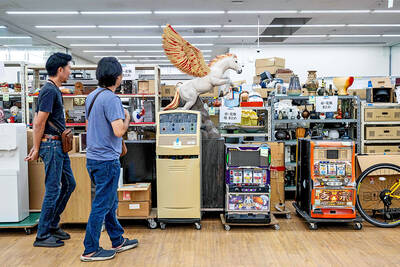
YUCK OR YUM? While it is difficult to sell second-hand goods that are more than seven years old in Japan, they are still popular in foreign markets, an executive said Under a scorching sun in a Bangkok suburb, a whistle blew, and shouts filled the air as dozens of shoppers rushed into a warehouse bearing the sign “Japanese Second-Hand Store.” From bags and bicycles to surfboards and suitcases, the Japanese second-hand market is booming, with quality-conscious buyers in other Asian countries increasingly tapping into the circular economy trend. “What is considered garbage for them can still be useful in Thailand,” said 36-year-old Lookpoo Sathitpanyapon, who runs an online store selling toy keychains. “That bag, that bag,” one shopper shouted while racing through the warehouse, filled with everything from colorful toys
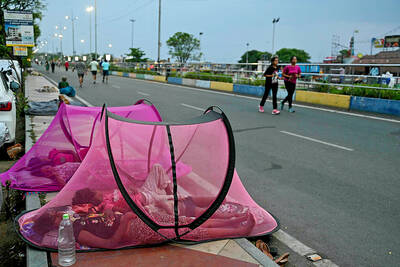
Growing up in Tahiti, Anna-Bella Failloux saw first-hand the threat posed by mosquitoes: Nearly one-third of adults on the picturesque island once had swollen limbs from elephantiasis caused by their bites. She has since dedicated her life to studying mosquitoes and the diseases they transmit — a concern that looms ever larger as climate change expands the area where the insects roam. “You have to accept being bitten by a mosquito from time to time,” the 63-year-old entomologist at France’s Pasteur Institute said. “But we have to avoid too many people getting sick and dying from the infections,” Failloux said, as she observed


 RSS
RSS