


The original scroll on which the infamous Marquis de Sade wrote The 120 Days of Sodom, his novel on sexual depravity, pedophilia, cruelty and murder, has returned to France.
Sade’s book was written in tiny writing on a narrow 12m-long strip of parchment in just 37 days while he was imprisoned in the Bastille and hidden in his cell. It was found when the jail was stormed during the French Revolution.It has changed hands and been fought over several times in the centuries since, its ownership causing almost as much controversy as its contents.
Now the parchment, bought by a French manuscript dealer, will go on display at a private museum in Paris to mark the 200th anniversary of the author’s death.
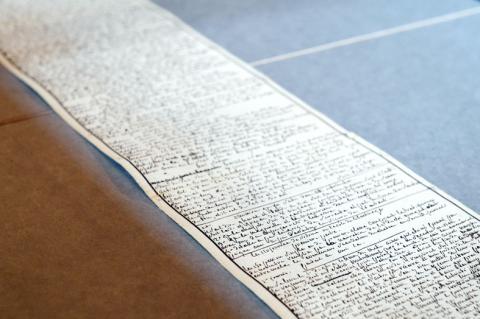
Photo: AFP
Sade’s work details the depraved behavior of four wealthy French libertines who rape, torture and finally murder their victims, who are mostly teenage girls in a remote medieval castle, in order to experience extreme sexual gratification.
The story remained unpublished until 1904 when it was obtained by a German psychiatrist who regarded it having scientific importance.
It has since been translated into many languages, and frequently banned as obscene. Feminist writer Andrea Dworkin has condemned it as “vile pornography” and described Sade as the embodiment of misogyny.
In 1929, the scroll was bought by a member of the Noailles family who was a direct descendant of Sade. It was later stolen, smuggled into Switzerland and sold to a collector. A furious international legal wrangle ensued with a French court ordering it to be returned to the Noailles family, only to be overruled in 1998 by a Swiss court that declared it had been bought by the collector in good faith.
It was first put on display near Geneva in 2004. Gerard Lheritier, president and founder of Aristophil, a company specializing in rare manuscripts, who bought the scroll for 7 million euros (US$9.6 million), will put it on display at the Museum of Letters and Manuscripts in Paris, which he owns.

A US YouTuber who caused outrage for filming himself kissing a statue commemorating Korean wartime sex slaves has been sentenced to six months in prison, a court in Seoul said yesterday. Johnny Somali, 25, gained notoriety several years ago for recording himself doing a series of provocative stunts in South Korea and Japan, and streaming them on platforms such as YouTube and Twitch. South Korean authorities indicted Somali — whose real name is Ramsey Khalid Ismael — in 2024 on public order violations and obstruction of business, and banned him from leaving the country. “The court has sentenced him to six months in

Former Lima mayor Rafael Lopez Aliaga, a Peruvian presidential hopeful, gathered hundreds of supporters in Lima on Tuesday and gave authorities 24 hours to annul the first round of the country’s election over allegations of fraud. Lopez Aliaga is locked in a tight three-way race with two other candidates for second place in Sunday’s vote. The election runner-up wins a ticket to June’s presidential run-off against front-runner Keiko Fujimori. “I am giving them 24 hours to declare this electoral fraud null and void,” said Lopez Aliaga, surrounded by a crowd of several hundred supporters. “If it is not declared null and void tomorrow,

PAPAL RETORT: Pope Leo told reporters that he has ‘no fear, neither of the Trump administration nor speaking out loudly about the message of the Gospel’ US President Donald Trump has feuded with Pope Leo XIV over the Iran conflict — setting off an unholy row that could have serious political implications for the Republican leader back in the US. Trump has drawn barbs even from some allies over the attacks on the US-born pontiff, who has criticized the Trump administration over its immigration crackdown, the intervention in Venezuela and the Iran war. The president risks alienating the religious right in November’s crucial US midterm elections. So far the unprecedented clash between the leader of the most powerful military on Earth and the head of the world’s 1.4 billion

A 16-year-old boy has been charged with murder and aggravated sexual abuse in Florida in the death of his 18-year-old stepsister on a Carnival Cruise ship, the US Department of Justice said on Monday. Timothy Hudson was initially charged in February and subsequently indicted on March 10, but the breadth of the case was not known until a seal was lifted on Friday last week, weeks after US District Judge Beth Bloom in Miami said that he would be prosecuted as an adult at the request of the government. Anna Kepner had been traveling on the Carnival Horizon ship in November last


 RSS
RSS