


In neat rows, the Pakistani girls in white headscarves listened carefully as the teacher described the changes in their bodies. When the teacher asked what they should do if a stranger touched them, the class erupted.
“Scream,” one called out, while another suggested “bite” and a third said: “Scratch really hard with your nails.”
Sex education is common in Western schools, but these groundbreaking lessons are taking place in deeply conservative Pakistan, a Muslim nation of 180 million people.
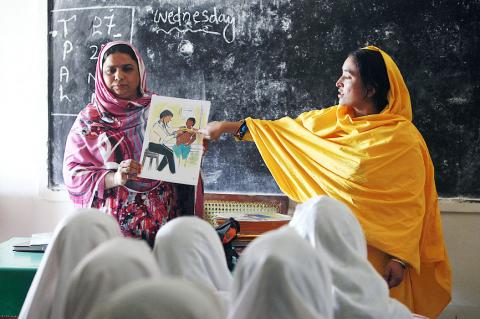
Photo: Reuters
Publicly talking about sex in Pakistan is taboo and can even be a death sentence. Parents have slit their daughters’ throats or doused them in acid for crimes as innocuous as dancing at a wedding or looking out the window.
Almost nowhere in Pakistan does an institute offer any kind of organized sex education and it has even been banned in some places.
Yet teachers working in the village of Johi in poverty-stricken Sindh Province say that most families there support their sex education project.
About 700 girls are enrolled in eight local schools run by the Village Shadabad Organization.
Their sex education lessons start at age eight and cover changes in their bodies, what their rights are and how to protect themselves.
“We cannot close our eyes,” organization head Akbar Lashari said. “It’s a topic people don’t want to talk about, but it’s fact of our life.”
Lashari said that most of the girls in the villages used to hit puberty without realizing that they would begin to menstruate, or got married without understanding the mechanics of sex.
The lessons even teach the girls about marital rape — a revolutionary idea in Pakistan, where forcing a spouse to have sex is not a crime.
“We tell them their husband can’t have sex with them if they are not willing,” Lashari said.
The lessons are an addition to regular classes and parents are informed of them before they enroll their daughters in the schools.
No parent has yet objected and the school has faced no opposition, Lashari said.
The eight schools received sponsorship from BHP Billiton, an Australian company that operates a nearby gas plant, but Lashari said that sex education was the villagers’ own idea.
Teacher Sarah Baloch, whose yellow shalwar khameez brightens up the dusty school yard, said she hoped to help girls understand what growing up meant.
“When girls start menstruating they think it is shameful and don’t tell their parents, and think they have fallen sick,” she said.
Baloch teaches at a tiny school of three brick classrooms where a fourth class is held outside because there are so many girls.
Three girls cram into each seat made for two, listening attentively to Baloch.
One flashcard shows a girl stopping an old man from touching her leg. Other cards encourage girls to tell their parents or friends if someone is stalking them.
The girls are shy, but the lessons have sunk in.
“My body is only mine and only I have the rights on it. If someone touches my private parts I’ll bite or slap him in the face,” 10-year-old Uzma Panhwar said as she blushed defiantly.
The lessons also cover marriage.
“Our teacher has told us everything that we’ll have to do when we get married. Now we’ve learned what we should do and what not,” Sajida Baloch, 16, said while staring at the ground.
Some of Pakistan’s most prominent schools, including the prestigious Beaconhouse School System, have been considering the type of sex education practiced in Johi.
“Girls feel shy to talk to their parents about sex,” said Roohi Haq, director of studies at Beaconhouse.
There is definitely demand for such education. Lahore-based Arshad Javed has written three books on sex education and said he sells about 7,000 per year.
However, none are sold to schools.
Not everyone agrees with the lessons, partly because young people are not supposed to have sex before adulthood.
Recently, the government forced the elite Lahore Grammar School to remove all sex education from its curriculum.
“It is against our constitution and religion,” said Mirza Kashif Ali, president of the All Pakistan Private Schools Federation, which says it represents more than 152,000 institutions across the country.
“What’s the point of knowing about a thing you’re not supposed to do? It should not be allowed at school level,” Mirza added.
In India, many government schools formally offer sex education, but Pakistani government schools have no such plans.
Pakistani Minister of Education for Sindh Province Nisar Ahmed Khuhro was shocked to hear of the lessons.
“Sex education for girls? How can they do that? That is not part of our curriculum, whether public or private,” he said.
However, Tahir Ashrafi, who heads an alliance of moderate clerics called the Pakistan Ulema Council, said such lessons were permissible under Islamic law as long as they were segregated and confined to theory.
“If the teachers are female, they can give such information to girls in the limits of Shariah,” he said.
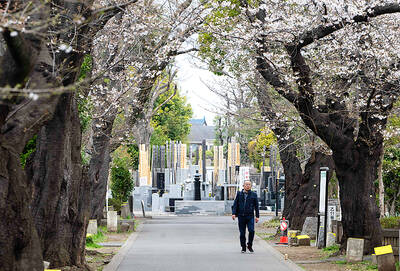
ROCKY RELATIONS: The figures on residents come as Chinese tourist numbers drop following Beijing’s warnings to avoid traveling to Japan The number of Chinese residents in Japan has continued to rise, even as ties between the two countries have become increasingly fractious, data released on Friday showed. As of the end of December last year, the number of Chinese residents had increased by 6.5 percent from the previous year to 930,428. Chinese people accounted for 22.6 percent of all foreign residents in Japan, making them by far the largest group, Japanese Ministry of Justice data showed. Beijing has criticized Tokyo in increasingly strident terms since Japanese Prime Minister Sanae Takaichi last year suggested that a military conflict around Taiwan could

A retired US colonel behind a privately financed rocket launch site in the Dominican Republic sees the project as a response to China’s dominance of the space race in Latin America. Florida-based Launch on Demand is slated to begin building a US$600 million facility in a remote region near the border with Haiti late this year. The project is designed to meet surging demand for the heavy-lift rockets needed to put clusters of satellites into orbit. It is also an answer to China’s growing presence in the region, said CEO Burton Catledge, a former commander of the US Air Force’s 45th Operations

Germany is considering Australia’s Ghost Bat robot fighter as it looks to select a combat drone to modernize its air force, German Minister of Defense Boris Pistorius said yesterday. Germany has said it wants to field hundreds of uncrewed fighter jets by 2029, and would make a decision soon as it considers a range of German, European and US projects developing so-called “collaborative combat aircraft.” Australia has said it will integrate the Ghost Bat, jointly developed by Boeing Australia and the Royal Australian Air Force, into its military after a successful weapons test last year. After inspecting the Ghost Bat in Queensland yesterday,
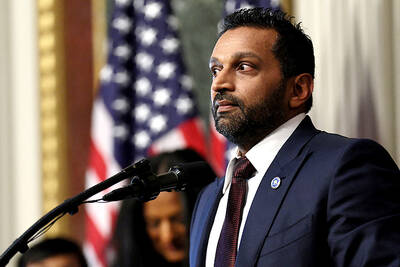
A pro-Iran hacking group claimed to breach FBI Director Kash Patel’s personal e-mail inbox and posted some of the contents online. The e-mails provided by the hacking group include travel details, correspondence with leasing agents in Washington and global entry, and loyalty account numbers. The e-mail address the hackers claim to have compromised has been previously tied to Patel’s personal details, and the leaked e-mails contain photos of Patel and others, in addition to correspondence with family members and colleagues. “The FBI is aware of malicious actors targeting Director Patel’s personal email information,” the agency said in a statement on


 RSS
RSS