


Venezuelan President Nicolas Maduro on Sunday ordered the expulsion of three US embassy officials after Washington came to the defense of an opposition hardliner accused by Venezuela’s leader of responsibility for bloodshed during anti-government protests.
Maduro did not identify the US consular officials, but said that Venezuelan intelligence officials who tailed them the past two months found evidence they were trying to infiltrate Venezuelan universities, a hotbed of recent unrest, under the cover of doing US visa outreach.
Venezuelan Foreign Minister Elias Jaua was scheduled to provide more details yesterday.
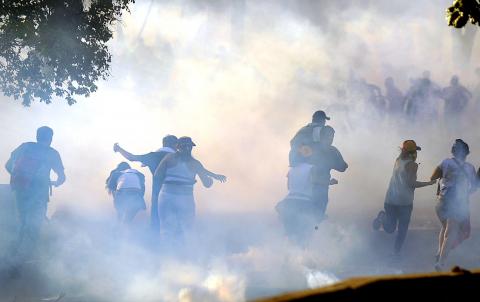
Photo: AFP
Triggering the expulsion was the US President Obama Barack administration’s siding with opposition leader Leopoldo Lopez, who is being hunted by Venezuelan police as Maduro accuses him of leading a “fascist” plot to oust the socialist government two months after it won mayoral elections by a landslide.
Maduro said US Department of State official Alex Lee, in a telephone conversation with Venezuela’s ambassador to the Washington-based Organization of American States, warned that arresting the 42-year-old former mayor would bring serious negative consequences, with international ramifications.
“These are unacceptable, insolent demands,” Maduro said during a televised address on Sunday night. “I don’t take orders from anyone in the world.”
There was no immediate reaction from the US government, which has denied the accusations that it is plotting with the opposition against him. The US has not had an ambassador in Caracas since 2010.
The Harvard-educated Lopez has been at the center of rising tensions in Venezuela since he led the biggest demonstration yet against Maduro’s 10-month-old government, mobilizing more than 10,000 people on Wednesday last week to peacefully protest hardships ranging from rampant crime to 56 percent inflation.
The government blamed him for the mayhem that erupted after the rally ended and a group of students battled with security forces and armed pro-government militias, leaving three dead. Most of the demonstrators had gone home before the violence broke out.
In his television speech, Maduro called for a march by oil workers today, beginning at the same central plaza in Caracas where Lopez said he would rally with supporters dressed in white the same day, setting up the potential for clashes between the opposing forces. Lopez announced his plans a few hours before Maduro’s speech, appearing in a video shot at an undisclosed location.
He said he did not fear arrest, but accused authorities of trying to violate his constitutional right to protest Maduro’s government.
He said that after today’s march to the Interior Ministry, he planned to walk the final steps alone to the agency to deliver a petition demanding a full investigation of the government’s role in the deaths. He said he was prepared to turn himself over to officials then and answer to an arrest order on charges ranging from terrorism and homicide to vandalism of public property.
“I haven’t committed any crime,” said Lopez, who has not been seen in public since a news conference on Wednesday night after the bloodshed. “If there is a decision to legally throw me in jail, I’ll submit myself to this persecution.”
Maduro on Sunday urged Lopez for his own safety to avoid a media “show” and accept an offer to negotiate his surrender. He claimed that some sectors of the extreme right-wing want to assassinate Lopez to provoke a political crisis.
Lopez’s comments came after security forces raided his home and that of his parents over the weekend, seeking to serve the arrest order. Lopez was not at either residence when the officials arrived about midnight to the sound of banging pots and pans by neighbors protesting what they consider an arbitrary detention order.
The raids capped another night of protests during which security forces fired tear gas and rubber bullets to break up a group of about 500 students who vowed to remain on the streets until all arrested anti-government demonstrators are released.
More protests took place on Sunday, and authorities said 18 people were injured.
Lopez is the most prominent of a group of opposition hardliners who are challenging two-time presidential candidate Henrique Capriles for leadership of the anti-government movement.

‘CROSSING THE LINE’: China’s embassy in Seoul criticized US Forces Korea Commander General Xavier Brunson, asking if his ‘hostile’ remarks were authorized by Washington South Korea and the US are in talks over recent public remarks by the commander of US Forces Korea, Seoul’s presidential office said yesterday, after the comments drew sharp criticism from China. In a recent podcast interview, US Forces Korea Commander General Xavier Brunson described South Korea as “the dagger in the heart of Asia” from China’s east coast, prompting the Chinese embassy in Seoul to say that he had “truly crossed the line.” The interview came amid growing speculation that Washington might seek to expand the role of US Forces Korea in countering the growing regional influence of China, a key

SEEKING ORDER: Rodrigo Paz said that ‘anyone who wants to destroy the nation will have to deal with this president and the full force of the constitution’ Bolivian President Rodrigo Paz on Wednesday said that the nation was at a “breaking point” after nearly a month of protests that have caused shortages of food, fuel and medicine. Paz, who took office six months ago amid the worst economic crisis there in four decades, is battling a groundswell of fury over his policies. The political capital, La Paz, has been besieged by low-income workers and members of the indigenous majority calling for his resignation. “The country needs order and is reaching breaking point,” the 58-year-old said at a public event in La Paz, renewing his appeal for dialogue. On Tuesday, the Bolivian

Australian researchers have trained lab-grown brain cells on a silicon computer chip to play the 1990s shooter game Doom and said they are just scratching the surface of what the neurons could be capable of doing. It is the science-fiction work of biotech boffins at Cortical Labs, who researched and developed the technology that harnesses the workings of the brain’s networking system. Each so-called “biological computer” contains about 200,000 living human brain cells, grown from stem cells that were harvested from blood donations. Having mastered the simple computer game Pong, where a paddle is moved up and down to send a ball

Through the noise of rushing papers and whirring belts at a print factory in Kyoto, two creators watch their photo essay come to life in broadsheet form — part of an effort to win new audiences in the age of artificial intelligence (AI). Despite the decline of the publishing industry, self-publication and handmade “zine” magazines are growing in popularity in Japan, reflecting the nation’s enduring love of paper in the digital era. While speaking to Agence France-Presse at the plant, his hands black with ink, one of the creators, Kazuma Obara, said: “I think [paper] is a medium that engages all five


 RSS
RSS