


More than 130 people, including 104 police officers, were injured on Thursday in a second day of anti-government demonstrations in the Bosnian town of Tuzla, as protests over unemployment and political inertia spread across the country.
The protests highlight public resentment over the political bickering that has stifled governance and economic development since the 1992-to-1995 war in the Balkan country.
Police fired tear gas to drive back several thousand people throwing stones, eggs and flares at a local government building in Tuzla, once the industrial heart of Bosnia’s north which has been hit hard by factory closures in recent years.
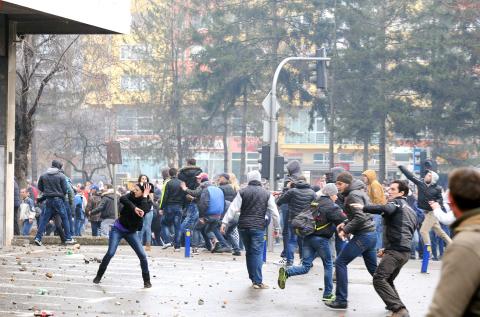
Photo: AFP
A strong police contingent dispersed the crowd in the evening after protesters started rioting, smashing shop windows and setting garbage bins on fire, a Tuzla police spokesman said.
The town’s emergency service said it admitted 104 police officers who were seriously hurt and 30 civilians with lighter injuries.
Hundreds of people turned out in solidarity protests in the capital, Sarajevo, and the towns of Zenica, Bihac and Mostar. In Sarajevo, protesters clashed with police who had blocked traffic in the city center. Four officers were taken to the hospital, officials said.
The prime minister of Bosnia’s autonomous Bosniak-Croat federation, where the protests took place, held an emergency meeting with regional security ministers and prosecutors.
“We put on one side the workers who were left without basic rights, such as pensions and health benefits... and on the other side, all hooligans who used this situation to create chaos,” Federation of Bosnia and Herzegovina Prime Minister Nermin Niksic said after the meeting.
“We will not come to the solution by destroying property, damaging vehicles and windows and fighting the police,” Niksic said, adding that police and prosecutors should take steps against those whom he called the hooligans.
The protesters were initially made up mainly of workers laid off when state-owned companies that were sold off collapsed under private ownership. They have been joined by thousands of jobless people and youths.
At 27.5 percent, Bosnia’s unemployment rate is the highest in the Balkans.
“It was our government that sold state assets for peanuts and left the people without pensions, jobs or health insurance,” said 24-year-old Hana Obradovic, an unemployed graduate from Sarajevo.
The Tuzla authorities ordered schools to cancel classes yesterday, when protests were expected to continue.
Demonstrations are also to be held in Sarajevo and other cities.
The authorities released 27 people who had been arrested on Wednesday.
Many people said feuding political leaders, brought to power by a power-sharing system created under Bosnia’s 1995 peace deal, offer few solutions for its problems.
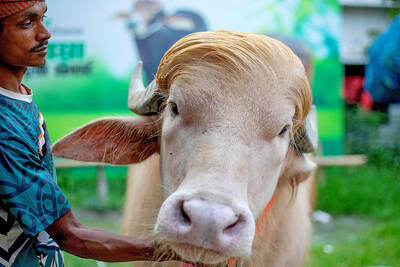
Crowds in Bangladesh are flocking to snap photographs with an unlikely social media star — an albino buffalo with flowing blond hair nicknamed “Donald Trump” that is due to be sacrificed within days. Owner Zia Uddin Mridha, 38, said his brother named the 700kg bull over its flowing helmet of hair resembling the signature look of the US president. “My younger brother picked this name because of the buffalo’s extraordinary hair,” he said at his farm in Narayanganj, just outside the capital, Dhaka. Mridha said that a constant stream of curious visitors — social media fans, onlookers and children — have come throughout

It began as a satirical online project. Now millions of young people in India are flocking to it as an outlet for their frustration. A parody political party called the Cockroach Janta Party, with the insect as its symbol, has exploded across India’s social media by turning absurdist humor into protest. Memes and short videos mocking corruption, joblessness and political dysfunction have flooded social media sites, where millions of users are embracing the cockroach — known for its ability to survive harsh conditions — as a tongue-in-cheek symbol of endurance. The online movement’s rise has been unusually rapid. The Cockroach Janta Party (CJP)
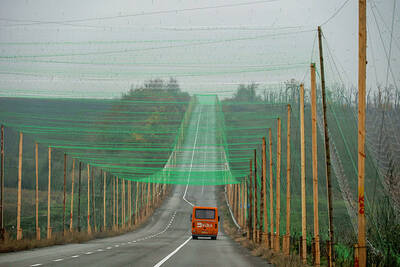
BIGGER ROLE: Beijing has said it maintains an impartial stance on the war in Ukraine, but by training Russian troops, China is far more involved than previously known China’s armed forces secretly trained about 200 Russian military personnel in China late last year, and some have since returned to fight in Ukraine, according to three European intelligence agencies and documents seen by Reuters. While China and Russia have held a number of joint military exercises since Moscow’s full-scale invasion of Ukraine in 2022, Beijing has repeatedly said that it is neutral in the conflict and presents itself as a peace mediator. The covert training sessions, which predominantly focused on the use of drones, were outlined in a dual-language Russian-Chinese agreement signed by senior Russian and Chinese officers in Beijing on
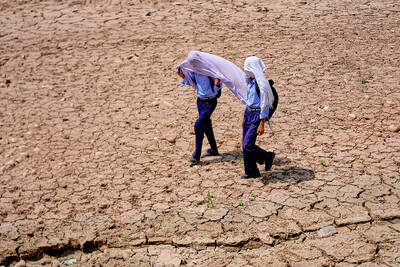
HOTTER: While Indians are accustomed to summer heat, climate change has caused northwestern India to warm faster than other parts of the country, an academic said Roads and markets have emptied during afternoons and some farmers have switched to nighttime work to avoid scorching temperatures as a heat wave grips large parts of India. The India Meteorological Department forecast maximum temperatures for yesterday of about 45°C in the capital, New Delhi, where authorities have opened temporary “cooling zones” to help people cope. The weather department warned that conditions would likely persist across several northern regions in the coming days, with temperatures staying well above seasonal averages. Authorities urged people to stay indoors during the hottest hours and take precautions against heat-related illnesses. India declares a heat wave whenever maximum temperatures


 RSS
RSS