


Violence in the Central African Republic’s capital, Bangui, is “out of control,” with fighting between Christians and Muslims resulting in lynchings and machete attacks, Medecins Sans Frontieres (MSF) said.
Since early last month teams working in several medical projects in Bangui have treated more than 1,000 victims of violence, the medical humanitarian organization founded in France in 1971, said in an e-mailed statement on Monday.
“People are coming in with machete wounds to the head, hands and arms,” Laurent Sury, emergency coordinator of MSF in Bangui, said in the statement. “We’ve also seen people who have been stabbed, sometimes multiple times, in the abdomen, and people who have either been tortured or brutally beaten. For the most part, these are young men.”
The Central African Republic was plunged into lawlessness after rebels overthrew Christian president Francois Bozize in March and Michel Djotodia, a Muslim, was appointed as national leader.
Fighting between militia from the Christian majority and Muslim rebels flared up on Dec. 5.
About 370,000 people, almost half the population of Bangui, have been displaced over the last three weeks, UNICEF said in an e-mailed statement on Monday. About 875,000 people have been internally displaced throughout the country since the outbreak of violence more than a year ago.
At least two children have been beheaded in the fighting, UNICEF said, adding “unprecedented” levels of violence were being committed against youngsters.
UNICEF said that of the two children beheaded, one had also been mutilated. It also said it could verify the deaths of at least 16 children and 60 injured since the outbreak of fighting last month.
“We are witnessing unprecedented levels of violence against children,” UNICEF representative in Central Africa Souleymasne Diabate said.
“More and more children are being recruited into armed groups, and they are also being directly targeted in atrocious revenge attacks,” he said. “Targeted attacks against children are a violation of international humanitarian and human rights law and must stop immediately.”
UNICEF said children forced into fighting by both sides in the conflict should be immediately disarmed and be protected from any reprisals. It also called for centers to be established for the “reintegration” of children as well as protect those still at risk.
Health facilities have also been affected by the violence, MSF said. An armed man entered a dispensary, medical teams were forced to temporarily evacuate a hospital and Ministry of Health staff were threatened, MSF said.
“The atmosphere is becoming increasingly tense with each of these ‘visits’ as the attackers become more and more aggressive,” Thomas Curbillon, MSF’s head of mission in Bangui said in the statement.

Through the noise of rushing papers and whirring belts at a print factory in Kyoto, two creators watch their photo essay come to life in broadsheet form — part of an effort to win new audiences in the age of artificial intelligence (AI). Despite the decline of the publishing industry, self-publication and handmade “zine” magazines are growing in popularity in Japan, reflecting the nation’s enduring love of paper in the digital era. While speaking to Agence France-Presse at the plant, his hands black with ink, one of the creators, Kazuma Obara, said: “I think [paper] is a medium that engages all five
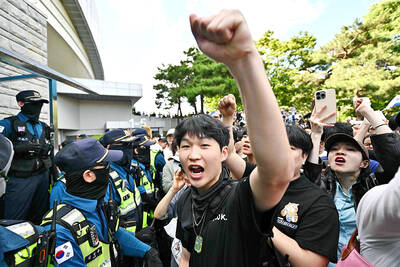
‘ABSURD MISTAKE’: The election commission said that there had been a failure to anticipate turnout after 14 polling stations ran short of ballot papers South Korean riot police yesterday cleared protesters from a Seoul polling station after a 35-hour blockade sparked by a shortage of ballot papers during local elections earlier this week. Wednesday’s election was the first nationwide vote since South Korean President Lee Jae-myung took office following the ouster of Yoon Suk-yeol over his short-lived martial law declaration. Lee’s ruling Democratic Party swept most races, but failed to flip the crucial Seoul mayoral seat. The South Korean National Election Commission apologized, blaming a failure to anticipate turnout after 14 polling stations in Seoul ran short of ballot papers. Some polling stations stayed open until 10pm to

Australian researchers have trained lab-grown brain cells on a silicon computer chip to play the 1990s shooter game Doom and said they are just scratching the surface of what the neurons could be capable of doing. It is the science-fiction work of biotech boffins at Cortical Labs, who researched and developed the technology that harnesses the workings of the brain’s networking system. Each so-called “biological computer” contains about 200,000 living human brain cells, grown from stem cells that were harvested from blood donations. Having mastered the simple computer game Pong, where a paddle is moved up and down to send a ball

France experienced its hottest spring on record, the French weather service said on Tuesday, after an exceptional early heat wave that also broke highs for the season in England and Wales. Meteo-France said the average nationwide temperature over March to May was 13.8°C — about 1.7°C above the norm, and surpassing records set in 2011 and 2020. “The warmest spring since records began in 1900,” it said in a bulletin. All three months were warmer than average, but the onset of an “unprecedented heatwave” late last month pushed the mercury to highs typically seen at the height of the summer. “Our country had never


 RSS
RSS