


A 100-minute film produced by the Chinese military that has been circulating widely on the Internet accuses the US of trying to undermine the Chinese Communist Party’s control of the People’s Liberation Army (PLA) and impose US values on China.
Among the US tactics denounced in the film are military-to-military exchanges, which Washington has long promoted to improve communications in the event of a crisis. The video, complete with an ominous soundtrack, warns that such visits are intended to corrupt Chinese officers.
The film, titled Silent Contest, also takes aim at Western non-governmental organizations, the US and British consulates in Hong Kong, and prominent reformers in China. It accuses Washington of sponsoring exiled minority figures such as Tibetan leader the Dalai Lama and Uighur dissident Rebiya Kadeer.
It is not clear if the video was intentionally released or leaked, but it began disappearing from Chinese Web sites on Thursday night last week. Its heavy ideological content and propaganda style suggest it may have been produced to support the work of the Chinese military’s political commissars, who are charged with indoctrinating troops and maintaining their morale, discipline and loyalty. As such, the film appears to offer a remarkably straightforward glimpse into the Cold War mindset of the Chinese military leadership.
Cutting from crude graphics of US dollar bills, to shots of the Statue of Liberty and blurry footage of US leaders, the video bemoans the fall of the Soviet Union and warns that China faces a similar fate if it fails to counter Washington’s nefarious efforts to infiltrate Chinese society.
The PLA’s General Staff Department is listed as a producer of the film, along with its National Defense University and the Chinese Academy of Social Sciences.
University president Wang Xibin (王喜斌), a PLA lieutenant-general, appears on film describing how the US grooms “friendly forces, so-called democratic forces,” inside China and on the “exterior goes against the party’s absolute control of the army.”
He also criticizes visits by US and Chinese military officials to each other’s countries, saying that the exchanges will increasingly be used by the US for “infiltration.”
The US has long urged a reluctant Beijing to boost military exchanges, saying that such visits yield transparency and trust. In recent months, several top Pentagon officers have traveled to China or hosted visits by their Chinese counterparts, a flurry that Washington has described as progress.
The film was undated, but contained footage of Chinese President Xi Jinping (習近平) after he took office in March. It makes no mention of US whistleblower Edward Snowden.
A spokesman for the US embassy in Beijing had no comment on the film.

Kouri Richins, a Utah mother who published a children’s book about grief after the death of her husband is to serve a life sentence for his murder without the possibility of parole, a judge ruled on Wednesday. Richins was convicted in March of aggravated murder for lacing a cocktail given to her husband, Eric Richins, with five times the lethal dose of fentanyl at their home near Park City in 2022. A jury also found her guilty of four other felonies, including insurance fraud, forgery and attempted murder for trying to poison her husband weeks earlier on Feb. 14, 2022, with a

‘PERSONAL MISTAKES’: Eileen Wang has agreed to plead guilty to the felony, which comes with a maximum sentence of 10 years in federal prison A southern California mayor has agreed to plead guilty to acting as an illegal agent for the Chinese government and has resigned from her city position, officials said on Monday. Eileen Wang (王愛琳), mayor of Arcadia, was charged last month with one count of acting in the US as an illegal agent of a foreign government. She was accused of doing the bidding of Chinese officials, such as sharing articles favorable to Beijing, without prior notification to the US government as required by law. The 58-year-old was elected in November 2022 to a five-person city council, from which the mayor is selected
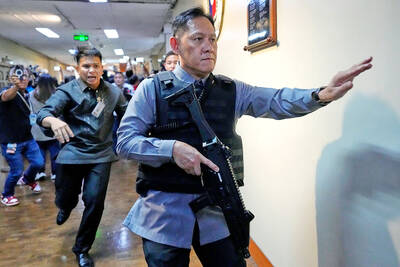
DELA ROSA CASE: The whereabouts of the senator, who is wanted by the ICC, was unclear, while President Marcos faces a political test over the senate situation Philippine authorities yesterday were seeking confirmation of reports that a top politician wanted by the International Criminal Court (ICC) had fled, a day after gunfire rang out at the Philippine Senate where he had taken refuge fearing his arrest. Senator Ronald “Bato” dela Rosa, the former national police chief and top enforcer of former Philippine president Rodrigo Duterte’s “war on drugs,” has been under Senate protection and is wanted for crimes against humanity, the same charges Duterte is accused of. “Several sources confirmed that the senator, Senator Bato, is no longer in the Senate premises, but we are still getting confirmation,” Presidential
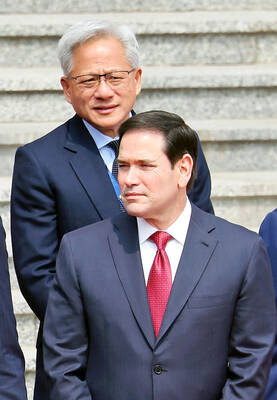
HELP DENIED? The US Department of State said that the Cuban leadership refuses to allow the US to provide aid to Cubans, ‘who are in desperate need of assistance’ US Secretary of State Marco Rubio on Wednesday said that Cuba’s leadership must change, as Washington renewed an offer of US$100 million in aid if the communist nation agrees to cooperate. Cuba has been suffering severe economic tumult led by an energy shortage that plunged 65 percent of the country into darkness on Tuesday. Cuba’s leaders have blamed US sanctions, but Rubio, a Cuban American and critic of the government established by Fidel Castro, said the system was to blame, including corruption by the military. “It’s a broken, nonfunctional economy, and it’s impossible to change it. I wish it were different,” he told


 RSS
RSS