


Bulgarian authorities on Thursday questioned a Roma couple thought to be the biological parents of Maria, a mysterious blonde girl whose discovery in a Greek Roma camp has made global headlines.
Local media identified the woman thought to be her mother as Sasha Ruseva, 35, from the small town of Nikolaevo in central Bulgaria, who was reportedly forced to leave her child out of poverty.
The woman confirmed during police questioning that she had given birth to a girl while working in Greece several years ago and left the child there with her employers at about seven months old, the Greek Ministry of the Interior said in a statement.
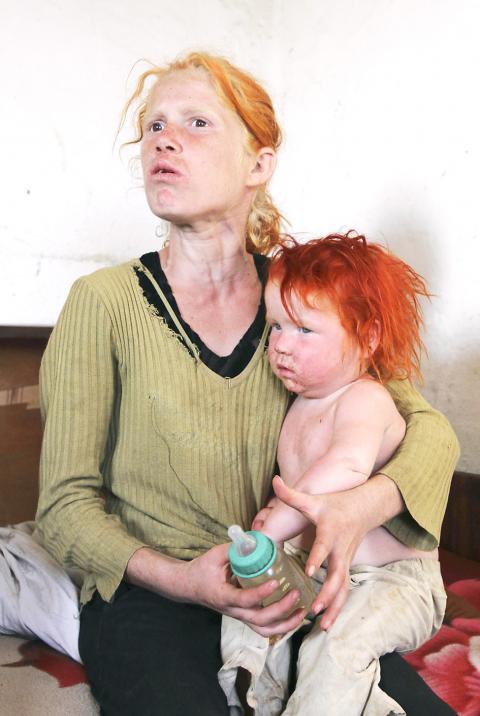
Photo: REUTERS
She claimed she recognized the Greek Roma couple she left her child with on television and that Maria resembled her other children, who reportedly number from eight to 10.
ALLEGED SALE
Bulgarian prosecutors said earlier they were investigating a woman with the initials S.R. for allegedly selling her child in Greece in 2009 and that the case was related to the discovery of Maria.
Ruseva denied that any money had changed hands.
“We gave the child for free. I did not take any money. I had nothing to feed her,” the thin, dark-complexioned Ruseva told reporters outside the police station, clutching another small, freckled and pale-skinned girl of two or three with dyed red hair.
“There is a resemblance, but how should I know if she is mine or not?” she said, adding that she would take Maria back if DNA tests confirmed that she was indeed her mother.
According to reports in Bulgaria, five of Ruseva and her husband’s other children are blonde and closely resemble the girl found last week.
Greek news portal Zougla said Ruseva had given birth to a girl on January 31, 2009, in the town of Lamia in central Greece, about 15km from the camp where Maria was discovered on Wednesday last week.
However, dental checks on Maria indicate an age of five or six, according to the Greek charity entrusted with her care, which has been inundated by hundreds of calls from parents of missing children around the world.
Lamia Mayor George Kotronias told Zougla that Ruseva unsuccessfully tried to register her daughter by falsely claiming she was unmarried, and that her application had been rejected.
Police in Greece, who have launched a global appeal via Interpol to find Maria’s parents, declined to comment.
The Greek Roma couple looking after Maria, a 39-year-old man and his 40-year-old wife, were detained and accused of abducting her.
They denied the accusation, telling investigators that the child’s Bulgarian Roma mother gave her to them because she could not afford to look after her.
IRELAND SEIZURE
Shortly after details of the case emerged, two blonde children aged seven and two were removed from their Roma families in Ireland before being given back after DNA tests, sparking alarm about racial profiling.
The head of the Roma Rights Center (ERRC), Dezideriu Gergely, said on Thursday that the cases had encouraged stereotypes about Roma communities.
Many Roma people in Europe do not have dark skin, have blue or green eyes, or are of mixed race, he said.
“Creating the perception that ethnicity can be linked to criminality is discriminatory. The effects of this not only fuel racist stereotypes but are potentially disastrous,” rights group Amnesty International said.

‘CROSSING THE LINE’: China’s embassy in Seoul criticized US Forces Korea Commander General Xavier Brunson, asking if his ‘hostile’ remarks were authorized by Washington South Korea and the US are in talks over recent public remarks by the commander of US Forces Korea, Seoul’s presidential office said yesterday, after the comments drew sharp criticism from China. In a recent podcast interview, US Forces Korea Commander General Xavier Brunson described South Korea as “the dagger in the heart of Asia” from China’s east coast, prompting the Chinese embassy in Seoul to say that he had “truly crossed the line.” The interview came amid growing speculation that Washington might seek to expand the role of US Forces Korea in countering the growing regional influence of China, a key

SEEKING ORDER: Rodrigo Paz said that ‘anyone who wants to destroy the nation will have to deal with this president and the full force of the constitution’ Bolivian President Rodrigo Paz on Wednesday said that the nation was at a “breaking point” after nearly a month of protests that have caused shortages of food, fuel and medicine. Paz, who took office six months ago amid the worst economic crisis there in four decades, is battling a groundswell of fury over his policies. The political capital, La Paz, has been besieged by low-income workers and members of the indigenous majority calling for his resignation. “The country needs order and is reaching breaking point,” the 58-year-old said at a public event in La Paz, renewing his appeal for dialogue. On Tuesday, the Bolivian

Australian researchers have trained lab-grown brain cells on a silicon computer chip to play the 1990s shooter game Doom and said they are just scratching the surface of what the neurons could be capable of doing. It is the science-fiction work of biotech boffins at Cortical Labs, who researched and developed the technology that harnesses the workings of the brain’s networking system. Each so-called “biological computer” contains about 200,000 living human brain cells, grown from stem cells that were harvested from blood donations. Having mastered the simple computer game Pong, where a paddle is moved up and down to send a ball

Through the noise of rushing papers and whirring belts at a print factory in Kyoto, two creators watch their photo essay come to life in broadsheet form — part of an effort to win new audiences in the age of artificial intelligence (AI). Despite the decline of the publishing industry, self-publication and handmade “zine” magazines are growing in popularity in Japan, reflecting the nation’s enduring love of paper in the digital era. While speaking to Agence France-Presse at the plant, his hands black with ink, one of the creators, Kazuma Obara, said: “I think [paper] is a medium that engages all five


 RSS
RSS