


Thousands of people marched through the Scottish capital, Edinburgh, on Saturday calling for independence, a year ahead of Scotland’s historic referendum on whether to break away from the UK.
The pro-independence campaign “Yes Scotland” estimated that 20,000 supporters joined the march, turning the city center into a sea of blue and white as they waved thousands of Scottish flags, though police said numbers were closer to 8,300.
Some of the men were clad in traditional Scottish kilts as they marched up Calton Hill, overlooking the city, to the sound of bagpipes.
Alex Salmond, leader of the pro-independence Scottish National Party and head of Scotland’s regional government, told the crowds they would have “the opportunity of a lifetime” when they vote on Sept. 18 next year.
“We’re a lucky generation,” he said. “To change our communities for the better we only need to say the word, to say ‘yes.’”
Opinion polls suggest only about a third of the 5.3 million Scots currently intend to vote to break away, but Salmond insists he can convince a majority that independence would bring economic and political benefits.
Student Calum Martin, who lives near the western Scottish city of Glasgow, said he would be voting in favor of independence because he believed Scots should have a better say over how their money is spent.
“Scotland is an incredibly wealthy country. This is a chance to put that wealth to much better use,” the 20-year-old said.
Scotland currently has its own parliament and a devolved government, which controls several policy areas including health and education, but other policies, such as defense and foreign affairs, are controlled by London.
The “no” campaign — backed by British Prime Minister David Cameron’s government — claims Scotland is stronger as part of the larger UK, comprising England, Scotland, Wales and Northern Ireland.
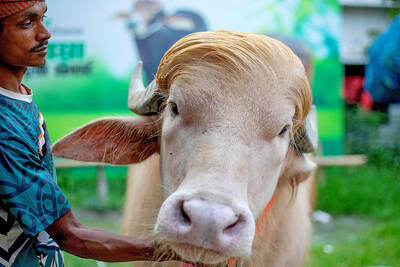
Crowds in Bangladesh are flocking to snap photographs with an unlikely social media star — an albino buffalo with flowing blond hair nicknamed “Donald Trump” that is due to be sacrificed within days. Owner Zia Uddin Mridha, 38, said his brother named the 700kg bull over its flowing helmet of hair resembling the signature look of the US president. “My younger brother picked this name because of the buffalo’s extraordinary hair,” he said at his farm in Narayanganj, just outside the capital, Dhaka. Mridha said that a constant stream of curious visitors — social media fans, onlookers and children — have come throughout

It began as a satirical online project. Now millions of young people in India are flocking to it as an outlet for their frustration. A parody political party called the Cockroach Janta Party, with the insect as its symbol, has exploded across India’s social media by turning absurdist humor into protest. Memes and short videos mocking corruption, joblessness and political dysfunction have flooded social media sites, where millions of users are embracing the cockroach — known for its ability to survive harsh conditions — as a tongue-in-cheek symbol of endurance. The online movement’s rise has been unusually rapid. The Cockroach Janta Party (CJP)
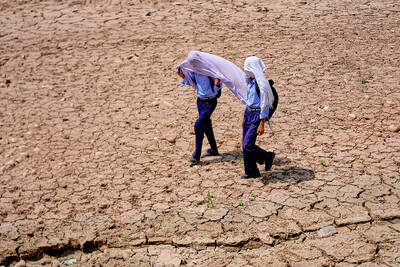
HOTTER: While Indians are accustomed to summer heat, climate change has caused northwestern India to warm faster than other parts of the country, an academic said Roads and markets have emptied during afternoons and some farmers have switched to nighttime work to avoid scorching temperatures as a heat wave grips large parts of India. The India Meteorological Department forecast maximum temperatures for yesterday of about 45°C in the capital, New Delhi, where authorities have opened temporary “cooling zones” to help people cope. The weather department warned that conditions would likely persist across several northern regions in the coming days, with temperatures staying well above seasonal averages. Authorities urged people to stay indoors during the hottest hours and take precautions against heat-related illnesses. India declares a heat wave whenever maximum temperatures
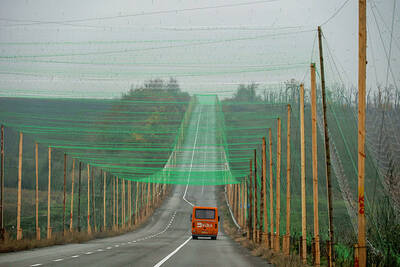
BIGGER ROLE: Beijing has said it maintains an impartial stance on the war in Ukraine, but by training Russian troops, China is far more involved than previously known China’s armed forces secretly trained about 200 Russian military personnel in China late last year, and some have since returned to fight in Ukraine, according to three European intelligence agencies and documents seen by Reuters. While China and Russia have held a number of joint military exercises since Moscow’s full-scale invasion of Ukraine in 2022, Beijing has repeatedly said that it is neutral in the conflict and presents itself as a peace mediator. The covert training sessions, which predominantly focused on the use of drones, were outlined in a dual-language Russian-Chinese agreement signed by senior Russian and Chinese officers in Beijing on


 RSS
RSS