


The leader of militant Islamist sect Boko Haram, Abubakar Shekau, may have died of gunshot wounds some weeks after a clash with soldiers, the Nigerian military said on Monday.
Past reports of Shekau’s death have proved false and there was no independent confirmation of the army account.
In a statement, the army said that Shekau, blamed for a campaign of deadly attacks on security targets and churches across Africa’s biggest oil-producing country, was hit during a gunbattle near one of his camps in the northeast on June 30.
He was taken over the border into Cameroon where he was believed to have died between July 25 and Aug. 3, according to the report issued by the military base in the northeast city of Maiduguri.
Intelligence reports “revealed that Abubakur Shekau, the most dreaded and wanted Boko Haram terrorist leader, may have died,” the statement read.
Boko Haram wants to impose Islamic law in Nigeria’s north, and, alongside other spin-off Islamist groups, has become the biggest threat to stability in Nigeria.
Though the death of Shekau would be a blow to Boko Haram’s campaign, the group has several factions without one homogeneous leadership structure. Spin-off groups like al-Qaeda-linked Ansaru, which has claimed responsibility for kidnapping and killing Westerners, are believed to operate independently.
Shekau assumed the leadership of Boko Haram when its founder Mohammed Yusuf was killed in police custody during a crackdown in 2009. He is the only high-profile member of Boko Haram, appearing in several videos posted on the Internet where, wagging his finger, he has sworn to bring down the government of Nigerian President Goodluck Jonathan and criticized the US for its treatment of Muslims.
The US has offered a reward of US$7 million for information leading to Shekau’s capture.
Shekau’s last public contact was thought to be in a video distributed to journalists in Maiduguri on Aug. 13. Though the video looked and sounded like the same person in previous recordings, the military said on Monday it was a fake.
“The recent video ... was dramatized by an impostor to hoodwink the sect members to continue with the terrorism and to deceive the undiscerning minds,” its statement said.
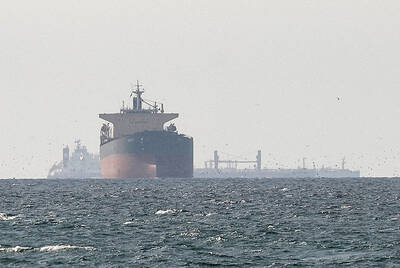
A ship that appears to be taking on the identity of a scrapped gas carrier exited the Strait of Hormuz on Friday, showing how strategies to get through the waterway are evolving as the Middle East war progresses. The vessel identifying as liquefied natural gas (LNG) carrier Jamal left the Strait on Friday morning, ship-tracking data show. However, the same tanker was also recorded as having beached at an Indian demolition yard in October last year, where it is being broken up, according to market participants and port agent’s reports. The ship claiming to be Jamal is likely a zombie vessel that
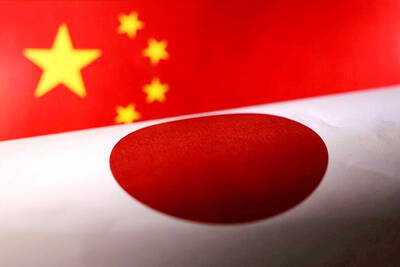
Japan is to downgrade its description of ties with China from “one of its most important” in an annual diplomatic report, according to a draft reviewed by Reuters, as relations with Beijing worsen. This year’s Diplomatic Bluebook, which Japanese Prime Minister Sanae Takaichi’s government is expected to approve next month, would instead describe China as an important neighbor and the relationship as “strategic” and “mutually beneficial.” The draft cites a series of confrontations with Beijing over the past year, including export controls on rare earths, radar lock-ons targeting Japanese military aircraft and increased pressure around Taiwan. The shift in tone underscores a deterioration
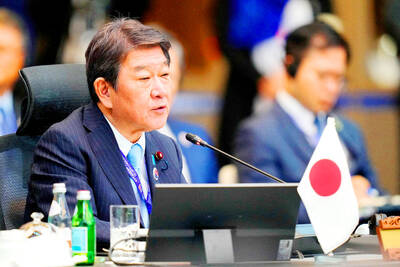
LAW CONSTRAINTS: The US has been pressing allies to send warships to open the Strait, but Tokyo’s military actions are limited under its postwar pacifist constitution Japan could consider deploying its military for minesweeping in the Strait of Hormuz if a ceasefire is reached in the war on Iran, Japanese Minister of Foreign Affairs Toshimitsu Motegi said yesterday. “If there were to be a complete ceasefire, hypothetically speaking, then things like minesweeping could come up,” Motegi said. “This is purely hypothetical, but if a ceasefire were established and naval mines were creating an obstacle, then I think that would be something to consider.” Japan’s military actions are limited under its postwar pacifist constitution, but 2015 security legislation allows Tokyo to use its Self-Defense Forces overseas if an attack,

German Chancellor Friedrich Merz’s conservative Christian Democratic Union (CDU) yesterday faced a regional election battle in Rhineland-Palatinate, now held by the center-left Social Democratic Party (SPD). Merz’s CDU has enjoyed a narrow poll lead over the SPD — their coalition partners at the national level — who have ruled the mid-sized state for 35 years. Polling third is the far-right Alternative for Germany (AfD), which spells a greater threat to the two centrist parties in several state elections in September in the country’s ex-communist east. The picturesque state of Rhineland-Palatinate, bordering France, Belgium and Luxembourg and with a population of about 4 million,


 RSS
RSS