


The litany of charges against a Cleveland man outline in numbing detail the crimes his victims allegedly suffered over 10 years of imprisonment: August 2002, kidnapping. September 2004, kidnapping. November 2006, aggravated murder.
Christmas Day 2006, rape.
A new 977-count indictment filed on Friday provides a painful look at what prosecutors say was a decade of captivity for three women in suspect Ariel Castro’s home in a rough Cleveland, Ohio, neighborhood. Among the most serious charges: that he caused the death of one of his victims’ fetuses by punching and starving her.
Among the most haunting: that he assaulted the women throughout their captivity, causing psychological harm to them and to the daughter he fathered with one of them through assault. And in another newly unveiled accusation, the indictment also alleges that on the same day that the child was born, Christmas of 2006, Castro raped one of the other women, who had helped deliver the baby.
“Today’s indictment moves us closer to resolution of this gruesome case,” Cuyahoga County Prosecutor Tim McGinty said in a statement.
Castro, 53, is accused of kidnapping the three women and holding them captive — sometimes restrained in chains — along with the six-year-old girl he fathered.
He is charged with two counts of aggravated murder related to one act, saying he purposely caused the unlawful termination of the pregnancy of one of the women. The new, 576-page indictment also charges him with 512 counts of kidnapping, 446 counts of rape, seven counts of gross sexual imposition, six counts of felonious assault, three counts of child endangerment and one count of possessing criminal tools.
Authorities say the filing covers the entire period that the women were imprisoned, from 2002 until May of this year, superseding an earlier indictment that listed accusations for only some of the years. The indictment does not include charges that could carry a death sentence, but McGinty said he is still reserving that option. Castro will be arraigned on the new charges on Wednesday. He is scheduled for trial on Aug. 5.
Castro pleaded not guilty to the earlier indictment of 329 counts. A message was left with his attorney on Friday seeking comment on the new charges. His legal team has hinted Castro would plead guilty if the death penalty was off the table. A communications firm representing the women said they would not comment. The women released a three-minute video this week thanking the community for its support.
News that the women had been found alive electrified the Cleveland area, where two of the victims were household names after years of searches, publicity and vigils. However, elation soon turned to shock as allegations about their treatment began to emerge.
Castro is accused of repeatedly restraining the women, sometimes chaining them to a pole in a basement — once with a motorcycle helmet over one of the women’s heads — to a bedroom heater or inside a van. It says one of the women tried to escape and he assaulted her with a vacuum cord around her neck.
Later, Castro moved them to upstairs rooms where they were kept as virtual prisoners, according to investigators.
All the while, Castro continued driving a school bus and playing bass in local bands, with fellow musicians saying they never suspected a thing. He was fired as a bus driver last fall after leaving his bus unattended for several hours.
The picture of Castro as a friendly musician began to erode soon after the women were freed, as family members told of a man who terrorized his common-law wife, beating her and locking her in an apartment and the same house where the women were later kept.

An American scientist convicted of lying to US authorities about payments from China while he was at Harvard University has rebuilt his research lab in Shenzhen, China, to pursue technology the Chinese government has identified as a national priority: embedding electronics into the human brain. Charles Lieber, 67, is among the world’s leading researchers in brain-computer interfaces. The technology has shown promise in treating conditions such as amyotrophic lateral sclerosis and restoring movement in paralyzed people. It also has potential military applications: Scientists at the Chinese People’s Liberation Army have investigated brain interfaces as a way to engineer super soldiers by boosting
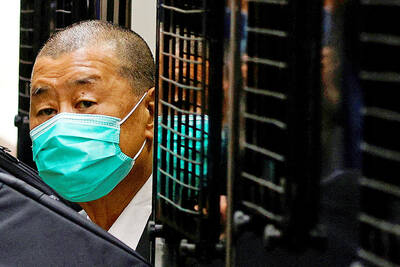
Jailed media entrepreneur Jimmy Lai (黎智英) has been awarded Deutsche Welle’s (DW) freedom of speech award for his contribution to Hong Kong’s pro-democracy movement. The German public broadcaster on Thursday said Lai would be presented in absentia with the 12th iteration of the award on June 23 at the DW Global Media Forum in Bonn. Deutsche Welle director-general Barbara Massing praised the 78-year-old founder of the now-shuttered news outlet Apple Daily for standing “unwaveringly for press freedom in Hong Kong at great personal risk.” “With Apple Daily, he gave journalists a platform for free reporting and a voice to the democracy movement in

PHILIPPINE COMMITTEE: The head of the committee that made the decision said: ‘If there is nothing to hide, there is no reason to hide, there is no reason to obstruct’ A Philippine congressional committee on Wednesday ruled that there was “probable cause” to impeach Philippine Vice President Sara Duterte after hearing allegations of unexplained wealth, misuse of state funds and threats to have the president assassinated. The unanimous decision of the 53-member committee in the Philippine House of Representatives sends the two impeachment complaints to deliberations and voting by the entire lower chamber, which has more than 300 lawmakers. The complaints centered on Duterte’s alleged illegal use and mishandling of intelligence funds from the vice president’s office, and from her time as education secretary under Philippine President Ferdinand Marcos Jr. Duterte and the

As evening falls in Fiji’s capital, a steady stream of people approaches a makeshift clinic that is a first line of defense against one of the world’s fastest-growing HIV epidemics. In the South Pacific nation — a popular tourist destination of just under a million people — more than 2,000 new HIV cases were recorded last year, a 26 percent increase from 2024. The government has declared an HIV outbreak and described it as a national crisis. “It’s spreading like wildfire,” said Siteri Dinawai, 46, who came to be tested. The Moonlight Clinic, a converted minibus parked in a suburban cul-de-sac in Suva, is


 RSS
RSS