


Simmering hostility between Syria’s mainstream rebels and jihadists has erupted into naked violence, with a Free Syrian Army commander in the coastal province of Latakia being shot dead by an al-Qaeda front group.
Kamal Hamami — better known by his nom-de-guerre Abu Bassir al-Jeblawi — was killed on Thursday by the Islamic State of Iraq and Syria (ISIS), one of the main jihadist groups operating in Syria and a front for al-Qaeda in Iraq, witnesses and a monitoring group said.
The killing follows months of tension between the mainstream, Arab and Western-backed rebel Free Syrian Army (FSA) and jihadist groups affiliated with al-Qaeda, most of whose fighters are non-Syrian.
Abu Ahmad, a rebel allied to Abu Bassir said via Facebook he witnessed what he said was a cold-blooded shooting at an ISIS checkpoint when the rebel chief was on his way to visit fighters at the front.
“They told us we weren’t allowed to cross, that they had orders from their emir, Abu Ayman,” who heads ISIS in Latakia, Abu Ahmad said.
“Abu Bassir told them: ‘Did you come to our country to help us or to be a burden?’ Abu Ayman then arrived at the scene. He said he would kill Abu Bassir, who replied: ‘You have nothing to do with Islam.’ Abu Ayman then killed him,” he said.
The Syrian Observatory for Human Rights gave a different version of events, saying Abu Bassir was killed when ISIS fighters tried to destroy a FSA checkpoint in the province’s Jabal al-Turkman region.
“FSA rebels fired into the air and subsequently, an ISIS fighter shot Abu Bassir dead and wounded two other fighters from his battalion,” the Observatory said.
FSA political and media coordinator Louay Muqdad said those behind the killing must “urgently” be handed over to the rebels for trial.
Experts link rising tensions to Western promises of aid to Syrian so long as they guarantee weapons will not fall into extremists’ hands.
“A lot of these groups, they have to show a hardline against al-Qaeda because that is what their funders expect from them,” Middle East specialist Aron Lund told reporters. “If they want money from US they have to push out al-Qaeda.”
French President Francois Hollande, whose country has been at the forefront of efforts to isolate the al-Assad regime, last month urged the FSA to push groups like al-Nusra out of the zones they control.
Journalists who met Abu Bassir earlier this year said the commander, in his 30s, hailed from a wealthy family from the city of Latakia, but chose to join the rebellion in the province’s mountains.
“They [jihadists] have left their homes, their countries to come fight our war, but this is our country and we don’t want outsiders to come and rule over it. They must realize that they have to leave once the war ends,” Abu Bassir said in May.
Highly organized and respected by his Ezz Bin Abdel Salam battalion, Abu Bassir “was a moderate and believed in the idea of a democratic state,” one of his friends told reporters via the Internet.
“During the liberation of the Christian village of Burj al-Kassab, a jihadist destroyed a cross. A fight broke out between Abu Bassir and the jihadists over this incident,” he added.
Residents in Latakia Province “are very angry” over the assassination, the friend said, adding that “the regime has tried for two years to kill Abu Bassir, and now these people come and kill him.”
Late last week, dozens of FSA fighters were killed in a battle against the ISIS in the northwestern province of Idlib. The FSA battalion chief there was beheaded by the ISIS and his brother slaughtered, the Observatory said.
In the early days of the Syrian uprising, when opponents of the regime were desperate for assistance from any quarter, jihadist fighters were welcomed, but a spate of abuses has fuelled a growing backlash.
Last month, the ISIS was accused of executing a teenager in Aleppo because he committed “blasphemy.”
Anti-alAssad activists in rebel areas are increasingly turning their attention to creating anti-ISIS campaigns.
While the FSA is fighting to overthrow the al-Assad regime, the jihadists are intent on installing an Islamic caliphate in Syria.
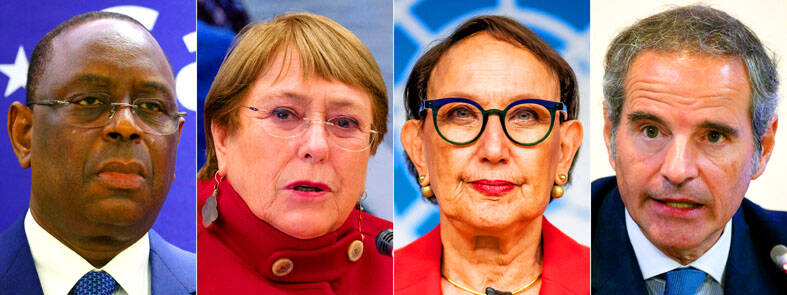
Four contenders are squaring up to succeed Antonio Guterres as secretary-general of the UN, which faces unprecedented global instability, wars and its own crushing budget crisis. Chile’s Michelle Bachelet, Argentina’s Rafael Grossi, Costa Rica’s Rebeca Grynspan and Senegal’s Macky Sall are each to face grillings by 193 member states and non-governmental organizations for three hours today and tomorrow. It is only the second time the UN has held a public question-and-answer, a format created in 2016 to boost transparency. Ultimately the five permanent members of the UN’s top body, the Security Council, hold the power, wielding vetoes over who leads the
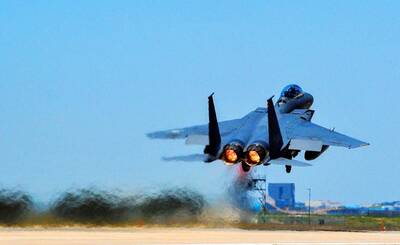
South Korea’s air force yesterday apologized for a 2021 midair collision involving two fighter jets, a day after auditors said the pilots were taking selfies and filming during the flight and held them responsible for the accident. “We sincerely apologize to the public for the concern caused by the accident that occurred in 2021,” an air force spokesman told a news conference, adding that one of the pilots involved had been suspended from flying duties, received severe disciplinary action and has since left the military. The apology followed a report released on Wednesday by the South Korean Board of Audit and Inspection,

About 240 Indians claiming descent from a Biblical tribe landed at Tel Aviv airport on Thursday as part of a government operation to relocate them to Israel. The newcomers passed under a balloon arch in blue and white, the colors of the Israeli flag, as dozens of well-wishers welcomed them with a traditional Jewish song. They were the first “bnei Menashe” (“sons of Manasseh”) to arrive in Israel since the government in November last year announced funding for the immigration of about 6,000 members of the community from the states of Manipur and Mizoram in northeast India. The community claims to descend from
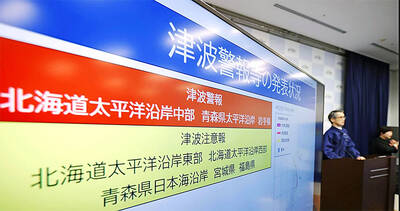
An earthquake registering a preliminary magnitude of 7.7 off northern Japan on Monday prompted a short-lived tsunami alert and the advisory of a higher risk of a possible mega-quake for coastal areas there. The Cabinet Office and the Japan Meteorological Agency said there was a 1% chance for a mega-quake, compared to a 0.1% chance during normal times, in the next week or so following the powerful quake near the Chishima and Japan trenches. Officials said the advisory was not a quake prediction but urged residents in 182 towns along the northeastern coasts to raise their preparedness while continuing their daily lives. Prime


 RSS
RSS