


When the Taliban sent a gunman to shoot Malala Yousufzai in October last year as she rode home on a bus after school, they made clear their intention: to silence the teenager and kill off her campaign for girls’ education.
Nine months and countless surgical interventions later, she stood up at the UN on her 16th birthday on Friday to deliver a defiant riposte.
“They thought that the bullet would silence us, but they failed,” she said.
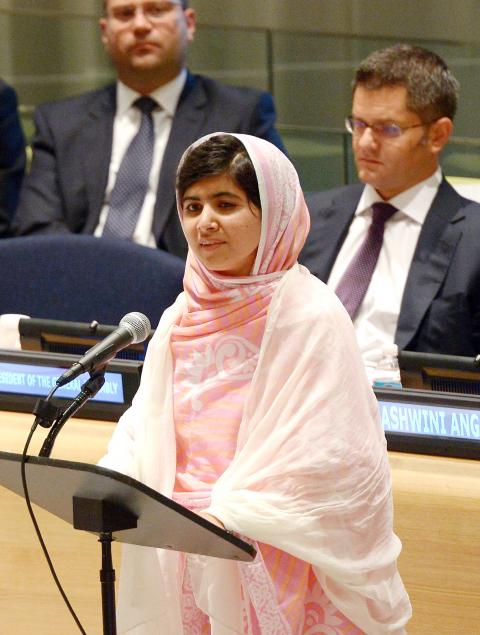
Photo: EPA
As 16th birthdays go, it was among the more unusual. Instead of blowing out candles on a cake, Malala sat in one of the UN’s main council chambers in the central seat usually reserved for world leaders.
She listened quietly as UN Secretary-General Ban Ki-moon described her as “our hero, our champion”; and as the former British prime minister and now UN education envoy Gordon Brown uttered what he called “the words the Taliban never wanted her to hear: Happy 16th birthday, Malala.”
The event, dubbed Malala Day, was the culmination of an extraordinary four years for the girl from Mingora, in the troubled Swat valley of Pakistan.
She was thrust into the public glare after she wrote a pseudonymous, but later celebrated blog for the BBC Urdu service describing her experiences struggling to get an education under the rising power of Taliban militants.
By 11, she was showing exceptional determination, calling personally on then-US envoy to Afghanistan and Pakistan Richard Holbrooke to use his influence to combat the Taliban’s drive against education for girls. By 14, she was on the radar of Archbishop Desmond Tutu, who put her forward for the international children’s peace prize, and by 15 she became the youngest Nobel Peace Prize nominee in history.
However, such dizzying global attention came at a price. Death threats followed her growing recognition, and on Oct. 9 last year, following a meeting of Pakistani Taliban leaders, the gunman was dispatched to remove what they called the “symbol of infidels and obscenity.”
Multiple operations in Pakistan and the UK followed the attack on the bus, including the fitting of a titanium plate on her left forehead, and a cochlear implant to restore her hearing. She now lives with her family in Birmingham and does what the Taliban tried to stop her doing: She goes to school every day.
“I am not against anyone,” she said in the UN chamber, having taken this day out from the classroom. “Neither am I here to speak in terms of personal revenge against the Taliban or any other terrorist group.”
Malala responded to the violence of the Taliban with her own countervailing force: words against bullets.
“I do not even hate the Talib who shot me. Even if there is a gun in my hand and he stands in front of me, I would not shoot him,” she said.
She spoke confidently, with only an injured eye and a slightly drooping left side of her face to hint at such fresh traumas. There was one other unstated allusion to the horror of her past: She wore a white shawl belonging to a woman who was also targeted by extremists, but who, unlike Malala, did not survive to tell the tale: former Pakistani prime minister Benazir Bhutto.
“The extremists are afraid of books and pens,” the teenager said. “The power of education frightens them. They are afraid of women. The power of the voice of women frightens them.”
She cited last month’s attack on a hospital in Quetta, capital of Baluchistan, and killings of female teachers in Khyber Pakhtunkhwa.
“That is why they are blasting schools every day — because they were and they are afraid of change, afraid of the equality that we will bring to our society,” she said.
And she gave her own opposing interpretation of Islam to the Taliban’s.
“They think that God is a tiny, little conservative being who would send girls to hell just because of going to school. The terrorists are misusing the name of Islam and Pashtun society for their own personal benefits. Islam is a religion of peace, humanity and brotherhood. Islam says that it is not only each child’s right to get education, rather it is their duty and responsibility,” she said.
Such ability to articulate what normally remains unarticulated — to give voice to young people normally silenced — has generated its own response.
The “stand with Malala” petition, calling for education for the 57 million children around the world who do not go to school, has attracted more than 4 million signatures — more than 1 million having been added in the past few days.

An American scientist convicted of lying to US authorities about payments from China while he was at Harvard University has rebuilt his research lab in Shenzhen, China, to pursue technology the Chinese government has identified as a national priority: embedding electronics into the human brain. Charles Lieber, 67, is among the world’s leading researchers in brain-computer interfaces. The technology has shown promise in treating conditions such as amyotrophic lateral sclerosis and restoring movement in paralyzed people. It also has potential military applications: Scientists at the Chinese People’s Liberation Army have investigated brain interfaces as a way to engineer super soldiers by boosting
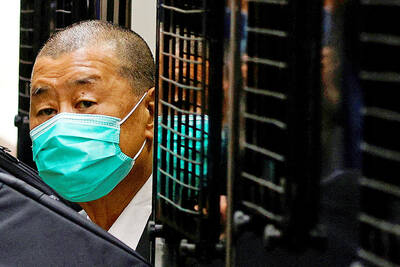
Jailed media entrepreneur Jimmy Lai (黎智英) has been awarded Deutsche Welle’s (DW) freedom of speech award for his contribution to Hong Kong’s pro-democracy movement. The German public broadcaster on Thursday said Lai would be presented in absentia with the 12th iteration of the award on June 23 at the DW Global Media Forum in Bonn. Deutsche Welle director-general Barbara Massing praised the 78-year-old founder of the now-shuttered news outlet Apple Daily for standing “unwaveringly for press freedom in Hong Kong at great personal risk.” “With Apple Daily, he gave journalists a platform for free reporting and a voice to the democracy movement in
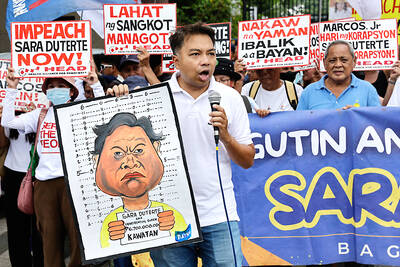
PHILIPPINE COMMITTEE: The head of the committee that made the decision said: ‘If there is nothing to hide, there is no reason to hide, there is no reason to obstruct’ A Philippine congressional committee on Wednesday ruled that there was “probable cause” to impeach Philippine Vice President Sara Duterte after hearing allegations of unexplained wealth, misuse of state funds and threats to have the president assassinated. The unanimous decision of the 53-member committee in the Philippine House of Representatives sends the two impeachment complaints to deliberations and voting by the entire lower chamber, which has more than 300 lawmakers. The complaints centered on Duterte’s alleged illegal use and mishandling of intelligence funds from the vice president’s office, and from her time as education secretary under Philippine President Ferdinand Marcos Jr. Duterte and the
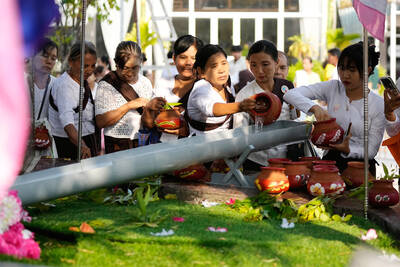
Burmese President Min Aung Hlaing yesterday cut all prisoners’ sentences by one-sixth, a blanket measure that a source close to deposed leader Aung San Suu Kyi said would further shorten her detention. Aung San Suu Kyi has been sequestered since a 2021 military coup, but the senior member of her dissolved National League for Democracy (NLD) party said that while her term had been reduced, her remaining sentence is still unclear. “We also don’t know exactly how many years she has left,” the source told reporters, speaking on condition of anonymity for security reasons. The military toppled Aung San Suu Kyi’s elected government


 RSS
RSS