


In a sign Venezuela’s food shortages could be worsening, restrictions on the sale of 20 basic items subject to price controls, including toilet paper and chicken, are set to begin next week in its most populous state, officials said on Tuesday.
A spokesman for Venezuelan President Nicolas Maduro’s government said it is incorrect to call the plan rationing because it is meant to fight smuggling of price-controlled food across the border into Colombia. He said there are no plans to extend the program nationally.
Details of how the system in Zulia State will work are still being worked out, said Blagdimir Labrador, the state governor’s chief of staff, but Zulia will issue computer chip cards beginning next week that will limit consumer purchases of products including rice, flour, cooking oil, sugar and powdered milk, he said.
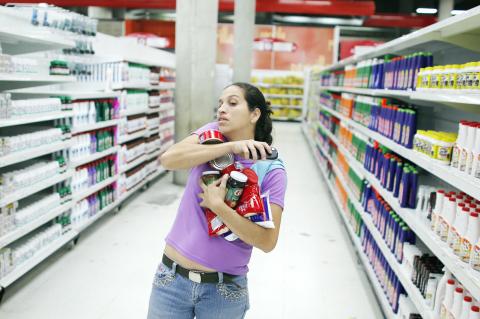
Photo: Reuters
The quantities each family will be allowed to buy, on a daily or weekly basis, have not yet been determined, he said.
The system will register purchases remotely on computer servers “so the same person can’t go to a different store on the same day and purchase the same product,” Labrador said.
The foray appears to be Venezuela’s first into food rationing. Communist-run Cuba has issued monthly ration cards for basic foodstuffs for decades, although the number of items has dwindled in recent years.
Labrador said the system would initially apply to 65 supermarkets in two cities, Maracaibo and San Francisco, in the state of 3.7 million people bordering Colombia.
The president of the state’s supermarket association, Andres de Candido, said he did not believe the system, run by the state-owned CANTV telecommunications company, would be ready in all supermarkets by next week, but said his group is ready to support it if it truly gets food smuggling to Colombia under control.
Authorities said that is the sole intent of the new system.
“This is only in Zulia State and it is not rationing,” Venezuelan Information Ministry spokesman Raimundo Urrechaga said. “It is focused only on Zulia, to control contraband.”
That is fine with Angelica Silva, a 52-year-old housewife who could not find butter or toilet paper in a downtown Caracas market on Tuesday.
“This isn’t a poor country like Cuba, where we all depend on the government,” she said.
However, Silva was still worried.
“What scares me is that there will be more scarcity and nobody will tolerate that,” she said.
To fight gasoline smuggling to Colombia, Zulia and another border state, Tachira, have in the past two years imposed a computer-chip system that limits purchases. However, it does not appear to have stemmed the cross-border smuggling of heavily subsidized Venezuelan gasoline.
That makes many economists skeptical that limiting food purchases, or rationing, can end worsening shortages of basic foodstuffs and medicine that Venezuelans generally blame on government mismanagement in a nation that gets 97 percent of its export earnings from oil.
One reason is that price controls on more than 100 items imposed more than a decade ago under late Venezuelan president Hugo Chavez are regularly ignored in all but state-run markets.
Merchants say adhering to them would be suicidal for their businesses given inflation reached 29.4 percent in April.

‘CROSSING THE LINE’: China’s embassy in Seoul criticized US Forces Korea Commander General Xavier Brunson, asking if his ‘hostile’ remarks were authorized by Washington South Korea and the US are in talks over recent public remarks by the commander of US Forces Korea, Seoul’s presidential office said yesterday, after the comments drew sharp criticism from China. In a recent podcast interview, US Forces Korea Commander General Xavier Brunson described South Korea as “the dagger in the heart of Asia” from China’s east coast, prompting the Chinese embassy in Seoul to say that he had “truly crossed the line.” The interview came amid growing speculation that Washington might seek to expand the role of US Forces Korea in countering the growing regional influence of China, a key

SEEKING ORDER: Rodrigo Paz said that ‘anyone who wants to destroy the nation will have to deal with this president and the full force of the constitution’ Bolivian President Rodrigo Paz on Wednesday said that the nation was at a “breaking point” after nearly a month of protests that have caused shortages of food, fuel and medicine. Paz, who took office six months ago amid the worst economic crisis there in four decades, is battling a groundswell of fury over his policies. The political capital, La Paz, has been besieged by low-income workers and members of the indigenous majority calling for his resignation. “The country needs order and is reaching breaking point,” the 58-year-old said at a public event in La Paz, renewing his appeal for dialogue. On Tuesday, the Bolivian

Through the noise of rushing papers and whirring belts at a print factory in Kyoto, two creators watch their photo essay come to life in broadsheet form — part of an effort to win new audiences in the age of artificial intelligence (AI). Despite the decline of the publishing industry, self-publication and handmade “zine” magazines are growing in popularity in Japan, reflecting the nation’s enduring love of paper in the digital era. While speaking to Agence France-Presse at the plant, his hands black with ink, one of the creators, Kazuma Obara, said: “I think [paper] is a medium that engages all five

Australian researchers have trained lab-grown brain cells on a silicon computer chip to play the 1990s shooter game Doom and said they are just scratching the surface of what the neurons could be capable of doing. It is the science-fiction work of biotech boffins at Cortical Labs, who researched and developed the technology that harnesses the workings of the brain’s networking system. Each so-called “biological computer” contains about 200,000 living human brain cells, grown from stem cells that were harvested from blood donations. Having mastered the simple computer game Pong, where a paddle is moved up and down to send a ball


 RSS
RSS