


The official mouthpiece of the Chinese Communist Party yesterday condemned an outbreak of giant yellow ducks across the country, after imitations of an artwork in Hong Kong landed in several cities.
Dutch artist Florentijn Hofman’s 16.5m tall yellow inflatable has been a sensation in both Hong Kong and China since it was installed in Victoria Harbour a month ago.
Property developers in several cities, among them Hangzhou, Wuhan and Tianjin, have rushed to install similar, albeit smaller, yellow ducks to attract potential customers to their projects.
In an editorial in the People’s Daily, China’s most-circulated newspaper, condemned the imitators for betraying what it said was Hofman’s own message.
The duck was a symbol of “humanity’s shared culture and childhood memories, pure art and anti-commercialization,” it said.
Copycat ducks were merely “kitsch” and such unoriginal behavior “will ruin our creativity and our future and lead to the loss of imagination eventually,” it said.
“The more yellow ducks are there, the further we are from Hofman’s anti-commercialization spirit, and the more obvious is our weak creativity,” it said.
“It’s good that the rubber duck is popular, but it’s sad to see the innovation of our country to go down. We often talk about awareness and confidence in our own culture, but where do they come from? Definitely not from following new trends,” it added.
Tourism authorities in Hunan Province have renamed a mountain long known as the “Southern Sky Column” as “Avatar Hallelujah Mountain” after it inspired landscapes in the Hollywood special-effects blockbuster, it said.
“This is not innovation, it’s selling our inheritance,” the newspaper said in the editorial, which appeared both in print and online editions.
For those who want a giant rubber duck of their own, China’s vast army of manufacturing firms has moved to meet demand.
One company, KK Inflatable, is selling ducks in multiple sizes, one of them even larger than Hofman’s creation, on Taobao, China’s biggest shopping Web site.
A 2m duck costs 2,800 yuan (US$460), one the size of Hofman’s is 118,000 yuan, and the biggest bird of all, a 20m monster duck, costs 149,800 yuan.
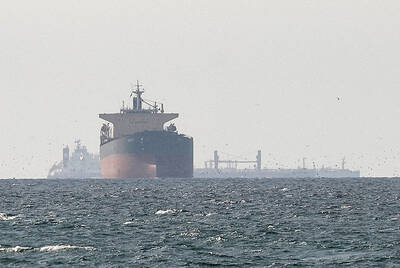
A ship that appears to be taking on the identity of a scrapped gas carrier exited the Strait of Hormuz on Friday, showing how strategies to get through the waterway are evolving as the Middle East war progresses. The vessel identifying as liquefied natural gas (LNG) carrier Jamal left the Strait on Friday morning, ship-tracking data show. However, the same tanker was also recorded as having beached at an Indian demolition yard in October last year, where it is being broken up, according to market participants and port agent’s reports. The ship claiming to be Jamal is likely a zombie vessel that

German Chancellor Friedrich Merz’s conservative Christian Democratic Union (CDU) yesterday faced a regional election battle in Rhineland-Palatinate, now held by the center-left Social Democratic Party (SPD). Merz’s CDU has enjoyed a narrow poll lead over the SPD — their coalition partners at the national level — who have ruled the mid-sized state for 35 years. Polling third is the far-right Alternative for Germany (AfD), which spells a greater threat to the two centrist parties in several state elections in September in the country’s ex-communist east. The picturesque state of Rhineland-Palatinate, bordering France, Belgium and Luxembourg and with a population of about 4 million,

Ugandan wildlife authorities have reintroduced rhinos into a remote protected area where they were once poached into extinction, an event seen by conservationists as a milestone in efforts to support the recovery of a species threatened by poaching. On Tuesday, two southern white rhinos from a private ranch in the East African country were reintroduced into Kidepo Valley National Park in the country’s northeast. Two more rhinos in metallic crates arrived on Thursday. There have been no rhinos in the park since 1983, the result of poaching. However, a private ranch in central Uganda — the Ziwa Rhino Sanctuary — has been

LAW CONSTRAINTS: The US has been pressing allies to send warships to open the Strait, but Tokyo’s military actions are limited under its postwar pacifist constitution Japan could consider deploying its military for minesweeping in the Strait of Hormuz if a ceasefire is reached in the war on Iran, Japanese Minister of Foreign Affairs Toshimitsu Motegi said yesterday. “If there were to be a complete ceasefire, hypothetically speaking, then things like minesweeping could come up,” Motegi said. “This is purely hypothetical, but if a ceasefire were established and naval mines were creating an obstacle, then I think that would be something to consider.” Japan’s military actions are limited under its postwar pacifist constitution, but 2015 security legislation allows Tokyo to use its Self-Defense Forces overseas if an attack,


 RSS
RSS