


Drug smugglers who race across the Caribbean in speedboats typically jettison their cargo when spotted by surveillance aircraft, hoping any chance of prosecuting them will vanish with the drugs sinking to the bottom of the sea.
That may be a less winning tactic in the future. The US Navy on Friday began testing two new aerial tools, borrowed from the battlefields of Afghanistan and Iraq, that officials say could make it easier to detect, track and videotape drug smugglers in action.
One of the devices on display aboard the high-speed vessel Swift is a large, white balloon-like craft known as an aerostat, which is tethered about 600m above the ship’s stern.
The other tool on board for tests in the Florida Straits is a type of drone that can be launched by hand from the deck.
Together, they expand the ability of navy and US Coast Guard personnel to see what is beyond their horizon, according to officials from both military branches and the contractors hoping to sell the devices to the US government.
The devices should allow authorities to detect and monitor suspected drug shipments from afar for longer sustained periods, giving them a better chance of stopping the smugglers. They also should allow them to make continuous videotapes that can be used in prosecutions.
“Being able to see them and watch what they are doing even before we get there is going to give us an edge,” said Chris Sinclair, assistant officer in charge of a law enforcement detachment on board the Swift, a private vessel leased to the navy that is about to begin a month-long deployment to the southwestern Caribbean, tracking the busy smuggling routes off Colombia and Honduras.
Crews practiced launching and operating both systems, before a small contingent of news media on board the Swift, managing to bring back video of vessels participating in a mock surveillance mission as well as radar and video images of the fishing charters and sailboats that dot the choppy seas separating Cuba from the US mainland.
The drone, officially a Puma All Environment unmanned aircraft system from Aerovironment of Simi Valley, California, splashed into the water on one landing and had to be retrieved. On the second round, it clacked noisily, but intact on the shifting deck of the 100m ship. Rear Admiral Sinclair Harris, commander of the navy’s Fourth Fleet, said the devices are necessary at a time when the service is making a transition to smaller, faster ships amid budget cuts.
The aerostat, formally the Aerostar TIF-25K and made by a division of Raven Industries of Sioux Falls, South Dakota, is filled with helium. It is an old technology, models of which have been used for decades, but it is packed with cameras and sensors that expand the ship’s radar capability from about 8km to about 80km. That can help teams in an on-board control center to identify larger ships, which now would appear as just dots on the horizon, from as far as 25km away.
Meanwhile, the Puma can be sent out to inspect a vessel flagged by the larger aerostat and give a “God’s eye view,” of what’s happening on board, a job usually handled by a plane or helicopter, said Craig Benson, director of business development for the company.
Both the aerostat and the drone have been used widely by the US government for overseas actions, but Harris and others aboard the Swift said neither has been used before by the navy to conduct counter-drug operations.

Four contenders are squaring up to succeed Antonio Guterres as secretary-general of the UN, which faces unprecedented global instability, wars and its own crushing budget crisis. Chile’s Michelle Bachelet, Argentina’s Rafael Grossi, Costa Rica’s Rebeca Grynspan and Senegal’s Macky Sall are each to face grillings by 193 member states and non-governmental organizations for three hours today and tomorrow. It is only the second time the UN has held a public question-and-answer, a format created in 2016 to boost transparency. Ultimately the five permanent members of the UN’s top body, the Security Council, hold the power, wielding vetoes over who leads the
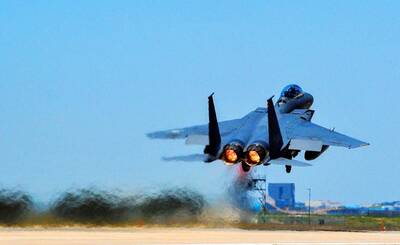
South Korea’s air force yesterday apologized for a 2021 midair collision involving two fighter jets, a day after auditors said the pilots were taking selfies and filming during the flight and held them responsible for the accident. “We sincerely apologize to the public for the concern caused by the accident that occurred in 2021,” an air force spokesman told a news conference, adding that one of the pilots involved had been suspended from flying duties, received severe disciplinary action and has since left the military. The apology followed a report released on Wednesday by the South Korean Board of Audit and Inspection,

Young Chinese, many who fear age discrimination in their workplace after turning 35, are increasingly starting “one-person companies” that have artificial intelligence (AI) do most of the work. Smaller start-ups are already in vogue in Silicon Valley and elsewhere, with rapidly advancing AI tools seen as a welcome teammate even as they threaten layoffs at existing firms. More young people in China are subscribing to the model, as cities pledge millions of dollars in funding and rent subsidies for such ventures, in alignment with Beijing’s political goal of “technological self-reliance.” “The one-person company is a product of the AI era,” said Karen Dai

About 240 Indians claiming descent from a Biblical tribe landed at Tel Aviv airport on Thursday as part of a government operation to relocate them to Israel. The newcomers passed under a balloon arch in blue and white, the colors of the Israeli flag, as dozens of well-wishers welcomed them with a traditional Jewish song. They were the first “bnei Menashe” (“sons of Manasseh”) to arrive in Israel since the government in November last year announced funding for the immigration of about 6,000 members of the community from the states of Manipur and Mizoram in northeast India. The community claims to descend from


 RSS
RSS