


French lawmakers on Tuesday defied months of angry protests to approve a bill that is to make France the 14th country worldwide to legalize same-sex marriages.
Opponents of the law vowed to fight on, quickly filing a constitutional challenge and promising more demonstrations to pressure French President Francois Hollande into backing down from signing the bill.
In its second and final reading, the French National Assembly, or lower house of parliament, voted 331 to 225 to adopt the bill allowing homosexual marriages and adoptions by gay couples.
French Minister of Justice Christiane Taubira hailed the approval of the bill as a “historic” moment.
“It grants new rights, stands firmly against discrimination [and] testifies to our country’s respect for the institution of marriage,” she said in a statement shortly after the vote.
However, the tension remained high inside parliament as well as on the streets: Ushers ejected two protesters from the parliamentary chamber as they unfurled a protest banner.
Soon after the law was voted through, lawmakers from right-wing parties filed a legal challenge with the constitutional council.
Senators from the main opposition UMP and other right-wing parties said: “The definition of marriage, a fundamental principle … cannot be modified by a simple law.”
Provisions allowing adoption by gay couples violate “fundamental principles” of France, including “the principle of human dignity and equality,” they argued.
Thousands of opponents of the law also refused to give up, demonstrating near to the National Assembly on Tuesday evening.
“We are going to show them that this is not over,” said the campaigner known as Frigide Barjot, leader of the “Manif pour tous” (Demo for all) group that has battled the bill.
She called on Hollande to hold a referendum on the issue. Another mass protest is already planned for May 26.
The Catholic Bishops’ Conference of France expressed its disappointment at the law and Bishop Bernard Podvin spoke of his “deep sadness.”
“Democracy has spoken,” he said. “But such a controversial law will not produce social cohesion.”
However, for Nicolas Gougain, a spokesman for Inter-LGBT, France’s leading gay rights group, the law was a victory for equality and democracy.
“This law takes no rights away from anyone, it only grants rights to others. This is liberation after years of fighting for equality,” he said.
In Paris late on Tuesday, police again clashed with a hard core of violent protesters among those opposing the law, as they had done during a series of protests in the capital last week.
One officer received a head injury as protesters threw firecrackers, bottles and stones at police, who responded with tear gas and made 12 arrests.
The constitutional council now has a month to make a ruling, but the government expressed confidence that the constitutional challenge would be dismissed.
Hundreds of thousands have taken to the streets in a series of protests against the bill, surprising many in a country that, while predominantly Catholic, is known for its secular traditions.
Hollande could scarcely have anticipated the scale of the opposition he would face over a reform that initially seemed to enjoy solid majority backing among French voters.
However, recent polls have suggested that a campaign in which the Roman Catholic Church initially played the leading role has shifted opinion to the extent that the electorate is now fairly evenly split on both gay marriage and adoption.
If Hollande signs the law, France will join eight other European countries — the Netherlands, Belgium, Spain, Norway, Sweden, Portugal, Iceland and Denmark — in legalizing same-sex marriages.

An American scientist convicted of lying to US authorities about payments from China while he was at Harvard University has rebuilt his research lab in Shenzhen, China, to pursue technology the Chinese government has identified as a national priority: embedding electronics into the human brain. Charles Lieber, 67, is among the world’s leading researchers in brain-computer interfaces. The technology has shown promise in treating conditions such as amyotrophic lateral sclerosis and restoring movement in paralyzed people. It also has potential military applications: Scientists at the Chinese People’s Liberation Army have investigated brain interfaces as a way to engineer super soldiers by boosting
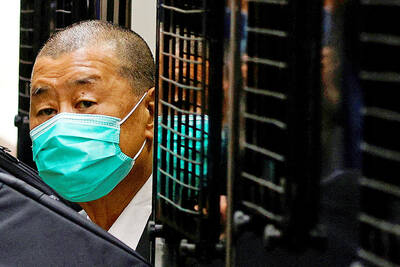
Jailed media entrepreneur Jimmy Lai (黎智英) has been awarded Deutsche Welle’s (DW) freedom of speech award for his contribution to Hong Kong’s pro-democracy movement. The German public broadcaster on Thursday said Lai would be presented in absentia with the 12th iteration of the award on June 23 at the DW Global Media Forum in Bonn. Deutsche Welle director-general Barbara Massing praised the 78-year-old founder of the now-shuttered news outlet Apple Daily for standing “unwaveringly for press freedom in Hong Kong at great personal risk.” “With Apple Daily, he gave journalists a platform for free reporting and a voice to the democracy movement in
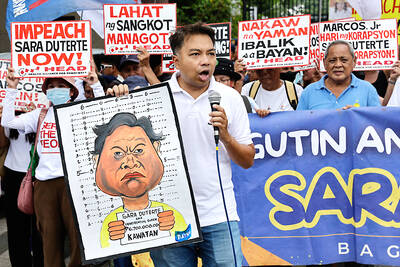
PHILIPPINE COMMITTEE: The head of the committee that made the decision said: ‘If there is nothing to hide, there is no reason to hide, there is no reason to obstruct’ A Philippine congressional committee on Wednesday ruled that there was “probable cause” to impeach Philippine Vice President Sara Duterte after hearing allegations of unexplained wealth, misuse of state funds and threats to have the president assassinated. The unanimous decision of the 53-member committee in the Philippine House of Representatives sends the two impeachment complaints to deliberations and voting by the entire lower chamber, which has more than 300 lawmakers. The complaints centered on Duterte’s alleged illegal use and mishandling of intelligence funds from the vice president’s office, and from her time as education secretary under Philippine President Ferdinand Marcos Jr. Duterte and the

Burmese President Min Aung Hlaing yesterday cut all prisoners’ sentences by one-sixth, a blanket measure that a source close to deposed leader Aung San Suu Kyi said would further shorten her detention. Aung San Suu Kyi has been sequestered since a 2021 military coup, but the senior member of her dissolved National League for Democracy (NLD) party said that while her term had been reduced, her remaining sentence is still unclear. “We also don’t know exactly how many years she has left,” the source told reporters, speaking on condition of anonymity for security reasons. The military toppled Aung San Suu Kyi’s elected government


 RSS
RSS