


Sheriff’s deputies who believed they had cornered a fugitive ex-cop in the mountains above Los Angeles did not purposely torch a cabin where a nine-day manhunt ended, but the deputies may have ignited the blaze by firing tear gas, officials said on Wednesday.
Former Los Angeles police officer Christopher Dorner, 33, was wanted in a killing spree targeting law enforcement officers that left four people dead.
A man matching his description was surrounded inside a lodging nestled in the San Bernardino National Forest on Tuesday.
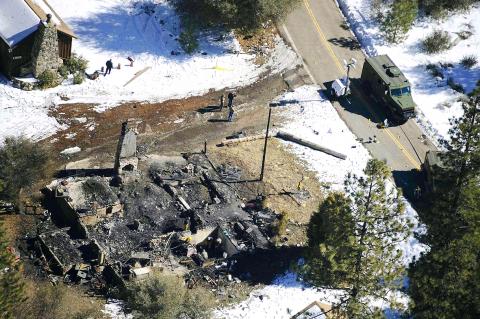
Photo: Reuters
“We did not intentionally burn down that cabin to get Mr Dorner out,” San Bernardino County Sheriff John McMahon said at an afternoon press conference.
Investigators had not yet formally identified charred remains found in the burned-out structure, although they are believed to be those of Dorner.
“The suspect that we were following ... matched his description,” McMahon said.
“Our coroner’s division is working on trying to confirm the identity through forensics and we should know that at some point here soon,” he said.
Dorner lost his job with the Los Angeles Police Department (LAPD) in 2008 after a police board of inquiry found he lied in accusing a training officer of using excessive force against a homeless man.
LAPD Chief Charlie Beck has opened a review of that case.
On Feb. 6, Dorner was named as the prime suspect in a double slaying that occurred the weekend before, about 64km south of Los Angeles in Irvine.
Police say he killed a university security officer and his fiancee, the 28-year-old daughter of a retired LAPD captain who represented Dorner in disciplinary action that led to his termination.
The search intensified on Thursday last week after he was accused of killing a Riverside policeman and wounding another officer in an ambush about 100km east of Los Angeles.
Law enforcement converged later that day in the San Bernardino Mountains after a pickup truck identified as Dorner’s was found abandoned and burning in the snow near the ski resort community of Big Bear Lake northeast of Los Angeles.
The ensuing manhunt, which stretched all the way from the desert north of the mountains to the Mexican border, was described by Beck as the region’s most extensive ever.
It ended on Tuesday following a shootout at the cabin that saw the slaying of San Bernardino Sheriff’s Deputy Jeremiah MacKay, 35, a married father of two young children, and the wounding of another deputy.

‘CROSSING THE LINE’: China’s embassy in Seoul criticized US Forces Korea Commander General Xavier Brunson, asking if his ‘hostile’ remarks were authorized by Washington South Korea and the US are in talks over recent public remarks by the commander of US Forces Korea, Seoul’s presidential office said yesterday, after the comments drew sharp criticism from China. In a recent podcast interview, US Forces Korea Commander General Xavier Brunson described South Korea as “the dagger in the heart of Asia” from China’s east coast, prompting the Chinese embassy in Seoul to say that he had “truly crossed the line.” The interview came amid growing speculation that Washington might seek to expand the role of US Forces Korea in countering the growing regional influence of China, a key

SEEKING ORDER: Rodrigo Paz said that ‘anyone who wants to destroy the nation will have to deal with this president and the full force of the constitution’ Bolivian President Rodrigo Paz on Wednesday said that the nation was at a “breaking point” after nearly a month of protests that have caused shortages of food, fuel and medicine. Paz, who took office six months ago amid the worst economic crisis there in four decades, is battling a groundswell of fury over his policies. The political capital, La Paz, has been besieged by low-income workers and members of the indigenous majority calling for his resignation. “The country needs order and is reaching breaking point,” the 58-year-old said at a public event in La Paz, renewing his appeal for dialogue. On Tuesday, the Bolivian

Through the noise of rushing papers and whirring belts at a print factory in Kyoto, two creators watch their photo essay come to life in broadsheet form — part of an effort to win new audiences in the age of artificial intelligence (AI). Despite the decline of the publishing industry, self-publication and handmade “zine” magazines are growing in popularity in Japan, reflecting the nation’s enduring love of paper in the digital era. While speaking to Agence France-Presse at the plant, his hands black with ink, one of the creators, Kazuma Obara, said: “I think [paper] is a medium that engages all five

Australian researchers have trained lab-grown brain cells on a silicon computer chip to play the 1990s shooter game Doom and said they are just scratching the surface of what the neurons could be capable of doing. It is the science-fiction work of biotech boffins at Cortical Labs, who researched and developed the technology that harnesses the workings of the brain’s networking system. Each so-called “biological computer” contains about 200,000 living human brain cells, grown from stem cells that were harvested from blood donations. Having mastered the simple computer game Pong, where a paddle is moved up and down to send a ball


 RSS
RSS