


Czechs chose Europe-friendly leftist and former premier Milos Zeman as their new president on Saturday for the first time by direct popular vote, as he trounced his conservative aristocrat rival with an anti-austerity campaign.
At 68 the burly, silver-haired Zeman scored 54.8 percent in the second-round vote against 45.19 percent for Czech Foregin Minister Karel Schwarzenberg, final results showed.
Victory for the outspoken Zeman — who was prime minster from 1998 to 2002 — ends a decade under Czech President Vaclav Klaus, 71, a strident euroskeptic and politically divisive head of state.
“Now it’s time to play for the Czech national team,” Zeman said in his victory speech, as overjoyed supporters chanted “Long live Zeman” at a Prague hotel.
“As a president elected in a direct vote by citizens, I will do my best to be the voice of all citizens,” he said.
Results showed he swept the central European country of 10.5 million struggling with recession, losing to Schwarzenberg only in better-off urban areas and in isolated pockets in the north and south. Turnout was 60 percent, similar to the 2010 general election.
Zeman is a self-described “euro-federalist” whose earlier leftist government helped negotiate the Czech Republic’s 2004 accession to the EU.
“We can safely assume Milos Zeman will take a more favorable stance towards the EU,” said Tomas Lebeda, a political analyst at Charles University in Prague.
“He’s no hardline euro-optimist, but he’ll take a far more rational stance than Vaclav Klaus, he’s a pro-European president,” Lebeda said.
The Czech presidential race revolved around issues related to the EU, corruption, an economy in recession and painful austerity cuts.
Zeman, an economist, focused largely on “voters from lower-income groups, older and less educated,” political analyst Josef Mlejnek said.
His supporters pointed to his traditionally leftist approach to social spending — something for which his critics label him a populist.
“He vowed to tell the government what a miserable life people in the Czech Republic are living, and I believe Mr Milos Zeman that he will keep his promise,” voter Miroslav Drobny said at Zeman’s Prague victory rally.
Heavily reliant on car exports to western Europe, notably to Germany, the Czech Republic sank into recession a year ago amid the eurozone crisis, after posting 1.9 percent growth in 2011.
A 0.9 percent contraction is forecast for last year, ahead of a pickup to 0.2 percent growth this year. Unemployment stood at 9.4 percent last month.
Zeman has been put under the microscope for alleged corruption over his links to former communist apparatchik Miroslav Slouf, suspected of mafia ties.
Other are worried that Zeman’s sharp tongue will ruffle feathers abroad.
“He’s always been rude, that’s how he behaves, and he will always be like that. He will only discredit us. When he opens his mouth during a visit abroad, as is his habit, there will be trouble,” voter Karel Matejka said in central Prague on Saturday.
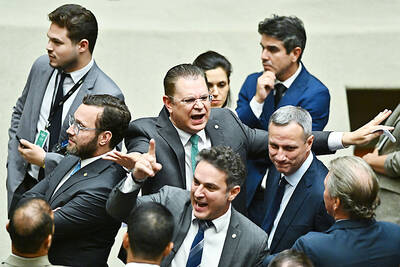
PARLIAMENT CHAOS: Police forcibly removed Brazilian Deputy Glauber Braga after he called the legislation part of a ‘coup offensive’ and occupied the speaker’s chair Brazil’s lower house of Congress early yesterday approved a bill that could slash former Brazilian president Jair Bolsonaro’s prison sentence for plotting a coup, after efforts by a lawmaker to disrupt the proceedings sparked chaos in parliament. Bolsonaro has been serving a 27-year term since last month after his conviction for a scheme to stop Brazilian President Luiz Inacio Lula da Silva from taking office after the 2022 election. Lawmakers had been discussing a bill that would significantly reduce sentences for several crimes, including attempting a coup d’etat — opening up the prospect that Bolsonaro, 70, could have his sentence cut to
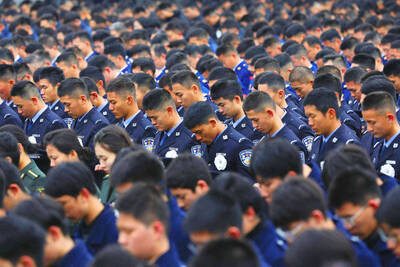
China yesterday held a low-key memorial ceremony for the 1937 Nanjing Massacre, with Chinese President Xi Jinping (習近平) not attending, despite a diplomatic crisis between Beijing and Tokyo over Taiwan. Beijing has raged at Tokyo since Japanese Prime Minister Sanae Takaichi last month said that a hypothetical Chinese attack on Taiwan could trigger a military response from Japan. China and Japan have long sparred over their painful history. China consistently reminds its people of the 1937 Nanjing Massacre, in which it says Japanese troops killed 300,000 people in what was then its capital. A post-World War II Allied tribunal put the death toll
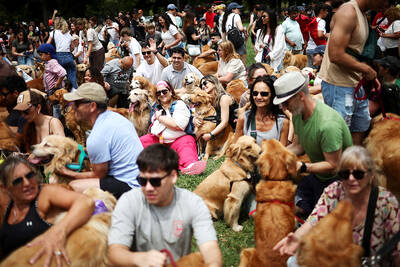
A passerby could hear the cacophony from miles away in the Argentine capital, the unmistakable sound of 2,397 dogs barking — and breaking the unofficial world record for the largest-ever gathering of golden retrievers. Excitement pulsed through Bosques de Palermo, a sprawling park in Buenos Aires, as golden retriever-owners from all over Argentina transformed the park’s grassy expanse into a sea of bright yellow fur. Dog owners of all ages, their clothes covered in dog hair and stained with slobber, plopped down on picnic blankets with their beloved goldens to take in the surreal sight of so many other, exceptionally similar-looking ones.

‘UNWAVERING ALLIANCE’: The US Department of State said that China’s actions during military drills with Russia were not conducive to regional peace and stability The US on Tuesday criticized China over alleged radar deployments against Japanese military aircraft during a training exercise last week, while Tokyo and Seoul yesterday scrambled jets after Chinese and Russian military aircraft conducted joint patrols near the two countries. The incidents came after Japanese Prime Minister Sanae Takaichi triggered a dispute with Beijing last month with her remarks on how Tokyo might react to a hypothetical Chinese attack on Taiwan. “China’s actions are not conducive to regional peace and stability,” a US Department of State spokesperson said late on Tuesday, referring to the radar incident. “The US-Japan alliance is stronger and more


 RSS
RSS