


Women in India’s capital are taking self-defense classes, snapping up pepper sprays, booking cabs with female drivers or leaving work early, all signs of growing insecurity following the brutal gang rape and murder of a student last month.
The assault on the 23-year-old — who was raped by six people and tortured with an iron bar on a bus, then left bleeding on a highway — stunned the nation and generated an unprecedented wave of protests calling for better security for women.
In response to the public outrage, authorities have initiated several measures to instill confidence, but many women say they cannot rely on India’s often gender-insensitive and under-resourced police force to ensure their security.
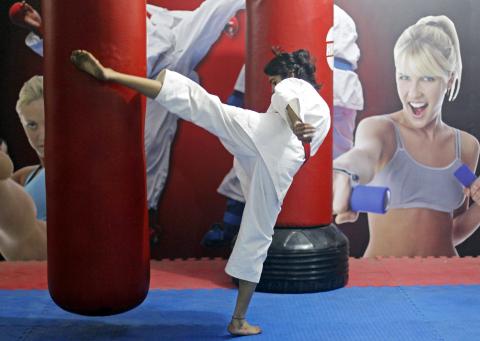
Photo: Reuters
“It’s no secret that Delhi is unsafe for women. A lot of us have known it for a long time, but this case has brought things to light,” said Sunanda Jalote, 18, a psychology student, attending her first self-defense class with Invictus Survival Sciences in South Delhi.
“It really has hit the confidence of women in the city. We don’t want to feel like that. We want to be able to go out wherever we want, at any time of day or night, and feel safe. So you have to learn how to defend yourself,” Jalote added.
New Delhi, with a burgeoning population of 16 million, has the unsavory reputation of being the country’s “rape capital,” recording more rapes annually than any other Indian city.
There were 706 rapes reported last year, a 23 percent rise from the previous year, according to the Delhi police, while molestation cases rose by 11 percent to 727.
Private companies running self-defense classes in the capital say they have had a flurry of requests since the Dec. 16 attack.
“Since the incident happened, the number of inquiries and enrolments has shot up considerably ... by about 40 percent,” said Ankur Sharma, senior instructor at Invictus, adding that most are from female students or professional women between the ages of 18 and 35.
Sharma added that many business process outsourcing (BPO) companies, especially those that employ women working late shifts, have been booking week-long self-defense workshops for their employees.
A survey conducted by the Associated Chambers of Commerce and Industry of India earlier this month found that 80 percent of women working in Delhi’s BPO/IT sectors were leaving work earlier than usual, affecting work productivity.
The poll, which questioned 2,500 women in the capital and its environs, said most women feared taking public transport such as buses, auto-rickshaws or the subway after sunset.
This is reinforced by the surge in bookings of taxi operator “Sakha Cab Services,” a women-only taxi service with female drivers, which says the number of cab bookings has increased by 35 percent over the last month.
For those who cannot afford private taxis or self-defense classes, pepper spray has been the answer.
Grocery stores, chemists and even cosmetic shops in Delhi’s centrally located Connaught Place say the brightly colored spray cans have been flying off shelves since the gang rape, selling up to five times more than usual.
Authorities in Delhi have announced a raft of measures to help women feel safer on the city’s streets.
These include a 24-hour helpline for women in distress, instructions to all BPOs to ensure female employees return home from work safely, more policing on the streets and a crackdown on drunk driving.
However, women like student Sunanda Jalote remain unconvinced.
“Women have to learn to defend themselves,” she said in between learning how to kick her partner in the crotch at a self-defense class. “We don’t want to have to wear a burqa in order to go out and feel safe.”

‘CROSSING THE LINE’: China’s embassy in Seoul criticized US Forces Korea Commander General Xavier Brunson, asking if his ‘hostile’ remarks were authorized by Washington South Korea and the US are in talks over recent public remarks by the commander of US Forces Korea, Seoul’s presidential office said yesterday, after the comments drew sharp criticism from China. In a recent podcast interview, US Forces Korea Commander General Xavier Brunson described South Korea as “the dagger in the heart of Asia” from China’s east coast, prompting the Chinese embassy in Seoul to say that he had “truly crossed the line.” The interview came amid growing speculation that Washington might seek to expand the role of US Forces Korea in countering the growing regional influence of China, a key

SEEKING ORDER: Rodrigo Paz said that ‘anyone who wants to destroy the nation will have to deal with this president and the full force of the constitution’ Bolivian President Rodrigo Paz on Wednesday said that the nation was at a “breaking point” after nearly a month of protests that have caused shortages of food, fuel and medicine. Paz, who took office six months ago amid the worst economic crisis there in four decades, is battling a groundswell of fury over his policies. The political capital, La Paz, has been besieged by low-income workers and members of the indigenous majority calling for his resignation. “The country needs order and is reaching breaking point,” the 58-year-old said at a public event in La Paz, renewing his appeal for dialogue. On Tuesday, the Bolivian

Australian researchers have trained lab-grown brain cells on a silicon computer chip to play the 1990s shooter game Doom and said they are just scratching the surface of what the neurons could be capable of doing. It is the science-fiction work of biotech boffins at Cortical Labs, who researched and developed the technology that harnesses the workings of the brain’s networking system. Each so-called “biological computer” contains about 200,000 living human brain cells, grown from stem cells that were harvested from blood donations. Having mastered the simple computer game Pong, where a paddle is moved up and down to send a ball

Through the noise of rushing papers and whirring belts at a print factory in Kyoto, two creators watch their photo essay come to life in broadsheet form — part of an effort to win new audiences in the age of artificial intelligence (AI). Despite the decline of the publishing industry, self-publication and handmade “zine” magazines are growing in popularity in Japan, reflecting the nation’s enduring love of paper in the digital era. While speaking to Agence France-Presse at the plant, his hands black with ink, one of the creators, Kazuma Obara, said: “I think [paper] is a medium that engages all five


 RSS
RSS