


North Korean leader Kim Jong-un yesterday called for a “radical turnabout” in the impoverished country’s economy in a rare New Year’s address that also appeared to offer an olive branch to South Korea.
Kim’s speech was the first of its kind for 19 years, since the death of his grandfather and the North’s founding president, Kim Il-sung.
Kim’s father and the country’s previous ruler, Kim Jong-il, never made a major address to his people.
This year will be one of “great creations and changes in which a radical turnabout will be effected,” Kim Jong-un said, adding that “the building of an economic giant is the most important task” facing the country.
Praising the success of the country’s scientists in launching a long-range rocket last month, he said a similar national effort was now needed on the economic front.
“The entire party, the whole country and all the people should wage an all-out struggle this year to effect a turnaround in building an economic giant and improving the people’s standard of living,” he said.
However, he offered no specifics for how this might be achieved by the isolated state, which is already under multiple sanctions and relies on its sole major ally China for 70 percent of its foreign trade.
When Kim Jong-il died in 2011 he left a country in dire economic straits — the result of a “military first” policy that fed an ambitious missile and nuclear program at the expense of a malnourished population.
Despite a rise in staple food output, daily life for millions is an ongoing struggle with under-nutrition, according to a recent World Food Programme report.
The address will be closely scrutinized in South Korea, which has just elected its first female president, the conservative Park Geun-hye, who has signaled a desire for greater engagement with Pyongyang.
Kim Jong-un’s tone was conciliatory as he urged a scaling down of tensions between the two Koreas, who remain technically at war.
“An important issue in putting an end to the division of the country and achieving its reunification is to remove confrontation between the North and the South,” he said. “The past records of inter-Korean relations show that confrontation between fellow countrymen leads to nothing but war.”
The South’s president-elect, Park, has distanced herself from outgoing South Korean President Lee Myung-bak’s hardline policy towards Pyongyang.
In her first policy statement following her election victory last month, Park made it clear she still saw Pyongyang as a serious threat and would put national security before any trust-building program.
South Korean Unification Minister Yu Woo-ik said the North should not test the patience of the international community with missile and nuclear programs.
Kim Jong-un made it clear that building the economy did not mean a complete shift away from his father’s “military first” policy.
“The military might of a country represents its national strength. Only when it builds up its military might in every way can it develop into a thriving country,” he said.
The UN Security Council is still considering whether to punish Pyongyang for its rocket launch, which most of the world saw as a disguised ballistic missile test.
The speech lauded the launch as a historic national achievement and stressed the need to develop more “sophisticated military hardware.”
However, Kim Jong-un made no mention of the North’s nuclear weapons program, despite growing speculation that Pyongyang is preparing to conduct a nuclear test following the rocket success.
Yang Moo-jin, a professor at Seoul’s University of North Korean Studies, said the general tone of the speech was positive.
“It might signal limited economic reforms this year and also sends a message to South Korea’s incoming president about a desire for improved cross-border relations,” Yang said.
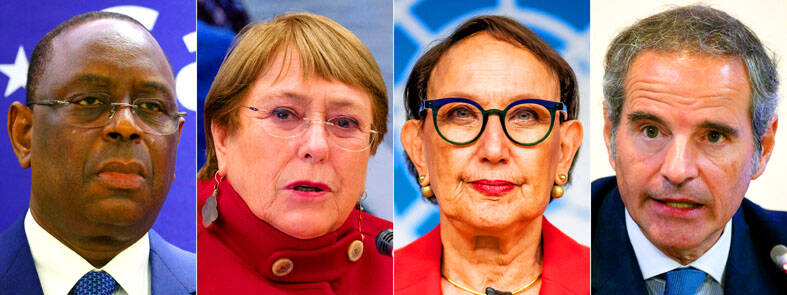
Four contenders are squaring up to succeed Antonio Guterres as secretary-general of the UN, which faces unprecedented global instability, wars and its own crushing budget crisis. Chile’s Michelle Bachelet, Argentina’s Rafael Grossi, Costa Rica’s Rebeca Grynspan and Senegal’s Macky Sall are each to face grillings by 193 member states and non-governmental organizations for three hours today and tomorrow. It is only the second time the UN has held a public question-and-answer, a format created in 2016 to boost transparency. Ultimately the five permanent members of the UN’s top body, the Security Council, hold the power, wielding vetoes over who leads the

South Korea’s air force yesterday apologized for a 2021 midair collision involving two fighter jets, a day after auditors said the pilots were taking selfies and filming during the flight and held them responsible for the accident. “We sincerely apologize to the public for the concern caused by the accident that occurred in 2021,” an air force spokesman told a news conference, adding that one of the pilots involved had been suspended from flying duties, received severe disciplinary action and has since left the military. The apology followed a report released on Wednesday by the South Korean Board of Audit and Inspection,

Young Chinese, many who fear age discrimination in their workplace after turning 35, are increasingly starting “one-person companies” that have artificial intelligence (AI) do most of the work. Smaller start-ups are already in vogue in Silicon Valley and elsewhere, with rapidly advancing AI tools seen as a welcome teammate even as they threaten layoffs at existing firms. More young people in China are subscribing to the model, as cities pledge millions of dollars in funding and rent subsidies for such ventures, in alignment with Beijing’s political goal of “technological self-reliance.” “The one-person company is a product of the AI era,” said Karen Dai

About 240 Indians claiming descent from a Biblical tribe landed at Tel Aviv airport on Thursday as part of a government operation to relocate them to Israel. The newcomers passed under a balloon arch in blue and white, the colors of the Israeli flag, as dozens of well-wishers welcomed them with a traditional Jewish song. They were the first “bnei Menashe” (“sons of Manasseh”) to arrive in Israel since the government in November last year announced funding for the immigration of about 6,000 members of the community from the states of Manipur and Mizoram in northeast India. The community claims to descend from


 RSS
RSS