


Newly appointed Japanese Prime Minister Shinzo Abe has voiced his willingness to build new nuclear reactors despite widespread public opposition to atomic energy since the 2011 crisis at the Fukushima Dai-ichi nuclear power plant, reports said yesterday.
During an interview on Sunday with television network TBS, Abe said new reactors would be different from those at the Fukushima plant that were crippled by the earthquake and tsunami of 2011, major news outlets reporterd.
“New reactors will be totally different from the ones built 40 years ago, those at the Fukushima Dai-ichi plant that caused the crisis,” Abe was quoted by the Mainichi Shimbun daily as saying.
It was the first time since Abe took office on Wednesday last week that he has voiced support for new reactors, although his pro-business government had been widely expected to restart Japan’s stalled nuclear program.
The day after being installed, his administration began signaling an about-face on the previous government’s policy of working toward a phasing out of atomic power.
Abe’s conservative Liberal Democratic Party (LDP) won a landslide victory in an election last month with promises to revive the economy. It benefited from voters’ desire to punish the previous administration of former Japanese prime minister Yoshihiko Noda.
While most major parties in the poll set their stalls against nuclear power, none gained enough electoral weight to counter the LDP.
The LDP remained vague on the issue in its manifesto, pledging to “decide” on restarts within three years. Currently, all but two of Japan’s 50 reactors are shuttered for safety checks and must get the blessing of a new regulator before being restarted.
In the interview, Abe did not clarify when or where new reactors might be built. He took pains to say that only the Fukushima reactors had been damaged by the magnitude 9 earthquake-triggered tsunami, while other regional power plants were undamaged.
He reportedly reiterated a belief that the election reflected the electorate’s trust in the LDP’s policies.
“The public seem worried about how we can meet the immediate demand for electricity,” Abe said.
“That’s why voters did not trust [candidates] who played word games, like pushing for ‘ending’ nuclear power or ‘graduating’ from nuclear power,” the Yomiuri Shimbun quoted Abe as saying.
Abe’s remarks came the day after he visited the wrecked Fukushima Dai-ichi plant, where operator Tokyo Electric Power has thousands of workers trying to contain the mess left by reactor meltdowns.
During the visit, Abe said the clean-up was “an unprecedented challenge in human history.”
The government and the power company expect to spend more than 30 years decommissioning the crippled reactors, which spewed out radioactive materials over a wide area and forced tens of thousands of people to evacuate their homes.
LDP critics have said that the party is partly responsible for the extent of the Fukushima catastrophe because of the culture of complicity it oversaw during its more than five-decade rule.

An American scientist convicted of lying to US authorities about payments from China while he was at Harvard University has rebuilt his research lab in Shenzhen, China, to pursue technology the Chinese government has identified as a national priority: embedding electronics into the human brain. Charles Lieber, 67, is among the world’s leading researchers in brain-computer interfaces. The technology has shown promise in treating conditions such as amyotrophic lateral sclerosis and restoring movement in paralyzed people. It also has potential military applications: Scientists at the Chinese People’s Liberation Army have investigated brain interfaces as a way to engineer super soldiers by boosting
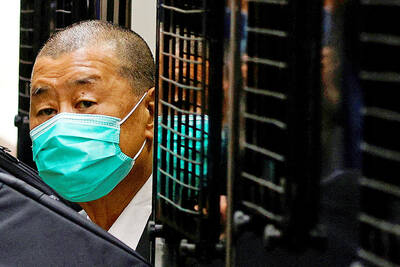
Jailed media entrepreneur Jimmy Lai (黎智英) has been awarded Deutsche Welle’s (DW) freedom of speech award for his contribution to Hong Kong’s pro-democracy movement. The German public broadcaster on Thursday said Lai would be presented in absentia with the 12th iteration of the award on June 23 at the DW Global Media Forum in Bonn. Deutsche Welle director-general Barbara Massing praised the 78-year-old founder of the now-shuttered news outlet Apple Daily for standing “unwaveringly for press freedom in Hong Kong at great personal risk.” “With Apple Daily, he gave journalists a platform for free reporting and a voice to the democracy movement in
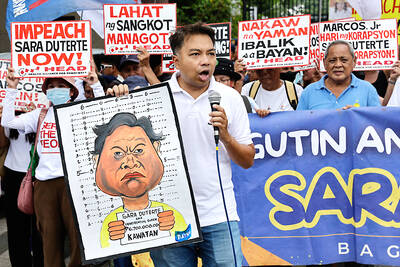
PHILIPPINE COMMITTEE: The head of the committee that made the decision said: ‘If there is nothing to hide, there is no reason to hide, there is no reason to obstruct’ A Philippine congressional committee on Wednesday ruled that there was “probable cause” to impeach Philippine Vice President Sara Duterte after hearing allegations of unexplained wealth, misuse of state funds and threats to have the president assassinated. The unanimous decision of the 53-member committee in the Philippine House of Representatives sends the two impeachment complaints to deliberations and voting by the entire lower chamber, which has more than 300 lawmakers. The complaints centered on Duterte’s alleged illegal use and mishandling of intelligence funds from the vice president’s office, and from her time as education secretary under Philippine President Ferdinand Marcos Jr. Duterte and the

Burmese President Min Aung Hlaing yesterday cut all prisoners’ sentences by one-sixth, a blanket measure that a source close to deposed leader Aung San Suu Kyi said would further shorten her detention. Aung San Suu Kyi has been sequestered since a 2021 military coup, but the senior member of her dissolved National League for Democracy (NLD) party said that while her term had been reduced, her remaining sentence is still unclear. “We also don’t know exactly how many years she has left,” the source told reporters, speaking on condition of anonymity for security reasons. The military toppled Aung San Suu Kyi’s elected government


 RSS
RSS