


Russia’s lower house of parliament has given final approval to a contentious bill that retaliates against a new US human rights measure by barring Americans from adopting the country’s children.
Washington swiftly slammed the move, saying Russian children would be harmed by the measure.
The State Duma passed the bill without debate in a quick 420-7 vote on Friday, while protesters picketed the building, demanding that the measure be voted down.
However, the vote took place in a largely ceremonial third and final reading of the legislation, and its outcome was never in doubt.
“We regret the results of today’s Duma vote,” US Ambassador to the Russian Federation Michal McFaul tweeted shortly after the decision.
He told the Interfax news agency separately that the US was “extremely concerned” by the law’s provisions.
The Kremlin-dominated upper house is now expected to approve the ban on Wednesday before passing it on to Russian President Vladimir Putin for his signature.
The Russian leader has indicated he is ready to put his name on the measure so that it could enter law on Jan. 1.
The measure, which underscores the severity of the recent strain in Russia-US ties, would end about 1,000 adoptions a year.
Caregivers in particular fear that the new rules are to hit the most disadvantaged children, because foreign adoptive parents are often ready to adopt kids rejected by Russian families.
Acting US Department of State spokesman Patrick Ventrell said the bill would ultimately have the effect of keeping Russian children from growing up in loving households in the US.
“What this would do is prevent children from growing up in a family environment of happiness, love and understanding,” he said. “And so that’s the basic premise of our bilateral adoption agreement. It’s something we’ve worked for many months with the Russians on. And so really it’s Russian children who would be harmed by this measure.”
The affair has also highlighted Cabinet splits between those who subscribe to strong anti-US rhetoric and those who prefer to cast Moscow as a more reasoned partner.

ACTIONABLE ADVICE: The majority of chatbots tested provided guidance on weapons, tactics and target selections, with Perplexity and Meta AI deemed to be the least safe From school shootings to synagogue bombings, leading artificial intelligence (AI) chatbots helped researchers plot violent attacks, according to a study published on Wednesday that highlighted the technology’s potential for real-world harm. Researchers from the nonprofit watchdog Center for Countering Digital Hate and CNN posed as 13-year-old boys in the US and Ireland to test 10 chatbots, including ChatGPT, Google Gemini, Perplexity, Deepseek and Meta AI. Eight of the chatbots assisted the make-believe attackers in more than half the responses, providing advice on “locations to target” and “weapons to use” in an attack, the study said. The chatbots had become a “powerful accelerant for

Australians were downloading virtual private networks (VPNs) in droves, while one of the world’s largest porn distributors said it was blocking users from its platforms as the country yesterday rolled out sweeping online age restriction. Australia in December became the first country to impose a nationwide ban on teenagers using social media. A separate law now requires artificial intelligence (AI)-powered chatbot services to keep certain content — including pornography, extreme violence and self-harm and eating disorder material — from minors or face fines of up to A$49.5 million (US$34.6 million). The country also joined Britain, France and dozens of US states requiring

Since the war in the Middle East began nearly two weeks ago, the telephone at Ron Hubbard’s bomb shelter company in Texas has not stopped ringing. Foreign and US clients are rushing to buy his bunkers, seeking refuge in case of air raids, nuclear fallout or apocalypse. With the US and Israel pounding Iran, and Tehran retaliating with strikes across the region, Hubbard has seen demand for his product soar, mostly from Gulf nation customers in Bahrain, Qatar, Kuwait and the United Arab Emirates. “You can imagine how many people are thinking: ‘I wish I had a bomb shelter,’” Hubbard, 63, said in
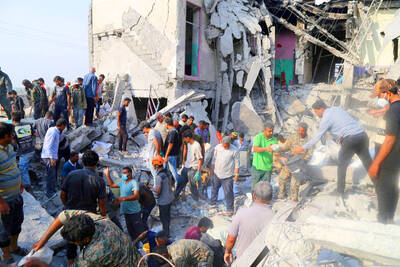
STILL IN POWER: US intelligence reports showed that the Iranian regime is not in danger of collapse and retains control of the public, casting doubt on Trump’s exit Nearly every US Senate Democrat on Wednesday signed a letter sent to US Secretary of Defense Pete Hegseth requesting a “swift investigation” of airstrikes on a girls’ school in Iran that killed scores of children and any other potential US military actions causing civilian harm. Reuters reported on Thursday last week that US military investigators believe it is likely that US forces were responsible for the Feb. 28 strike on the school, as US and Israeli forces launched attacks on Iran. “The results of this school attack are horrific. The majority of those killed in the strikes were girls between the ages


 RSS
RSS