


From a devilish-looking bat to a frog that sings like a bird, scientists have identified 126 new species in the Greater Mekong area, the WWF said yesterday in a new report detailing discoveries made last year.
However, from deforestation to the construction of major hydropower projects on the Mekong River, existing threats to the region’s biodiversity mean many of the new species are already struggling to survive, the conservation group warned.
“The good news is new discoveries. The bad news is that it is getting harder and harder in the world of conservation and environmental sustainability,” Nick Cox, manager of WWF-Greater Mekong’s Species Program, told reporters.
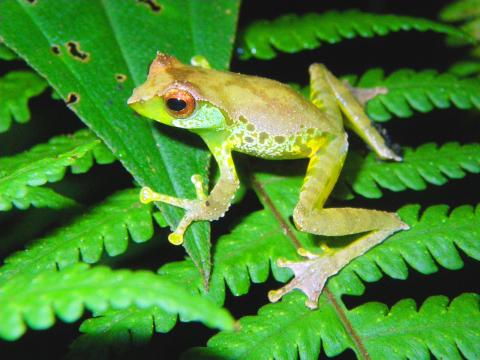
Photo: AFP / WWF / JODI J.L. ROWLEY / AUSTRALIAN MUSEUM
About 126 species were newly recorded last year in the Greater Mekong region, which consists of Thailand, Cambodia, Myanmar, Vietnam, Laos and the southwestern Chinese province of Yunnan.
Some, such as the Beelzebub tube-nosed bat discovered in Vietnam, depend on tropical forests for survival and so are especially vulnerable to deforestation.
In just four decades, 30 percent of the Greater Mekong’s forests have disappeared, the report says.
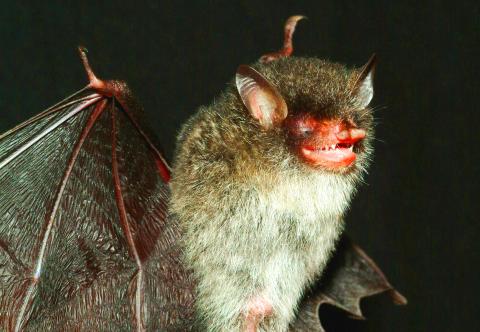
Photo: AFP / World Wide Fund for Nature (WWF) / GABOR CSORBA
Others, such as a short-tailed python species found in Myanmar, are more at risk from illegal hunting for meat, skins and the exotic pet trade, the report added.
“Poaching for the illegal wildlife trade poses one of the greatest threats to the existence of many species across Southeast Asia,” Cox said in a statement accompanying the report.
The list, dominated by plants, included 21 reptiles and five amphibians, such as a frog that sings and another that has black-and-white eye patterns that look like yin and yang symbols.
The WWF said that while the number of new species discovered was testament to the region’s astounding biodiversity, there had been some “worrying developments” that posed a threat to their future.
WWF singled out Laos’ determination to construct the Xayaburi Dam on the main stream of the Mekong River as a significant threat to the river’s “extraordinary biodiversity” and the livelihoods of more than 60 million people.
“The Mekong River supports levels of aquatic biodiversity second only to the Amazon River,” Cox said. “The Xayaburi Dam would prove an impassable barrier for many fish species, signaling the demise for wildlife already known and as yet undiscovered.”
The Mekong River supports about 850 fish species and the world’s most intensive inland fishery, the report said.
Last month, Laos said it had begun work on the controversial multi-billion US dollar Xayaburi Dam, defying objections from environmentalists in its bid to become a regional energy hub.

It began as a satirical online project. Now millions of young people in India are flocking to it as an outlet for their frustration. A parody political party called the Cockroach Janta Party, with the insect as its symbol, has exploded across India’s social media by turning absurdist humor into protest. Memes and short videos mocking corruption, joblessness and political dysfunction have flooded social media sites, where millions of users are embracing the cockroach — known for its ability to survive harsh conditions — as a tongue-in-cheek symbol of endurance. The online movement’s rise has been unusually rapid. The Cockroach Janta Party (CJP)

SPEAKING OUT: After Siranudh Scott’s allegations surfaced, celebrities and public figures took to social media to share their own experiences of sexual misconduct and abuse A high-profile alleged sexual abuse case within a wealthy Thai beer brewing family has prompted a wave of painful accounts from survivors of unconnected abuse in the conservative nation. Siranudh Scott, a member of the billionaire Thai family that founded the ubiquitous Singha beer brand, posted an emotional video this month accusing his elder brother Sunit of repeatedly abusing him when he was a teenager. Sunit, who is in his 30s, later denied the allegations in a video posted online, but Singha parent Boonrawd dismissed him from his executive role with the company on Tuesday last week. “I felt I needed to speak

A Hong Kong astronaut is to join a Chinese space mission for the first time as part of a three-person crew launching today, as Beijing edges closer to its goal of landing people on the moon. The Tiangong space station — crewed by teams of three astronauts that are typically rotated every six months — is the crown jewel of China’s space program, boosted by billions in state investment in a bid to catch up with the US and Russia. The Shenzhou-23 mission is to blast off at 11:08pm from the Jiuquan Satellite Launch Center in northwestern China, carrying three astronauts to

UPGRADED ALERT: The risk inside DR Congo is now considered ‘very high,’ while neighboring countries face a ‘high’ threat as the outbreak continues, the WHO said Ebola is spreading faster than responders can track it in eastern Congo, where health workers managed to follow up with barely one in five identified contacts in a single day. Authorities in the Democratic Republic of the Congo (DR Congo) reported 83 confirmed infections, 746 suspected cases and 1,603 identified contacts as of Thursday, but health workers were able to follow up on only 342 contacts that day — about 21 percent of the total under monitoring — data released by the DR Congo Ministry of Public Health on Friday showed. The figures suggest the response is falling behind the outbreak itself,


 RSS
RSS