


Islamists rallied yesterday in support of Egyptian President Mohamed Morsi’s new expanded powers and the drafting of a contested charter, in a clear show of Egypt’s deepening polarization.
The demonstration in the heart of Cairo comes a day after tens of thousands of Morsi opponents converged on Tahrir Square in the city to protest against the president’s decree and the speedy adoption of the draft constitution.
The charter has taken center stage in the country’s worst political crisis since Morsi’s election in June, squaring largely Islamist forces against secular-leaning opponents.

Photo: AFP
It is expected to go to a popular referendum within two weeks.
Members of the constituent assembly were due to hand Morsi at 4pm the final draft of the constitution adopted after a marathon overnight session on Thursday that was boycotted by liberals, seculars and Christians.
By mid-morning, hundreds of pro-Morsi demonstrators, including from the Muslim Brotherhood, on whose ticket Morsi ran for office, and other hardline Salafist groups gathered at Cairo University, with riot police on standby and roadblocks in place.
“The Muslim Brotherhood supports President Morsi’s decisions,” read a banner carried by Islamists, who chanted: “The people want the implementation of God’s law.”
Veiled women ullulated among the protesters, with banners reading “Together [with Morsi] to save the revolution.”
“There are people who want instability,” said demonstrator Khaled, referring to anti-Morsi protesters. “There needs to be a constitution for there to be stability.”
The Muslim Brotherhood and their supporters have branded the opposition as enemies of the revolution that toppled former longtime Egyptian president Hosni Mubarak last year.
Across the Nile river, hundreds of protesters camping out in Tahrir Square since Morsi issued a decree expanding his powers were expected to be joined by more demonstrators throughout the day.
The National Rescue Front — a coalition of opponents led by dissident former UN nuclear watchdog head Mohamed ElBaradei, ex-Arab League head Amr Mussa and former presidential candidate Hamdeen Sabbahi — has called on the decree’s opponents to keep up the pressure.
It has called on Egyptians to “reject the illegitimate” decree and the “void” draft constitution, and stressed the public’s right “to use any peaceful method to protest, including a general strike and civil disobedience.”
The crisis was sparked when Morsi issued the decree on Nov. 22 giving himself sweeping powers and placing his decisions beyond judicial review, provoking mass protests and a judges’ strike.
His decree prevented the top legal body, the Supreme Constitutional Court, from potentially dissolving the Islamist-run constituent assembly, in a ruling it was to make today on the body’s legality.
“Rushing through a draft while serious concerns about key rights protections remain unaddressed will create huge problems,” said Joe Stork of Human Rights Watch.
Amnesty International said the draft “raises concerns about Egypt’s commitment to human rights treaties,” specifically ignoring “the rights of women [and] restricting freedom of expression in the name of religion.”
In an interview broadcast on Thursday night, Morsi stressed again that his new powers would expire once the constitution was ratified, a point which Islamist supporters have repeatedly made in favor of his decree last week.

An American scientist convicted of lying to US authorities about payments from China while he was at Harvard University has rebuilt his research lab in Shenzhen, China, to pursue technology the Chinese government has identified as a national priority: embedding electronics into the human brain. Charles Lieber, 67, is among the world’s leading researchers in brain-computer interfaces. The technology has shown promise in treating conditions such as amyotrophic lateral sclerosis and restoring movement in paralyzed people. It also has potential military applications: Scientists at the Chinese People’s Liberation Army have investigated brain interfaces as a way to engineer super soldiers by boosting
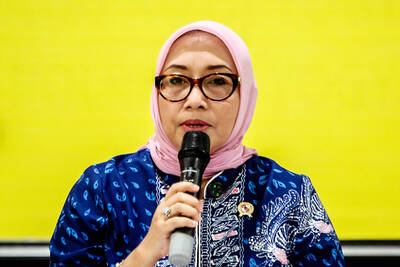
Indonesian police have arrested 13 people after shocking images of alleged abuse against small children at a daycare center went viral, sparking outrage across the nation, officials said on Monday. Police on Friday last week raided Little Aresha, a daycare center in Yogyakarta on Java island, following a report from a former employee. CCTV footage circulating on social media showed children, most younger than two, lying on the floor wearing only diapers, their hands and feet bound with rags. The police have confirmed that the footage is authentic. Police said they also found 20 children crammed into a room just 3m by 3m. “So
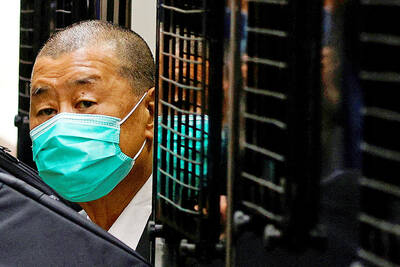
Jailed media entrepreneur Jimmy Lai (黎智英) has been awarded Deutsche Welle’s (DW) freedom of speech award for his contribution to Hong Kong’s pro-democracy movement. The German public broadcaster on Thursday said Lai would be presented in absentia with the 12th iteration of the award on June 23 at the DW Global Media Forum in Bonn. Deutsche Welle director-general Barbara Massing praised the 78-year-old founder of the now-shuttered news outlet Apple Daily for standing “unwaveringly for press freedom in Hong Kong at great personal risk.” “With Apple Daily, he gave journalists a platform for free reporting and a voice to the democracy movement in
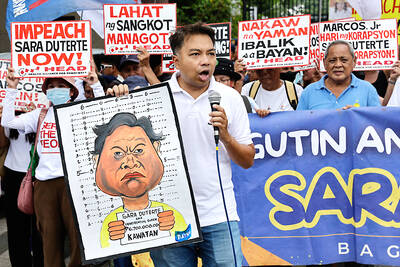
PHILIPPINE COMMITTEE: The head of the committee that made the decision said: ‘If there is nothing to hide, there is no reason to hide, there is no reason to obstruct’ A Philippine congressional committee on Wednesday ruled that there was “probable cause” to impeach Philippine Vice President Sara Duterte after hearing allegations of unexplained wealth, misuse of state funds and threats to have the president assassinated. The unanimous decision of the 53-member committee in the Philippine House of Representatives sends the two impeachment complaints to deliberations and voting by the entire lower chamber, which has more than 300 lawmakers. The complaints centered on Duterte’s alleged illegal use and mishandling of intelligence funds from the vice president’s office, and from her time as education secretary under Philippine President Ferdinand Marcos Jr. Duterte and the


 RSS
RSS