


US President Barack Obama laid out his second-term agenda on Wednesday, expressing a willingness to work with Republicans in the US Congress and a resolve to defy them if necessary.
In his first full-scale news conference since March, Obama said he was willing to compromise with Republicans to forge a deal on the nation’s debt and taxes to avoid the “fiscal cliff,” a combination of budget cuts and tax increases that will kick in next year if such an agreement is not reached.
However, he said he would not abandon his campaign pledge to allow tax cuts on the top 2 percent of US earners to expire.
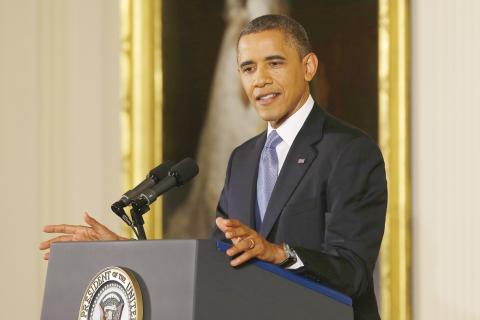
Photo: AFP
After a re-election campaign that critics said offered few details of his vision for the next four years, Obama discussed his priorities on policies from immigration to climate change during an hour-long press conference.
The president was relaxed, bantered with reporters who challenged him and expressed gratitude for having the chance to be in the White House for another four years.
“I don’t have another election, and Michelle and I were talking last night about what an incredible honor and privilege it is to be put in this position,” he said, referring to his wife.
Critics of his first term say Obama did not do enough to reach out to lawmakers, particularly Republicans who still hold a majority in the US House of Representatives. Obama took a conciliatory tone toward Congress while sticking to his positions on issues that divide Democrats and Republicans, including tax rates and reducing the budget deficit.
“Look, I think there’s no doubt that I can always do better and so I will examine ways that I can make sure to communicate my desire to work with everybody, so long as it’s advancing the cause of strengthening our middle class and improving our economy,” he said.
His conciliatory tone broke down when asked about US senators John McCain and Lindsey Graham’s criticism of UN Ambassador Susan Rice — a contender to succeed US Secretary of State Hillary Rodham Clinton — saying they would not support her nomination for a Cabinet post because she made misleading statements about the September attack on the US consulate in Benghazi, Libya, that killed four Americans.
“For them to go after the UN ambassador, who had nothing to do with Benghazi and was simply making a presentation based on intelligence that she had received, and to besmirch her reputation is outrageous,” Obama said.
If he decided Rice was the best person to succeed Clinton at the Department of State, he would nominate her, Obama said, adding: “That’s not a determination that I’ve made yet.”
The controversy over former CIA director David Petraeus’ extramarital affair and subsequent resignation dominated the initial questions for the president, who said the former four-star general had an “extraordinary career” and served the US with distinction.
On fiscal matters, Obama did not go so far as to claim a strong mandate to push through everything he wanted.
“I’ve got a mandate to help middle-class families and families that are working hard to try to get into the middle class,” Obama said. “That’s my mandate. That’s what the American people said.”
“I don’t presume that because I won an election that everybody suddenly agrees with me on everything,” he added. “I’m more than familiar with all the literature about presidential overreach in second terms. We are very cautious about that.”
However, Obama was not cautious about putting timetables on the policy priorities he has set for his second term.
He said he expects to introduce a bill in Congress on comprehensive immigration reform “very soon” after his January inauguration, and he promised to engage scientists, engineers and elected officials in a conversation about reducing carbon emissions in the coming weeks and months.
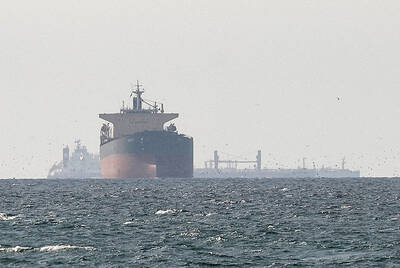
A ship that appears to be taking on the identity of a scrapped gas carrier exited the Strait of Hormuz on Friday, showing how strategies to get through the waterway are evolving as the Middle East war progresses. The vessel identifying as liquefied natural gas (LNG) carrier Jamal left the Strait on Friday morning, ship-tracking data show. However, the same tanker was also recorded as having beached at an Indian demolition yard in October last year, where it is being broken up, according to market participants and port agent’s reports. The ship claiming to be Jamal is likely a zombie vessel that
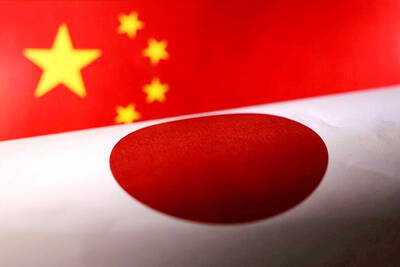
Japan is to downgrade its description of ties with China from “one of its most important” in an annual diplomatic report, according to a draft reviewed by Reuters, as relations with Beijing worsen. This year’s Diplomatic Bluebook, which Japanese Prime Minister Sanae Takaichi’s government is expected to approve next month, would instead describe China as an important neighbor and the relationship as “strategic” and “mutually beneficial.” The draft cites a series of confrontations with Beijing over the past year, including export controls on rare earths, radar lock-ons targeting Japanese military aircraft and increased pressure around Taiwan. The shift in tone underscores a deterioration
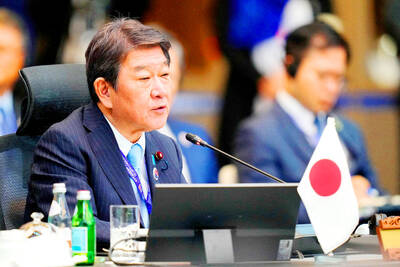
LAW CONSTRAINTS: The US has been pressing allies to send warships to open the Strait, but Tokyo’s military actions are limited under its postwar pacifist constitution Japan could consider deploying its military for minesweeping in the Strait of Hormuz if a ceasefire is reached in the war on Iran, Japanese Minister of Foreign Affairs Toshimitsu Motegi said yesterday. “If there were to be a complete ceasefire, hypothetically speaking, then things like minesweeping could come up,” Motegi said. “This is purely hypothetical, but if a ceasefire were established and naval mines were creating an obstacle, then I think that would be something to consider.” Japan’s military actions are limited under its postwar pacifist constitution, but 2015 security legislation allows Tokyo to use its Self-Defense Forces overseas if an attack,

German Chancellor Friedrich Merz’s conservative Christian Democratic Union (CDU) yesterday faced a regional election battle in Rhineland-Palatinate, now held by the center-left Social Democratic Party (SPD). Merz’s CDU has enjoyed a narrow poll lead over the SPD — their coalition partners at the national level — who have ruled the mid-sized state for 35 years. Polling third is the far-right Alternative for Germany (AfD), which spells a greater threat to the two centrist parties in several state elections in September in the country’s ex-communist east. The picturesque state of Rhineland-Palatinate, bordering France, Belgium and Luxembourg and with a population of about 4 million,


 RSS
RSS