


The Syrian regime may be their sworn enemy, but rebels fighting to bring down Syrian President Bashar al-Assad say they pay hard cash to government agents for guns and bullets.
For Syria’s plethora of armed opposition groups, obtaining weapons is a constant struggle. Furious with the West for failing to provide heavy weaponry, they say they have little choice but to line al-Assad’s coffers.
In a country where national service is compulsory, and a conflict where brothers fight on opposing sides and rebels defect from the armed forces, they say it is not difficult to find a “middleman” or an “old friend” to help.

Photo: Reuters
“We buy from al-Assad spies and on the market,” Major Abu Mahar said.
He claims to lead 200 men who conduct “special missions” against al-Assad’s forces. Yet like other units, they are poorly armed with machineguns, rocket-propelled grenades, sniper rifles and homemade rockets and bombs.
Seven Kalashnikovs hang upside down from hooks and a bucket of bullets sits in the corner of Abu Mahar’s office in a converted gym, which overlooks the mirror-lined workout room where bodybuilders used to flex their pecs.
Abu Mahar defected this summer from the air force. Like other rebels, he still has associates in various branches of the Syrian government military and security.
Abu Mahar says a bullet costs 110 Syrian pounds (US$1.60) to buy from the regime, compared with US$2 on the market.
He claims that most of his group’s ammunition supplies come from the shabiha, the term used to refer to state-sponsored militia.
“We buy them from double agents, they need the money. The shabiha’s God is money. They don’t care about anything else. If you give them money they’ll even sell you their own mother,” he said. “They have open access to army, police and intelligence bullet stores. They’re saving up for when the regime falls.”
However, Abu Mahar is evasive about where and how often the exchanges take place. He says his network uses a “pointman” or an “old friend,” and they do not meet face to face.
Rebels seem unperturbed about bankrolling their enemy, particularly when the West has declined to provide heavy weaponry and there is no prospect of a NATO-enforced no-fly zone that was so vital in toppling former Libyan leader Muammar Qaddafi.
“They’ve already taken our money for the last 40 years, our gold, our minds, what difference does it make?” said one member of the main rebel group, the Free Syrian Army (FSA), in northern Syria near the Turkish border.
For Yussef Abud, a commander in the FSA’s Tawhid Brigade, it is a matter of survival.
“What can I do? Sometimes I don’t have enough weapons or bullets. I don’t like it, but without these bullets and weapons, many FSA will be killed,” he told reporters.
Rebels also take guns from soldiers they kill on the battlefield, while others who defect from the regime often manage to smuggle their weapons out with them.
Sitting guard in an old sports complex on the Aleppo front line, Mohammed Abu Issam al-Halabi, 49, claims to have bought his Kalashnikov “from bad guys in the regime” for US$1,000 when he decided to become a mujahidin eight months ago.
“You can’t buy these on the market and I need a weapon. What can I do?” he said.
The former factory boss told reporters that before the uprising the gun would have cost only US$200 or US$300.
Across the road, Lieutenant Ahmed Saadeen, 24, agrees that buying armaments from the regime is right.
Like many rebels, he angrily criticizes the apparent refusal of the West and the Gulf to provide Syria’s rebels with anti-tank and anti-aircraft weapons.
“Where else can we buy them?” he said, before sprinting away to dodge sniper fire.

Through the noise of rushing papers and whirring belts at a print factory in Kyoto, two creators watch their photo essay come to life in broadsheet form — part of an effort to win new audiences in the age of artificial intelligence (AI). Despite the decline of the publishing industry, self-publication and handmade “zine” magazines are growing in popularity in Japan, reflecting the nation’s enduring love of paper in the digital era. While speaking to Agence France-Presse at the plant, his hands black with ink, one of the creators, Kazuma Obara, said: “I think [paper] is a medium that engages all five
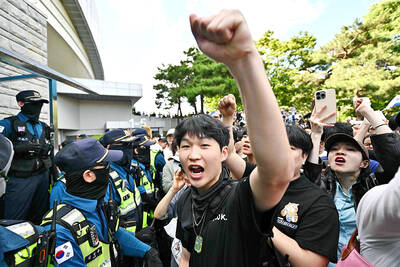
‘ABSURD MISTAKE’: The election commission said that there had been a failure to anticipate turnout after 14 polling stations ran short of ballot papers South Korean riot police yesterday cleared protesters from a Seoul polling station after a 35-hour blockade sparked by a shortage of ballot papers during local elections earlier this week. Wednesday’s election was the first nationwide vote since South Korean President Lee Jae-myung took office following the ouster of Yoon Suk-yeol over his short-lived martial law declaration. Lee’s ruling Democratic Party swept most races, but failed to flip the crucial Seoul mayoral seat. The South Korean National Election Commission apologized, blaming a failure to anticipate turnout after 14 polling stations in Seoul ran short of ballot papers. Some polling stations stayed open until 10pm to

Australian researchers have trained lab-grown brain cells on a silicon computer chip to play the 1990s shooter game Doom and said they are just scratching the surface of what the neurons could be capable of doing. It is the science-fiction work of biotech boffins at Cortical Labs, who researched and developed the technology that harnesses the workings of the brain’s networking system. Each so-called “biological computer” contains about 200,000 living human brain cells, grown from stem cells that were harvested from blood donations. Having mastered the simple computer game Pong, where a paddle is moved up and down to send a ball

France experienced its hottest spring on record, the French weather service said on Tuesday, after an exceptional early heat wave that also broke highs for the season in England and Wales. Meteo-France said the average nationwide temperature over March to May was 13.8°C — about 1.7°C above the norm, and surpassing records set in 2011 and 2020. “The warmest spring since records began in 1900,” it said in a bulletin. All three months were warmer than average, but the onset of an “unprecedented heatwave” late last month pushed the mercury to highs typically seen at the height of the summer. “Our country had never


 RSS
RSS