


Iraq prevented a North Korean plane from entering its airspace on suspicion it was carrying weapons for Syria, prompting praise from the US on Friday, but also demands for a ban of Iranian aircraft with similar suspect cargo.
Iraq’s decision could potentially close a supply line for Syrian President Bashar al-Assad’s embattled regime.
US officials have accused Baghdad of allowing Iran — like North Korea, an ally of Syria — to fly weapons to Syrian forces through Iraqi airspace, a charge Iraq has denied.
“We urge the government of Iraq to take additional steps to prevent others, including Iran, from abusing its airspace by shipping arms to Syria,” US Department of State spokesman Michael Lavallee said, calling the move to ban the North Korean flight a “positive step.”
Activists on Friday raised the number of people killed in Syria in the past 18 months to nearly 30,000. Daily tolls have been rising in recent weeks, with the regime attacking from the air and some rebels using heavy weapons.
The new UN-Arab League envoy to Syria, who started his job three weeks ago, said on Friday he is not in a rush to devise a new roadmap to peace after his predecessor, former UN secretary-general Kofi Annan, failed to get his proposal implemented.
“Following the failure of Kofi Annan’s six-point plan, I don’t think we are capable of withstanding another failure,” Lakhdar Brahimi told the al-Arabiya TV station.
Meanwhile, al-Assad was adamant that the rebels “will not succeed.”
In comments published on Friday, he also said a foreign military intervention such as the one that helped topple former Libyan leader Muammar Qaddafi will “not be repeated” in Syria.
Both sides have foreign backers. Al-Assad’s allies include Russia and China, along with Iran and North Korea, while the rebels are supported by the US and its Western allies, Turkey and several Gulf states, such as Qatar and Saudi Arabia.
On Wednesday, the US Treasury identified 117 Iranian aircraft it said were ferrying weapons to the Syrian regime. The department said the planes were delivering weapons and Iranian forces under the cover of “humanitarian” shipments.
Iraq has accepted Iranian assurances that it is not using Iraqi airspace to smuggle weapons into Syria, said Stephen Beecroft, US President Barack Obama’s choice for ambassador to Iraq, earlier this week.
Iraq’s ban of the North Korean flight came on Thursday, after Pyongyang requested to fly a plane to Syria through Iraqi skies. Iraqi government spokesman Ali al-Moussawi confirmed the move a day later, saying it was made over suspicion the plane carried weapons.
Iraqi Prime Minister Nouri al-Maliki, an ally of Iran, has denied that he is allowing weapons trafficking and has said Baghdad will remain neutral in the Syria conflict.
Iraq rejects “any arming activities through Iraqi territories or skies,” al-Maliki said on Friday.
The issue has been an enduring sore point between Baghdad and Washington, raised again in a phone call between al-Maliki and US Vice President Joe Biden the same day. Biden spoke of the need “to prevent any state from taking advantage of Iraq’s territory or air space to send weapons to Syria,” the White House said.
Meanwhile, in Damascus, al-Assad lashed out at Gulf countries, which he accused of using their enormous oil wealth to try to drive him from power. He singled out Saudi Arabia and Qatar, among his most vocal critics.
“They think their money can buy geography, history and a regional role,” al-Assad was quoted as saying in the Egyptian weekly Al-Ahram Al-Arabi.
The upheaval in Syria presents an opportunity for the Gulf’s Sunni rulers to bolster their influence and possibly leave Shiite powerhouse Iran without its critical alliances that flow through Damascus. Al-Assad’s regime is led by the minority Alawite sect, an offshoot of Shiite Islam.
Syrian Information Minister Omran al-Zoebi later told state-run TV that al-Assad had received nine Egyptian journalists to have a chat with them about the latest developments.
In the meeting with the Egyptian journalists, al-Assad was also quoted as saying that the only way to solve the Syrian crisis is through “dialogue with the opposition” and that the “door for dialogue is open.”
Activists and pro-government media reported fighting in several locations on Friday, including Syria’s largest city, Aleppo, and in the capital Damascus. The state-run news agency SANA said government troops retook the Damascus suburb of al-Hajar al-Aswad.
SANA also said troops found a mass grave containing 25 blindfolded and handcuffed bodies in the al-Qadam suburb of the city. The agency said the dead were people who had been seized by rebels.

Crowds in Bangladesh are flocking to snap photographs with an unlikely social media star — an albino buffalo with flowing blond hair nicknamed “Donald Trump” that is due to be sacrificed within days. Owner Zia Uddin Mridha, 38, said his brother named the 700kg bull over its flowing helmet of hair resembling the signature look of the US president. “My younger brother picked this name because of the buffalo’s extraordinary hair,” he said at his farm in Narayanganj, just outside the capital, Dhaka. Mridha said that a constant stream of curious visitors — social media fans, onlookers and children — have come throughout

It began as a satirical online project. Now millions of young people in India are flocking to it as an outlet for their frustration. A parody political party called the Cockroach Janta Party, with the insect as its symbol, has exploded across India’s social media by turning absurdist humor into protest. Memes and short videos mocking corruption, joblessness and political dysfunction have flooded social media sites, where millions of users are embracing the cockroach — known for its ability to survive harsh conditions — as a tongue-in-cheek symbol of endurance. The online movement’s rise has been unusually rapid. The Cockroach Janta Party (CJP)

BIGGER ROLE: Beijing has said it maintains an impartial stance on the war in Ukraine, but by training Russian troops, China is far more involved than previously known China’s armed forces secretly trained about 200 Russian military personnel in China late last year, and some have since returned to fight in Ukraine, according to three European intelligence agencies and documents seen by Reuters. While China and Russia have held a number of joint military exercises since Moscow’s full-scale invasion of Ukraine in 2022, Beijing has repeatedly said that it is neutral in the conflict and presents itself as a peace mediator. The covert training sessions, which predominantly focused on the use of drones, were outlined in a dual-language Russian-Chinese agreement signed by senior Russian and Chinese officers in Beijing on
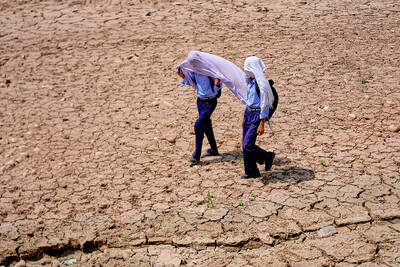
HOTTER: While Indians are accustomed to summer heat, climate change has caused northwestern India to warm faster than other parts of the country, an academic said Roads and markets have emptied during afternoons and some farmers have switched to nighttime work to avoid scorching temperatures as a heat wave grips large parts of India. The India Meteorological Department forecast maximum temperatures for yesterday of about 45°C in the capital, New Delhi, where authorities have opened temporary “cooling zones” to help people cope. The weather department warned that conditions would likely persist across several northern regions in the coming days, with temperatures staying well above seasonal averages. Authorities urged people to stay indoors during the hottest hours and take precautions against heat-related illnesses. India declares a heat wave whenever maximum temperatures


 RSS
RSS