


The two men vying to become the next Dutch prime minister played down the option of governing together in a televised debate on Monday night as each made a last-ditch attempt to win over undecided voters two days before a general election.
However, the tone of the debate between caretaker Prime Minister Mark Rutte, the Liberal Party leader, and Diederik Samsom of the moderate left opposition Labor Party, was less confrontational than during the preceding weeks.
The duo — who found common ground on issues from the euro to international affairs, but haggled over immigration, welfare and the housing market — are widely expected to be in coalition talks by the end of this week.
According to the latest opinion polls, the Liberals and Labor are in a dead heat after the leftist party made a surprising rebound in less than a month and would need just one other party to form a coalition government together.
The run-up to the election has been dominated by the eurozone crisis, and is considered a microcosm of the wider European debate over austerity versus stimulus as a solution.
In his election campaign, Rutte promised voters Greece would not get any more money, whereas Samsom, who wants the Netherlands to be given more time to meet its own EU budget targets, said Greece may have to be given more time if it is to have a chance of staying in the euro.
Samsom, Labor’s new leader, has emerged as the star of several televised debates over the past two weeks, propelling his party from fourth to joint first place.
To loud laughter from the audience, Rutte praised Samsom for winning so much ground saying he was now “the man in the polls who is breathing down my neck,” while Samsom said he “doesn’t know of another prime minister who faces problems so cheerfully — and that’s a good thing because he creates a lot of them.”
Some analysts predict Labor could even overtake the Liberals on election day.

An American scientist convicted of lying to US authorities about payments from China while he was at Harvard University has rebuilt his research lab in Shenzhen, China, to pursue technology the Chinese government has identified as a national priority: embedding electronics into the human brain. Charles Lieber, 67, is among the world’s leading researchers in brain-computer interfaces. The technology has shown promise in treating conditions such as amyotrophic lateral sclerosis and restoring movement in paralyzed people. It also has potential military applications: Scientists at the Chinese People’s Liberation Army have investigated brain interfaces as a way to engineer super soldiers by boosting

Indonesian police have arrested 13 people after shocking images of alleged abuse against small children at a daycare center went viral, sparking outrage across the nation, officials said on Monday. Police on Friday last week raided Little Aresha, a daycare center in Yogyakarta on Java island, following a report from a former employee. CCTV footage circulating on social media showed children, most younger than two, lying on the floor wearing only diapers, their hands and feet bound with rags. The police have confirmed that the footage is authentic. Police said they also found 20 children crammed into a room just 3m by 3m. “So
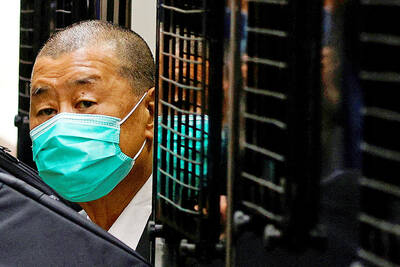
Jailed media entrepreneur Jimmy Lai (黎智英) has been awarded Deutsche Welle’s (DW) freedom of speech award for his contribution to Hong Kong’s pro-democracy movement. The German public broadcaster on Thursday said Lai would be presented in absentia with the 12th iteration of the award on June 23 at the DW Global Media Forum in Bonn. Deutsche Welle director-general Barbara Massing praised the 78-year-old founder of the now-shuttered news outlet Apple Daily for standing “unwaveringly for press freedom in Hong Kong at great personal risk.” “With Apple Daily, he gave journalists a platform for free reporting and a voice to the democracy movement in
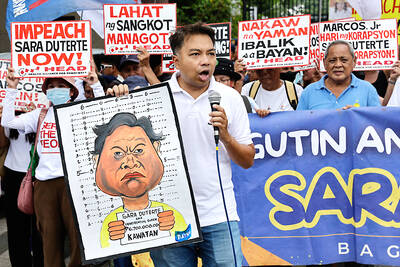
PHILIPPINE COMMITTEE: The head of the committee that made the decision said: ‘If there is nothing to hide, there is no reason to hide, there is no reason to obstruct’ A Philippine congressional committee on Wednesday ruled that there was “probable cause” to impeach Philippine Vice President Sara Duterte after hearing allegations of unexplained wealth, misuse of state funds and threats to have the president assassinated. The unanimous decision of the 53-member committee in the Philippine House of Representatives sends the two impeachment complaints to deliberations and voting by the entire lower chamber, which has more than 300 lawmakers. The complaints centered on Duterte’s alleged illegal use and mishandling of intelligence funds from the vice president’s office, and from her time as education secretary under Philippine President Ferdinand Marcos Jr. Duterte and the


 RSS
RSS