


The relentless, weather-gone-crazy type of heat that has blistered the US and other parts of the world recently is so rare that it cannot be anything but man-made global warming, a new statistical analysis from a top government scientist says.
The research by a man often called the “godfather of global warming” says that the likelihood of such temperatures occurring from the 1950s through the 1980s was rarer than one in 300. Now, the odds are closer to one in 10, according to the study by NASA scientist James Hansen. He says that statistically, what is happening is not random or normal, but pure and simple climate change.
“This is not some scientific theory. We are now experiencing scientific fact,” Hansen said.
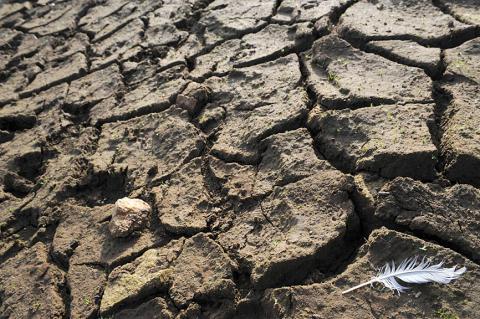
Photo: AFP
Hansen is a scientist at NASA’s Goddard Institute for Space Studies in New York and a professor at Columbia University. However, he is also a strident activist who has called for government action to curb greenhouse gases for years. While his study was published online on Saturday in the Proceedings of the National Academy of Science, it is unlikely to sway opinion among the remaining climate change skeptics.
However, several climate scientists praised the new work.
In a blunt departure from most climate research, Hansen’s study — based on statistics, not the more typical climate modeling — blames these three heat waves purely on global warming: last year’s devastating Texas-Oklahoma drought; the 2010 heat waves in Russia and the Middle East, which led to thousands of deaths; the 2003 European heat wave blamed for tens of thousands of deaths, especially among the elderly in France.
The analysis was written before the current drought and record-breaking temperatures that have seared much of the US this year. The new research makes the case for the severity of global warming in a different way than most scientific studies and uses simple math instead of relying on complex climate models or an understanding of atmospheric physics. It also does not bother with the usual caveats about individual weather events having numerous causes.
The increase in the chance of extreme heat, drought and heavy downpours in certain regions is so huge that scientists should stop hemming and hawing, Hansen said.
“This is happening often enough, over a big enough area that people can see it happening,” he said.
Scientists have generally responded that it is impossible to say whether single events are caused by global warming, because of the influence of natural weather variability.
However, that position has been shifting in recent months, as other studies, too, have concluded that climate change is happening right before our eyes.
Hansen hopes his new study will shift people’s thinking about climate change and goad governments into action. He wrote an opinion piece that appeared online Friday in the Washington Post.
“There is still time to act ... but we are wasting precious time,” he wrote.
The science in Hansen’s study is excellent “and reframes the question,” said Andrew Weaver, a climate scientist at the University of Victoria in British Columbia who was a member of the Nobel Prize-winning international panel of climate scientists that issued a series of reports on global warming.
“Rather than say: ‘Is this because of climate change?’ That’s the wrong question. What you can say is: ‘How likely is this to have occurred with the absence of global warming?’ It’s so extraordinarily unlikely that it has to be due to global warming,” Weaver said.
For years scientists have run computer models combining various factors to see how likely a weather event would happen without global warming and with it. About 25 aspects of climate change have been formally attributed to man-made greenhouse gases in dozens of formal studies. However, these are generally broad and non-specific, such as more heat waves in some regions and heavy rainfall in others.
Another upcoming study by Kevin Trenberth, climate analysis chief at the National Center for Atmospheric Research, links the 2010 Russian heat wave to global warming by looking at the underlying weather that caused it. He called Hansen’s paper an important one that helps communicate the problem.
However, there is bound to be continued disagreement. Previous studies had been unable to link the two and one by the National Oceanic and Atmospheric Administration concluded the Russian drought, which also led to major wildfires, was not related to global warming.
White House science adviser John Holdren praised the paper’s findings in a statement.
However, he also said it was true that scientists could not blame single events on global warming: “This work, which finds that extremely hot summers are over 10 times more common than they used to be, reinforces many other lines of evidence showing that climate change is occurring and that it is harmful.”
Skeptical scientist John Christy of the University of Alabama at Huntsville said Hansen should not have compared recent years to the time period from the 1950s to the 1980s because he said that was a quiet time for extremes.
However, Derek Arndt, director of climate monitoring for the US government’s National Climatic Data Center, said that range is a fair one and often used because it is the “golden era” for good statistics.
Hansen says now he underestimated how bad things would get.While he hopes his new study will spur action including a tax on the burning of fossil fuels, which emit carbon dioxide, a key greenhouse gas, others doubt it.
Science policy expert Roger Pielke Jr of the University of Colorado said Hansen clearly does not understand social science, thinking a study like his could spur action. Just because something ought to happen, does not mean it will, he said.
In an e-mail, he wrote: “Hansen is pursuing a deeply flawed model of policy change, one that will prove ineffectual and with its most lasting consequence a further politicization of climate science [if that is possible!].”

A US YouTuber who caused outrage for filming himself kissing a statue commemorating Korean wartime sex slaves has been sentenced to six months in prison, a court in Seoul said yesterday. Johnny Somali, 25, gained notoriety several years ago for recording himself doing a series of provocative stunts in South Korea and Japan, and streaming them on platforms such as YouTube and Twitch. South Korean authorities indicted Somali — whose real name is Ramsey Khalid Ismael — in 2024 on public order violations and obstruction of business, and banned him from leaving the country. “The court has sentenced him to six months in

Former Lima mayor Rafael Lopez Aliaga, a Peruvian presidential hopeful, gathered hundreds of supporters in Lima on Tuesday and gave authorities 24 hours to annul the first round of the country’s election over allegations of fraud. Lopez Aliaga is locked in a tight three-way race with two other candidates for second place in Sunday’s vote. The election runner-up wins a ticket to June’s presidential run-off against front-runner Keiko Fujimori. “I am giving them 24 hours to declare this electoral fraud null and void,” said Lopez Aliaga, surrounded by a crowd of several hundred supporters. “If it is not declared null and void tomorrow,

PAPAL RETORT: Pope Leo told reporters that he has ‘no fear, neither of the Trump administration nor speaking out loudly about the message of the Gospel’ US President Donald Trump has feuded with Pope Leo XIV over the Iran conflict — setting off an unholy row that could have serious political implications for the Republican leader back in the US. Trump has drawn barbs even from some allies over the attacks on the US-born pontiff, who has criticized the Trump administration over its immigration crackdown, the intervention in Venezuela and the Iran war. The president risks alienating the religious right in November’s crucial US midterm elections. So far the unprecedented clash between the leader of the most powerful military on Earth and the head of the world’s 1.4 billion

A 16-year-old boy has been charged with murder and aggravated sexual abuse in Florida in the death of his 18-year-old stepsister on a Carnival Cruise ship, the US Department of Justice said on Monday. Timothy Hudson was initially charged in February and subsequently indicted on March 10, but the breadth of the case was not known until a seal was lifted on Friday last week, weeks after US District Judge Beth Bloom in Miami said that he would be prosecuted as an adult at the request of the government. Anna Kepner had been traveling on the Carnival Horizon ship in November last


 RSS
RSS