


Hong Kong parents are battling plans to introduce lessons praising Chinese Communist Party rule, saying the curriculum amounts to brainwashing and an attack on the territory’s cherished freedoms.
Up to 90,000 people, led by stroller-pushing parents and banner-waving children, took to the streets of the semi-autonomous territory on Sunday to denounce “national education,” as the subject is officially called.
The issue has been on the Hong Kong Government’s agenda since it was handed over from Britain to China in 1997, but a new teaching booklet lauding the “China model” of development has infuriated educators and parents.
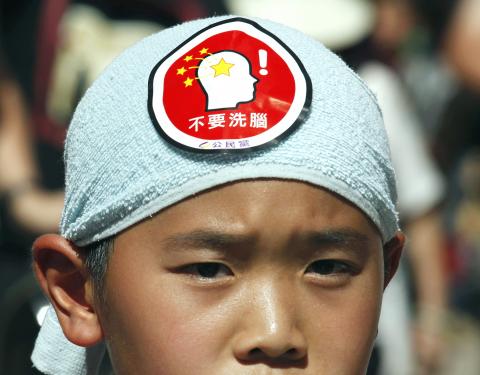
PHOTO: REUTERS
“It will poison our children’s minds,” 34-year-old office clerk Gordon Chan said as he marched with his wife and nine-month-old daughter. “This is putting politics before education.”
Mercury Leung, a 21-year-old university student, said: “Students, especially those in primary schools, are like pieces of white paper. They absorb what is taught in schools. This subject is akin to painting the paper red.”
Sunday’s march was the third major demonstration in Hong Kong in the past two months, reflecting growing fears about the extent of Beijing’s economic and political influence in the southern Chinese financial center.
Scores of thousands attended an annual vigil on the anniversary of the 1989 Tiananmen Square crackdown in early June, while on July 1, hundreds of thousands rallied on the 15th anniversary of the handover.
Like many others in Sunday’s protest, Chan and Leung said they did not oppose the teaching of Chinese values in Hong Kong’s schools, but were against the teaching of Chinese Communist Party propaganda.
Concerned parents and students have pointed out that the proposed curriculum fails to properly address upheavals in 20th-century Chinese history, such as the Tiananmen protests and the violent radicalism of the Cultural Revolution.
The 34-page government-sponsored booklet called “China Model” praises the Chinese Communist Party as “progressive, selfless and united.”
China’s one-party rule is referred to as a “society-first” and “united” system, and is compared favorably to multi-party democracy as practiced in the US, which is described as inefficient and disruptive.
A section on multi-party politics comes with the headline: “When the parties struggle, there is disaster for the citizens.”
The booklet is one small part of the national education curriculum, which was approved last year and will become compulsory for all primary and secondary students from 2016.
Students will attend the classes for one hour a week, but will not be required to sit exams on the subject.
“National education teaches our kids to lie,” Wong Kin, an irate father of three, said at a recent public conference where teachers and parents vented their anger at the government’s plans. “There are already courses for Chinese history, Chinese culture and Chinese language, there’s no need to teach national education.”
In response to the protests, Hong Kong Chief Executive Leung Chun-ying (梁振英) promised another round of consultation with parents to reassure them that their children would not be subjected to Chinese Communist Party indoctrination.
“The government definitely does not have the intention to brainwash,” he said on Monday. “Schools, teachers and educational bodies will have a lot of space, using professional attitudes and using open methods, to teach this subject.”
His comments contrast with those of Jiang Yudui, of the pro-Beijing China Civic Education Promotion Association in Hong Kong, who fueled critics’ suspicions when he said brainwashing was justified.
“A brain needs washing if there is a problem, just as clothes need washing if they’re dirty, and a kidney needs washing if it’s sick,” he said ahead of Sunday’s demonstration, according to local media.
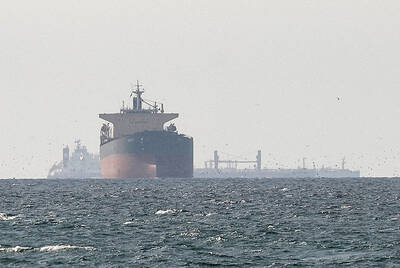
A ship that appears to be taking on the identity of a scrapped gas carrier exited the Strait of Hormuz on Friday, showing how strategies to get through the waterway are evolving as the Middle East war progresses. The vessel identifying as liquefied natural gas (LNG) carrier Jamal left the Strait on Friday morning, ship-tracking data show. However, the same tanker was also recorded as having beached at an Indian demolition yard in October last year, where it is being broken up, according to market participants and port agent’s reports. The ship claiming to be Jamal is likely a zombie vessel that
Japan is to downgrade its description of ties with China from “one of its most important” in an annual diplomatic report, according to a draft reviewed by Reuters, as relations with Beijing worsen. This year’s Diplomatic Bluebook, which Japanese Prime Minister Sanae Takaichi’s government is expected to approve next month, would instead describe China as an important neighbor and the relationship as “strategic” and “mutually beneficial.” The draft cites a series of confrontations with Beijing over the past year, including export controls on rare earths, radar lock-ons targeting Japanese military aircraft and increased pressure around Taiwan. The shift in tone underscores a deterioration
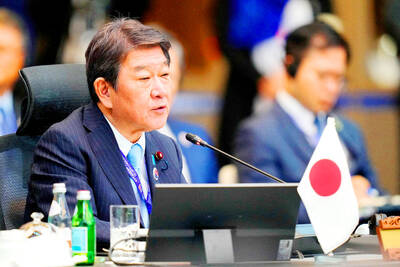
LAW CONSTRAINTS: The US has been pressing allies to send warships to open the Strait, but Tokyo’s military actions are limited under its postwar pacifist constitution Japan could consider deploying its military for minesweeping in the Strait of Hormuz if a ceasefire is reached in the war on Iran, Japanese Minister of Foreign Affairs Toshimitsu Motegi said yesterday. “If there were to be a complete ceasefire, hypothetically speaking, then things like minesweeping could come up,” Motegi said. “This is purely hypothetical, but if a ceasefire were established and naval mines were creating an obstacle, then I think that would be something to consider.” Japan’s military actions are limited under its postwar pacifist constitution, but 2015 security legislation allows Tokyo to use its Self-Defense Forces overseas if an attack,

German Chancellor Friedrich Merz’s conservative Christian Democratic Union (CDU) yesterday faced a regional election battle in Rhineland-Palatinate, now held by the center-left Social Democratic Party (SPD). Merz’s CDU has enjoyed a narrow poll lead over the SPD — their coalition partners at the national level — who have ruled the mid-sized state for 35 years. Polling third is the far-right Alternative for Germany (AfD), which spells a greater threat to the two centrist parties in several state elections in September in the country’s ex-communist east. The picturesque state of Rhineland-Palatinate, bordering France, Belgium and Luxembourg and with a population of about 4 million,


 RSS
RSS