


The shifting relationship between China’s one-party government and the military is a “risk management issue” for Japan, while North Korea poses a “significant threat,” Tokyo warned yesterday.
In its annual defense report, Japan said the Chinese People’s Liberation Army (PLA) had been speaking out on foreign policy more frequently, a key shift in political-military ties that has set alarm bells ringing in Tokyo.
“Relations between the [Chinese Communist Party] leadership and the People’s Liberation Army have been getting more complex,” the report said yesterday, calling the shift a “risk management issue.”
“The degree of military influence on foreign policy decisions has been changing,” it said.
Senior Chinese military officials have become more vocal, making public comments about US military drills in regional waters, for example, Japanese defense officials said at a briefing.
China has been embroiled in separate spats over regional territorial claims — with Japan as well as with several Southeast Asian nations, including Vietnam and the Philippines — which have flared up in recent years.
However, the report also said the PLA may have limited influence, with the number of its personnel on key political decisionmaking bodies declining, as China readies for a once-in-a-decade leadership shuffle.
“As part of Japan’s risk management, we recognize that the intention and purpose behind China’s actions are becoming less predictable, which is a challenge when we address the country,” said Toshinori Tanaka, director of the defense ministry’s strategic intelligence analysis office.
Japanese Minister of Defense Satoshi Morimoto said that “there is a certain degree of wariness, not only in Japan, but in the whole of East Asia, as to which direction China will be heading.”
Tokyo once again in this year’s report described China’s response to disputes with neighbors as “assertive,” a description that raised eyebrows in Beijing when it was published in last year’s report.
“China’s [military] moves, together with the lack of transparency in its military affairs and security issues, are a matter of concern,” the report said, adding that Chinese defense spending had grown 30-fold in the past two decades.
The report comes days after Japanese Prime Minister Yoshihiko Noda and Morimoto suggested Tokyo could use force to defend disputed East China Sea islands, known as Senkaku in Japanese and Diaoyutai Islands (釣魚台) in Taiwan, which also claims the islands.
Tensions between China and Japan rose again earlier this month after Chinese vessels twice entered waters near the resource-rich disputed islands, sparking a diplomatic row. Tokyo’s comments about possibly buying the islands from their private Japanese owner generated an angry protest in Beijing.
The uninhabited outcrops were the scene of a particularly nasty row in late 2010 when Japan arrested a Chinese trawlerman who had rammed two of its coastguard vessels.
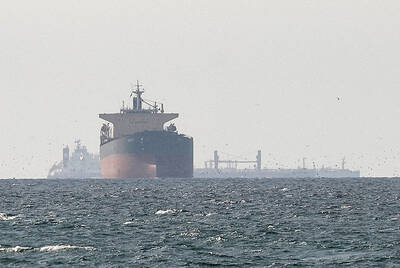
A ship that appears to be taking on the identity of a scrapped gas carrier exited the Strait of Hormuz on Friday, showing how strategies to get through the waterway are evolving as the Middle East war progresses. The vessel identifying as liquefied natural gas (LNG) carrier Jamal left the Strait on Friday morning, ship-tracking data show. However, the same tanker was also recorded as having beached at an Indian demolition yard in October last year, where it is being broken up, according to market participants and port agent’s reports. The ship claiming to be Jamal is likely a zombie vessel that
Japan is to downgrade its description of ties with China from “one of its most important” in an annual diplomatic report, according to a draft reviewed by Reuters, as relations with Beijing worsen. This year’s Diplomatic Bluebook, which Japanese Prime Minister Sanae Takaichi’s government is expected to approve next month, would instead describe China as an important neighbor and the relationship as “strategic” and “mutually beneficial.” The draft cites a series of confrontations with Beijing over the past year, including export controls on rare earths, radar lock-ons targeting Japanese military aircraft and increased pressure around Taiwan. The shift in tone underscores a deterioration
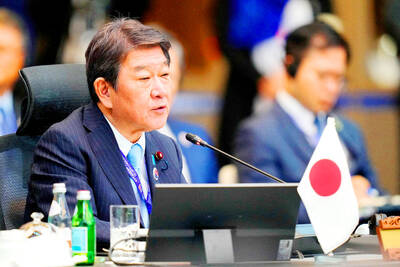
LAW CONSTRAINTS: The US has been pressing allies to send warships to open the Strait, but Tokyo’s military actions are limited under its postwar pacifist constitution Japan could consider deploying its military for minesweeping in the Strait of Hormuz if a ceasefire is reached in the war on Iran, Japanese Minister of Foreign Affairs Toshimitsu Motegi said yesterday. “If there were to be a complete ceasefire, hypothetically speaking, then things like minesweeping could come up,” Motegi said. “This is purely hypothetical, but if a ceasefire were established and naval mines were creating an obstacle, then I think that would be something to consider.” Japan’s military actions are limited under its postwar pacifist constitution, but 2015 security legislation allows Tokyo to use its Self-Defense Forces overseas if an attack,

German Chancellor Friedrich Merz’s conservative Christian Democratic Union (CDU) yesterday faced a regional election battle in Rhineland-Palatinate, now held by the center-left Social Democratic Party (SPD). Merz’s CDU has enjoyed a narrow poll lead over the SPD — their coalition partners at the national level — who have ruled the mid-sized state for 35 years. Polling third is the far-right Alternative for Germany (AfD), which spells a greater threat to the two centrist parties in several state elections in September in the country’s ex-communist east. The picturesque state of Rhineland-Palatinate, bordering France, Belgium and Luxembourg and with a population of about 4 million,


 RSS
RSS