


Egyptian President Mohammed Morsi will respect a court ruling overturning his decree for the dissolved Islamist-dominated parliament to convene, his office said amid a power struggle with the military. The statement issued on Wednesday appears aimed at mollifying an infuriated judiciary, which has been placed at the forefront of the complex struggle between powerful generals adjusting to their new Islamist president.
“If yesterday’s constitutional court ruling prevents parliament from fulfilling its responsibilities, we will respect that because we are a state of the law,” the statement said, a day after the court froze Morsi’s decree.
“There will be consultations with [political] forces and institutions and the supreme council for legal authorities to pave a suitable way out of this,” the statement added.

Photo: AFP / HO / AHMED FUAD / EGYPTIAN PRESIDENCY
Last week, Morsi ordered parliament to convene, in defiance of a military decision, to disband the house in line with a court ruling last month before the generals handed power to the president.
Morsi’s decree was applauded by supporters who believed the court’s decision to disband parliament was political, but it set off a firestorm of criticism from opponents who accused him of overstepping his authority.
According to the country’s interim constitution, drafted by the military generals who took charge after former Egyptian president Hosni Mubarak’s overthrow early last year, the military assumed the dissolved parliament’s powers.
Morsi’s decision was seen as an opening shot in a power struggle between Egypt’s first civilian leader and the Mubarak-appointed generals, who wanted to retain broad powers even after they transferred control on June 30.
On Sunday, Morsi had ordered parliament back and invited it to convene. Taking its cue from the president, the People’s Assembly met on Tuesday.
“We are gathered today to review the court rulings, the ruling of the Supreme Constitutional Court,” People’s Assembly Speaker Saad al-Katatni said.
“I want to stress, we are not contradicting the ruling, but looking at a mechanism for the implementation of the ruling of the respected court. There is no other agenda today,” he added.
According to Morsi’s decree, new parliamentary elections are to be held after a constituent assembly picked by the legislature finishes a constitution.
However, the assembly’s fate is in doubt, with the administrative court deciding on Wednesday to look into complaints on the panel’s legality on Tuesday, rather than in September as had been scheduled, the official MENA news agency reported.
Should the court declare the parliament appointed assembly illegal, the military will appoint a new one, as stipulated in its interim constitution.
The origins of the battle for parliament lay in the constitutional declaration issued by the Supreme Council of the Armed Forces (SCAF), which ruled Egypt during its transition after Mubarak was ousted last year.
The declaration, which acts as a temporary constitution until a new one is drafted, granted the military sweeping powers, including legislative control, and rendering the presidential post little more than symbolic.
The SCAF consists of generals appointed by Mubarak, as was the head of the constitutional court that annulled parliament because it found certain articles of the law governing its election invalid.
Critics said the decision was politically motivated.
“The constitutional court whose judges were appointed by Mubarak has canceled the president’s decree and restored the field marshal’s decree,” prominent commentator Alaa al-Aswany wrote, referring to SCAF head Hussein Tantawi.

A humanoid robot that won a half-marathon race for robots in Beijing on Sunday ran faster than the human world record in a show of China’s technological leaps. The winner from Honor, a Chinese smartphone maker, completed the 21km race in 50 minutes and 26 seconds, said a WeChat post by the Beijing Economic-Technological Development Area, also known as Beijing E-Town, where the race began. That was faster than the human world record holder, Ugandan Jacob Kiplimo, who finished the same distance in about 57 minutes in March at the Lisbon road race. The performance by the robot marked a significant step forward
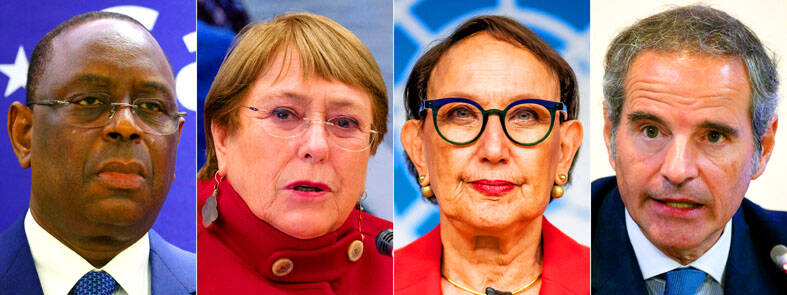
Four contenders are squaring up to succeed Antonio Guterres as secretary-general of the UN, which faces unprecedented global instability, wars and its own crushing budget crisis. Chile’s Michelle Bachelet, Argentina’s Rafael Grossi, Costa Rica’s Rebeca Grynspan and Senegal’s Macky Sall are each to face grillings by 193 member states and non-governmental organizations for three hours today and tomorrow. It is only the second time the UN has held a public question-and-answer, a format created in 2016 to boost transparency. Ultimately the five permanent members of the UN’s top body, the Security Council, hold the power, wielding vetoes over who leads the

South Korea’s air force yesterday apologized for a 2021 midair collision involving two fighter jets, a day after auditors said the pilots were taking selfies and filming during the flight and held them responsible for the accident. “We sincerely apologize to the public for the concern caused by the accident that occurred in 2021,” an air force spokesman told a news conference, adding that one of the pilots involved had been suspended from flying duties, received severe disciplinary action and has since left the military. The apology followed a report released on Wednesday by the South Korean Board of Audit and Inspection,
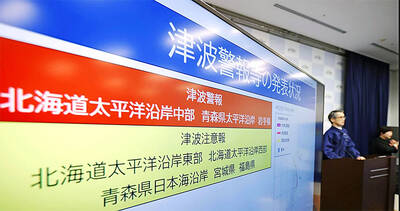
An earthquake registering a preliminary magnitude of 7.7 off northern Japan on Monday prompted a short-lived tsunami alert and the advisory of a higher risk of a possible mega-quake for coastal areas there. The Cabinet Office and the Japan Meteorological Agency said there was a 1% chance for a mega-quake, compared to a 0.1% chance during normal times, in the next week or so following the powerful quake near the Chishima and Japan trenches. Officials said the advisory was not a quake prediction but urged residents in 182 towns along the northeastern coasts to raise their preparedness while continuing their daily lives. Prime


 RSS
RSS