


An exiled Iranian opposition group said on Saturday that Iran has about 60 scientists and engineers involved in a concerted and expanding program to develop nuclear weapons under defense ministry auspices.
However, diplomats say the National Council of Resistance of Iran (NCRI) has had a spotty record with allegations about Iran’s nuclear work since exposing a secret uranium enrichment plant at Natanz in 2002. A top US nuclear expert said the NCRI report, like previous ones, should be treated with great skepticism.
Its latest report, whose details could not be verified, appeared timed to encourage a tougher line at talks with Iran the UN nuclear watchdog will have in Vienna today and tomorrow and six world powers will hold in Baghdad on May 23.
However, it clashed with the assessment of US and Israeli -intelligence officials that Iran has not decided whether to “weaponize” its enrichment program. Tehran says it is refining uranium solely for peaceful energy.
In the six-page report, the Paris-based NCRI cited sources in Iran’s government and military as saying about 60 scientists were pursuing bomb-relevant research in 11 agencies operating clandestinely under defense ministry control.
“Information ... shows that the clerical regime has expanded the organization responsible for nuclear weapons development,” the report said. “This finding reveals a complete and elaborate, and highly ... secret research structure and a network for procurement of the required parts and equipment.”
“So far, the identities of 60 directors and experts working in various parts of the New Defence Research Organization and 11 institutions and companies affiliated with it have been detailed,” the report went on.
It featured diagrams said to lay out the disguised command structure and named scientists and engineers involved.
The NCRI, an umbrella bloc of five opposition groups in exile that seek an end to Shiite Muslim clerical rule in Iran, urged the International Atomic Energy Agency (IAEA) to launch a “robust probe” into Iran’s nuclear program and all personnel involved.
Iran says it is stockpiling enriched uranium for a future network of nuclear power plants, but the world’s No. 5 oil exporter has stonewalled an almost decade-old IAEA investigation into suspected military dimensions to its atomic activity.
World powers trying to rein in Iran’s nuclear activity via negotiations want to halt a spiral toward confrontation that has stoked fear of a new Middle East war, with Israel mooting last-resort air strikes on the nuclear sites of its arch-enemy.
However, Western leaders have rejected Iranian calls for an end to UN sanctions against it as a precondition for any deal.
In its last quarterly report on Iran issued in February, the IAEA cited generally credible information indicating Iran had carried out activities relevant to developing a nuclear explosive, but without evidence of actual weaponization.
The NCRI is the political wing of the People’s Mujahedin Organization of Iran (PMOI), which the US classifies as a terrorist organization.
David Albright, head of an influential Washington-based think tank that tracks Iran’s nuclear work and has access to sensitive intelligence, said: “We have to be extremely skeptical of whatever they [the NCRI] say.
“[They are] an activist group with a huge incentive to say there is a nuclear weapons program that is making great progress,” Albright said when asked about the report.
“We know this organization exists,” he said, referring to the command structure cited by the NCRI. “We know the [NCRI] receives intelligence information from countries so sometimes it is good, but the trouble is, they fill in details [without] evidence. You just don’t know whether it’s true or not.”

Australians were downloading virtual private networks (VPNs) in droves, while one of the world’s largest porn distributors said it was blocking users from its platforms as the country yesterday rolled out sweeping online age restriction. Australia in December became the first country to impose a nationwide ban on teenagers using social media. A separate law now requires artificial intelligence (AI)-powered chatbot services to keep certain content — including pornography, extreme violence and self-harm and eating disorder material — from minors or face fines of up to A$49.5 million (US$34.6 million). The country also joined Britain, France and dozens of US states requiring
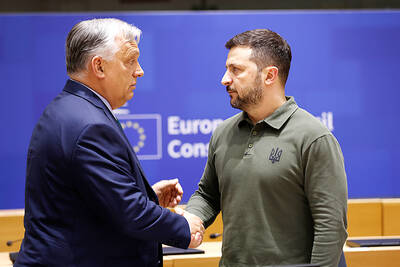
Hungarian authorities temporarily detained seven Ukrainian citizens and seized two armored cars carrying tens of millions of euros in cash across Hungary on suspicion of money laundering, officials said on Friday. The Ukrainians were released on Friday, following their detention on Thursday, but Hungarian officials held onto the cash, prompting Ukraine to accuse Hungary’s Russia-friendly government of illegally seizing the money. “We will not tolerate this state banditism,” Ukrainian Minister of Foreign Affairs Andrii Sybiha said. The seven detained Ukrainians were employees of the Ukrainian state-owned Oschadbank, who were traveling in the two armored cars that were carrying the money between Austria and

Kosovar President Vjosa Osmani on Friday after dissolving the Kosovar parliament said a snap election should be held as soon as possible to avoid another prolonged political crisis in the Balkan country at a time of global turmoil. Osmani said it is important for Kosovo to wrap up the upcoming election process and form functional institutions for political stability as the war rages in the Middle East. “Precisely because the geopolitical situation is that complex, it is important to finish this electoral process which is coming up,” she said. “It is very hard now to imagine what will happen next.” Kosovo, which declared

MORE BANS: Australia last year required sites to remove accounts held by under-16s, with a few countries pushing for similar action at an EU level and India considering its own ban Indonesia on Friday said it would ban social media access for children under 16, citing threats from online pornography, cyberbullying, online fraud and Internet addiction. “Accounts belonging to children under 16 on high-risk platforms will start to be deactivated, beginning with YouTube, TikTok, Facebook, Instagram, Threads, X, Bigo Live and Roblox,” Indonesian Minister of Communications and Digital Meutya Hafid said. “The government is stepping in so that parents no longer have to fight alone against the giants of the algorithm. Implementation will begin on March 28, 2026,” she said. The social media ban would be introduced in stages “until all platforms fulfill their


 RSS
RSS