

More than 2,000 people braved pelting rain in Sao Paulo on Saturday to stage a protest against what they described as persecution of Afro-Brazilian religious groups.
The “March of Axe” (life force in the Afro-Brazilian religion Candomble) in the city’s Ibirapuera Park was also joined by some gay groups and NGOs fighting against racism and bigotry.
The marchers representing major Afro-Brazilian faiths such as Candomble and Umbanda from around the country demanded “freedom of expression and of religion,” as well as an end to injustice, intolerance and racism.
Candomble, introduced in Brazil in the 16th century by west African slaves, also incorporates Roman Catholic elements.
Umbanda, founded a little more than a century ago, blends African religious beliefs, the spirituality of Brazil’s indigenous people and spiritism, a doctrine based on the teachings of 19th century French spiritualist Allan Kardec.
Jorge Scritori, one of the march organizers, said the protesters were denouncing intolerance and violence directed at followers of Afro-Brazilian religions.
“We want inclusion and acceptance ... It is the duty of all to show religious tolerance,” he added.
Followers of Candomble and Umbanda have held annual marches against religious intolerance since 2008, after several places of Afro-Brazilian worship were sacked and their leaders attacked.
Some of them accuse Christian evangelicals, including Candomble defectors, of outright hostility toward Afro-Brazilian faiths.
Candomble and Umbanda followers also complain about what they view as racist misconceptions that associate their beliefs with witchcraft.
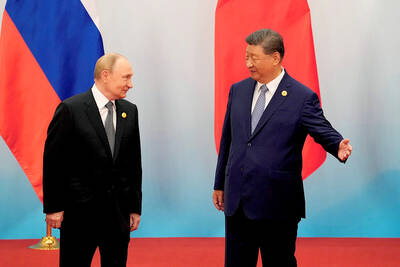
PLENARY SESSION: Although the SCO says it is ‘not an alliance directed against other states,’ Putin and Xi have repeatedly made anti-Western speeches during its summits Russian President Vladimir Putin and Chinese President Xi Jinping (習近平) are expected tomorrow in Kyrgyzstan for a two-day summit, also attended by Iran’s and India’s leaders, of a regional bloc seeking to be a counter-influence to the West. Around a dozen heads of states would head to the Kyrgyz capital, Bishkek, to mark 25 years of the Shanghai Cooperation Group (SCO). The group brings together Russia, China, India, Pakistan, Iran, four Central Asian countries and Moscow-allied Belarus. Putin and Xi have previously used SCO summits to promote their vision of a multipolar world and present a united front against the

Dozens of Israeli settlers on Saturday attacked the Palestinian village of Qusra in the northern occupied West Bank after nearly three weeks of tension in the area, drawing rare condemnation from Israeli Prime Minister Benjamin Netanyahu. Earlier this month, a group of settlers began blocking supplies from entering Palestinian houses on the outskirts of the village near Nablus, trapping residents inside and drawing unusually strong criticism from the US ambassador. Weeks later, Israeli forces continue to operate in the area while settlers still roam the surrounding hills. On Saturday, Qusra residents and dozens of settlers had descended on the village,

Ontario Premier Doug Ford on Saturday answered US President Donald Trump’s “Lake America” decree with a billboard-sized message on the Canadian shoreline — “Lake Ontario. Now and Always” — as Canadian leaders met Trump’s move with ridicule rather than outrage. Wearing a Canada national soccer team jersey, Ford unveiled the sign near Grimsby and posed for photographs. The message is repeated in French. The display followed Trump’s executive order directing US federal agencies to call Lake Ontario “Lake America.” After months of tariffs, threats to make Canada the 51st US state and personal attacks on its leaders, the reaction in

A swarm of about 700 artificial intelligence (AI) agents created by OpenAI carried out last month’s hack of the open-source platform Hugging Face and in many cases tried to cover their tracks, a pair of reports into the breach said on Wednesday. The coordinated activity by AI agents — programs that run with minimal human supervision — and their attempts to hide it raise questions about how closely AI companies are monitoring tests of increasingly powerful models, and could add fuel to calls for tighter oversight. While some of the rogue behavior has been disclosed or alluded to previously, the two reports


 RSS
RSS