


A university Web site offering ordinary Hong Kongers a chance to vote for their next leader ahead of tomorrow’s election is under “systematic attack” from hackers, organizers said yesterday.
Thousands of people who do not have the right to vote in the tightly controlled “small-circle election” are expressing their views through the unofficial poll organized by the University of Hong Kong.
“The system has been very busy,” Robert Chung (鍾庭耀), director of the university’s respected Public Opinion Programme, told Cable TV. “We suspect it is under systematic attack as there are over 1 million clicks on our system every second.”
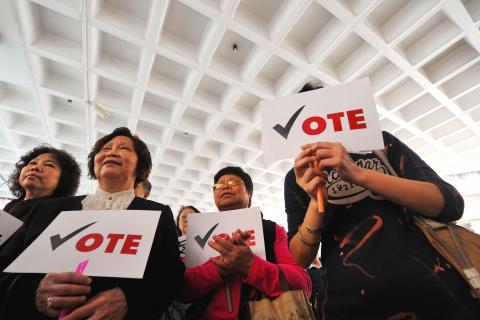
Photo: AFP
Chung did not indicate who could be responsible for the disruption, but his team of pollsters has a history of aggravating authorities in Beijing with surveys indicating public opinion that is at odds with Beijing’s official line.
The vast majority of Hong Kong’s 7 million residents have no right to determine who will replace Honk Kong Chief Executive Donald Tsang (曾蔭權), whose term expires in June, as the financial center’s next leader. The vote is restricted to a 1,200-member committee packed with pro-Beijing elites, who will cast their ballots tomorrow.
The leading candidates are Henry Tang (唐英年), an heir to a textile fortune and former Honk Kong chief secretary, and Leung Chun-ying (梁振英), a policeman’s son turned self-made property consultant — both regarded as pro-Beijing establishment figures.
The university’s so-called civil referendum began at midnight on Thursday and continued until 9pm yesterday, with ballots cast through the Web site, via mobile phones or at 15 “polling stations.”
“This is a meaningful exercise because it shows Hong Kong people want direct elections,” university lecturer Michele Ho said after casting her vote at a booth. “Although we can’t influence the election outcome on Sunday, this mock vote shows we want to have a say and we should have the right to decide who is our next leader.”
Before the polls opened, organizers said they had hoped to attract at 5 million votes.
Hong Kongers were also expressing themselves through a free iPhone app called I want to vote for my chief executive.
The version for iPhones had more than 4,200 votes by 1:30pm yesterday, with Leung leading on 34.6 percent. He was closely followed by blank or donkey votes on 32 percent. Tang was next on 19.2 percent and third candidate Albert Ho (何俊仁) had 14.9 percent of the vote.
Tang was seen as China’s choice until a slew of scandals and gaffes made him unpopular with the public. Even so, he continues to enjoy the strong support of key committee members including Asia’s richest man, Li Ka-shing (李嘉誠).

‘CROSSING THE LINE’: China’s embassy in Seoul criticized US Forces Korea Commander General Xavier Brunson, asking if his ‘hostile’ remarks were authorized by Washington South Korea and the US are in talks over recent public remarks by the commander of US Forces Korea, Seoul’s presidential office said yesterday, after the comments drew sharp criticism from China. In a recent podcast interview, US Forces Korea Commander General Xavier Brunson described South Korea as “the dagger in the heart of Asia” from China’s east coast, prompting the Chinese embassy in Seoul to say that he had “truly crossed the line.” The interview came amid growing speculation that Washington might seek to expand the role of US Forces Korea in countering the growing regional influence of China, a key

SEEKING ORDER: Rodrigo Paz said that ‘anyone who wants to destroy the nation will have to deal with this president and the full force of the constitution’ Bolivian President Rodrigo Paz on Wednesday said that the nation was at a “breaking point” after nearly a month of protests that have caused shortages of food, fuel and medicine. Paz, who took office six months ago amid the worst economic crisis there in four decades, is battling a groundswell of fury over his policies. The political capital, La Paz, has been besieged by low-income workers and members of the indigenous majority calling for his resignation. “The country needs order and is reaching breaking point,” the 58-year-old said at a public event in La Paz, renewing his appeal for dialogue. On Tuesday, the Bolivian

Australian researchers have trained lab-grown brain cells on a silicon computer chip to play the 1990s shooter game Doom and said they are just scratching the surface of what the neurons could be capable of doing. It is the science-fiction work of biotech boffins at Cortical Labs, who researched and developed the technology that harnesses the workings of the brain’s networking system. Each so-called “biological computer” contains about 200,000 living human brain cells, grown from stem cells that were harvested from blood donations. Having mastered the simple computer game Pong, where a paddle is moved up and down to send a ball

Through the noise of rushing papers and whirring belts at a print factory in Kyoto, two creators watch their photo essay come to life in broadsheet form — part of an effort to win new audiences in the age of artificial intelligence (AI). Despite the decline of the publishing industry, self-publication and handmade “zine” magazines are growing in popularity in Japan, reflecting the nation’s enduring love of paper in the digital era. While speaking to Agence France-Presse at the plant, his hands black with ink, one of the creators, Kazuma Obara, said: “I think [paper] is a medium that engages all five


 RSS
RSS