


Bahraini police clashed with protesters yesterday, witnesses said, as the kingdom’s security chief warned citizens not to heed calls by activists to mark the first anniversary of a Shiite-led uprising.
Police fired tear gas and sound grenades at hundreds of demonstrators in what some described as “violent” clashes in Shiite neighborhoods that lasted throughout the night on Sunday and into yesterday morning, the witnesses said.
One witness said that “many” protesters were wounded, but gave no further details. Shiite protesters often seek medical treatment in private homes for fear of retaliation or arrest by government security forces if they check in to a public hospital.
Meanwhile, public security chief Major General Tariq al-Hassan cautioned Bahrainis “not to respond to the inciting calls on [online] social networks to demonstrate,” in a statement published on the official BNA news agency early yesterday.
Hassan warned that security forces would not hesitate to respond to “those that want to take advantage ... to carry out unlawful, irresponsible acts that threaten public order.”
He said the government “will prevent” such actions, but also appealed to citizens not to “escalate tensions.”
Activists called for demonstrations on Sunday, yesterday and today at Manama’s former Pearl Square, the focal point of the Shiite-dominated protests that erupted on Feb. 14 last year and was crushed a month later.
Hassan said that Bahraini forces have already taken the necessary measures to bolster security in anticipation of demonstrations.
Witnesses have reported a heavy security presence at main junctions in Manama since Sunday morning, with a concentration of forces at the al-Farook interchange what was built on Pearl Square after it was razed, a day after the protests were crushed last year.
Meanwhile, King Hamad bin Isa Al Khalifa said last year’s events were regrettable, although he downplayed the severity of the threat the protests had posed to the 200-year-old-rule of the Sunni dynasty.
The king says that a massive opposition movement does not really exist in the country.
“I regret the events of the past year,” he told the German weekly Der Spiegel in an interview that was published on Sunday. “But there is no opposition in Bahrain, not in the sense of a united bloc. Such a thing is not in our constitution. There are just people with different views, and that is good.”
Shiites account for about 70 percent of Bahrain’s population of about 525,000 people, but say they have faced decades of discrimination, such as being blocked from top political and security posts.
Bahrain’s Sunni rulers have taken steps on reforms, including giving more powers to parliament. In an announcement early yesterday, the king named a Shiite, Sadok bin Abdulkarim al-Shehabi, as health minister.
The health position is significant because Bahrain’s main hospital figured prominently during the early weeks of the uprising with authorities claiming medical staff aided demonstrators. Dozens of doctors and nurses have been put on trial.
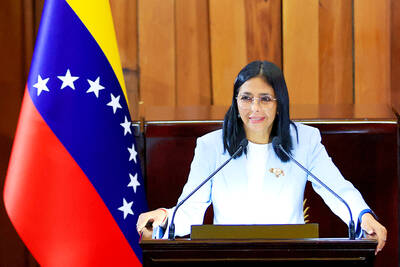
VAGUE: The criteria of the amnesty remain unclear, but it would cover political violence from 1999 to today, and those convicted of murder or drug trafficking would not qualify Venezuelan Acting President Delcy Rodriguez on Friday announced an amnesty bill that could lead to the release of hundreds of prisoners, including opposition leaders, journalists and human rights activists detained for political reasons. The measure had long been sought by the US-backed opposition. It is the latest concession Rodriguez has made since taking the reins of the country on Jan. 3 after the brazen seizure of then-Venezuelan president Nicolas Maduro. Rodriguez told a gathering of justices, magistrates, ministers, military brass and other government leaders that the ruling party-controlled Venezuelan National Assembly would take up the bill with urgency. Rodriguez also announced the shutdown
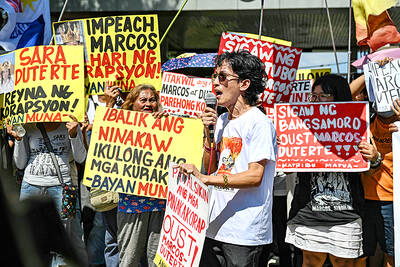
Civil society leaders and members of a left-wing coalition yesterday filed impeachment complaints against Philippine Vice President Sara Duterte, restarting a process sidelined by the Supreme Court last year. Both cases accuse Duterte of misusing public funds during her term as education secretary, while one revives allegations that she threatened to assassinate former ally Philippine President Ferdinand Marcos Jr. The filings come on the same day that a committee in the House of Representatives was to begin hearings into impeachment complaints against Marcos, accused of corruption tied to a spiraling scandal over bogus flood control projects. Under the constitution, an impeachment by the
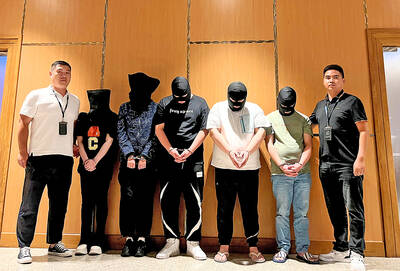
China executed 11 people linked to Myanmar criminal gangs, including “key members” of telecom scam operations, state media reported yesterday, as Beijing toughens its response to the sprawling, transnational industry. Fraud compounds where scammers lure Internet users into fake romantic relationships and cryptocurrency investments have flourished across Southeast Asia, including in Myanmar. Initially largely targeting Chinese speakers, the criminal groups behind the compounds have expanded operations into multiple languages to steal from victims around the world. Those conducting the scams are sometimes willing con artists, and other times trafficked foreign nationals forced to work. In the past few years, Beijing has stepped up cooperation
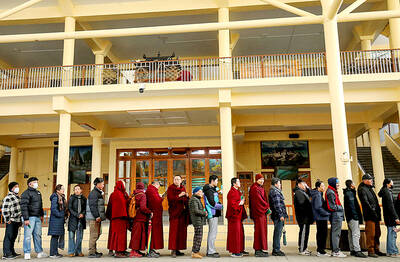
Exiled Tibetans began a unique global election yesterday for a government representing a homeland many have never seen, as part of a democratic exercise voters say carries great weight. From red-robed Buddhist monks in the snowy Himalayas, to political exiles in megacities across South Asia, to refugees in Australia, Europe and North America, voting takes place in 27 countries — but not China. “Elections ... show that the struggle for Tibet’s freedom and independence continues from generation to generation,” said candidate Gyaltsen Chokye, 33, who is based in the Indian hill-town of Dharamsala, headquarters of the government-in-exile, the Central Tibetan Administration (CTA). It


 RSS
RSS