


The US Army on Friday dropped all charges against the fifth soldier it had accused of killing Afghan civilians for sport during a 2010 deployment.
Army Specialist Michael Wagnon, 31, had been charged with the unlawful killing of one Afghan civilian in February 2010. He had been expected to go on trial next month.
In a statement, Joint Base Lewis-McChord said the charges were dismissed “in the interest of justice.”
Wagnon’s lawyer, Colby Vokey, said his client was “ecstatic” at the news, “very, very relieved” and eager to tell his wife.
“He kept saying over and over: ‘This is great news — I can’t wait to tell Carrie,’” Vokey said.
Four other soldiers from a Lewis-McChord Stryker brigade have been sent to prison in connection with the killings of three unarmed men during patrols in Kandahar Province.
In all, 12 soldiers were charged in connection with alleged misconduct that in addition to murder included hash smoking, collection of illicit weapons, the mutilation and photography of Afghan remains and the gang-beating of a soldier who reported the drug use. Eleven soldiers were convicted on various counts.
An army investigating officer had twice recommended that prosecutors dismiss the case against Wagnon.
Vokey said he thought preparations for the impending trial “just kept developing the evidence of Michael’s innocence until it just became overwhelming.
“The witnesses coming forward that we were able to speak to all confirmed the same thing — that Michael Wagnon had nothing to do with any kind of illegal activity,” the lawyer said.
The case hinged on an account from a “kill team” participant, Specialsit Jeremy Morlock, who is serving 24 years after admitting his involvement in all three killings. Morlock testified that Wagnon knowingly participated in a scheme to kill a civilian.
Wagnon had testified that he shot at an Afghan on the day in question because he believed the man had fired a weapon at Staff Sergeant Calvin Gibbs. Gibbs in November was sentenced to life in prison in the killings of three Afghans, including the man in the February 2010 encounter.
Wagnon “was simply a soldier pulling security who responded to the firing of weapons and came to support another soldier,” Vokey said.
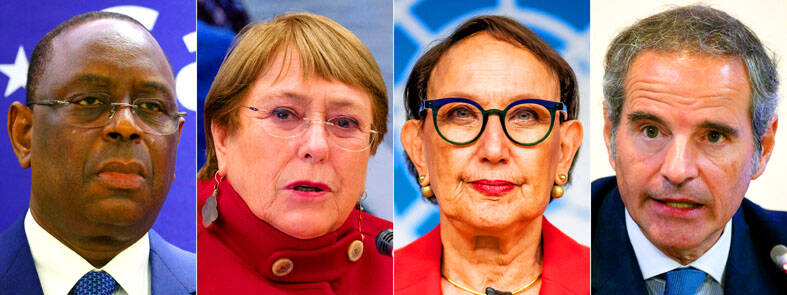
Four contenders are squaring up to succeed Antonio Guterres as secretary-general of the UN, which faces unprecedented global instability, wars and its own crushing budget crisis. Chile’s Michelle Bachelet, Argentina’s Rafael Grossi, Costa Rica’s Rebeca Grynspan and Senegal’s Macky Sall are each to face grillings by 193 member states and non-governmental organizations for three hours today and tomorrow. It is only the second time the UN has held a public question-and-answer, a format created in 2016 to boost transparency. Ultimately the five permanent members of the UN’s top body, the Security Council, hold the power, wielding vetoes over who leads the

South Korea’s air force yesterday apologized for a 2021 midair collision involving two fighter jets, a day after auditors said the pilots were taking selfies and filming during the flight and held them responsible for the accident. “We sincerely apologize to the public for the concern caused by the accident that occurred in 2021,” an air force spokesman told a news conference, adding that one of the pilots involved had been suspended from flying duties, received severe disciplinary action and has since left the military. The apology followed a report released on Wednesday by the South Korean Board of Audit and Inspection,

About 240 Indians claiming descent from a Biblical tribe landed at Tel Aviv airport on Thursday as part of a government operation to relocate them to Israel. The newcomers passed under a balloon arch in blue and white, the colors of the Israeli flag, as dozens of well-wishers welcomed them with a traditional Jewish song. They were the first “bnei Menashe” (“sons of Manasseh”) to arrive in Israel since the government in November last year announced funding for the immigration of about 6,000 members of the community from the states of Manipur and Mizoram in northeast India. The community claims to descend from

Young Chinese, many who fear age discrimination in their workplace after turning 35, are increasingly starting “one-person companies” that have artificial intelligence (AI) do most of the work. Smaller start-ups are already in vogue in Silicon Valley and elsewhere, with rapidly advancing AI tools seen as a welcome teammate even as they threaten layoffs at existing firms. More young people in China are subscribing to the model, as cities pledge millions of dollars in funding and rent subsidies for such ventures, in alignment with Beijing’s political goal of “technological self-reliance.” “The one-person company is a product of the AI era,” said Karen Dai


 RSS
RSS