


A month after the last US troops left Iraq, the US Department of State is operating a small fleet of surveillance drones here to help protect its embassy and consulates, as well as US personnel. Senior Iraqi officials expressed outrage at the program, saying the unarmed aircraft are an affront to Iraqi sovereignty.
The program was described by the department’s diplomatic security branch in a little-noticed section of its most recent annual report and outlined in broad terms in a two-page online prospectus for companies that might bid on a contract to manage the program. It foreshadows a possible expansion of unmanned drone operations into the diplomatic arm of the US government; until now they have been mainly the province of the Pentagon and the CIA.
US contractors say they have been told that the State Department is considering plans in the future to field unarmed surveillance drones in a handful of other potentially “high-threat” countries, including Indonesia and Pakistan, and in Afghanistan after the bulk of US troops leave in the next two years. State Department officials say that no decisions have been made beyond the drone operations in Iraq.
The drones are the latest example of the State Department’s efforts to take over functions in Iraq that the military used to perform. About 5,000 private security contractors now protect the embassy’s 11,000-person staff, for example, and typically drive around in heavily armored military vehicles.
When embassy personnel move throughout the country, small helicopters buzz over the convoys to provide support in case of an attack. Often, two contractors armed with machine guns are tethered to the outside of the helicopters. The State Department began operating some drones in Iraq last year on a trial basis and stepped up their use after the last US troops left Iraq last month.
The US, which will soon begin taking bids to manage drone operations in Iraq over the next five years, needs formal approval from the Iraqi government to use such aircraft here, Iraqi officials said. Such approval may be untenable given the political tensions between the two countries. Now that the troops are gone, Iraqi politicians often denounce the US to rally support from their followers.
A senior US official said that negotiations were under way to obtain authorization for the drone operations, but Ali al-Mosawi, a top adviser to Iraqi Prime Minister Nouri al-Maliki; Iraqi National Security Adviser Falih al-Fayadh; and Iraqi Acting Minister of the Interior Adnan al-Asadi all said in interviews that they had not been consulted by the US.
Al-Asadi said that he opposed the drone program: “Our sky is our sky, not the USA’s sky.”
The Pentagon and CIA have been stepping up their use of armed Predator and Reaper drones to conduct missile strikes against militants in places like Pakistan, Yemen and Somalia. More recently, the US has expanded drone bases in Ethiopia, the Seychelles and a secret location in the Arabian Peninsula.
The State Department drones, by contrast, carry no weapons and are meant to provide data and images of possible hazards, like public protests or roadblocks, to security forces on the ground, US officials said. They are much smaller than armed drones, with wingspans as short as 46cm, compared with 16.8m for the Predators.
The State Department has about two-dozen drones in Iraq, but many are used only for spare parts, the officials said.
The US embassy in Baghdad referred all questions about the drones to the State Department in Washington.
The State Department confirmed the existence of the program, calling the devices unmanned aerial vehicles (UAV), but it declined to provide details.
“The department does have a UAV program,” it said in a statement. “The UAVs being utilized by the US State Department are not armed, nor are they capable of being armed.”
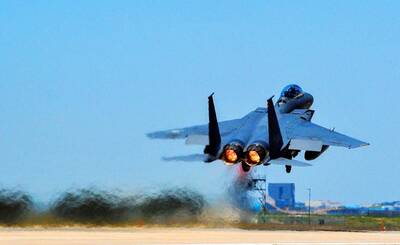
South Korea’s air force yesterday apologized for a 2021 midair collision involving two fighter jets, a day after auditors said the pilots were taking selfies and filming during the flight and held them responsible for the accident. “We sincerely apologize to the public for the concern caused by the accident that occurred in 2021,” an air force spokesman told a news conference, adding that one of the pilots involved had been suspended from flying duties, received severe disciplinary action and has since left the military. The apology followed a report released on Wednesday by the South Korean Board of Audit and Inspection,

Young Chinese, many who fear age discrimination in their workplace after turning 35, are increasingly starting “one-person companies” that have artificial intelligence (AI) do most of the work. Smaller start-ups are already in vogue in Silicon Valley and elsewhere, with rapidly advancing AI tools seen as a welcome teammate even as they threaten layoffs at existing firms. More young people in China are subscribing to the model, as cities pledge millions of dollars in funding and rent subsidies for such ventures, in alignment with Beijing’s political goal of “technological self-reliance.” “The one-person company is a product of the AI era,” said Karen Dai

About 240 Indians claiming descent from a Biblical tribe landed at Tel Aviv airport on Thursday as part of a government operation to relocate them to Israel. The newcomers passed under a balloon arch in blue and white, the colors of the Israeli flag, as dozens of well-wishers welcomed them with a traditional Jewish song. They were the first “bnei Menashe” (“sons of Manasseh”) to arrive in Israel since the government in November last year announced funding for the immigration of about 6,000 members of the community from the states of Manipur and Mizoram in northeast India. The community claims to descend from

‘TROUBLING’: The firing of Phelan, who was an adviser to a nonprofit that supported the defense of Taiwan, was another example of ‘dysfunction’ under Trump, a US senator said US Secretary of the Navy John Phelan has been fired, a US official and a person familiar with the matter said on Wednesday, in another wartime shakeup at the Pentagon coming just weeks after US Secretary of Defense Pete Hegseth ousted the Army’s top general. The Pentagon announced his departure in a brief statement, saying he was leaving the administration “effective immediately,” but it did not provide a reason or say whether it was his decision to go. The sources, who spoke on condition of anonymity, said Phelan was dismissed in part because he was moving too slowly to implement reforms to


 RSS
RSS