


As a harbinger of a gradual shift in global power it is easy to miss — a discreet red, blue and green banded symbol bearing the mysterious legend UnionPay — but walk into Harrods, Selfridges and other high-end stores in London and you will see it at many tills, meaning the shop accepts China’s most popular bank card and is therefore actively chasing income from one of the few global economies still expanding at speed.
The taste among Chinese consumers for luxury brands is nothing new. Louis Vuitton first set up shop in Beijing in 1992 and it now has almost 40 outlets inside the country. Within a few years Burberry will have 100.
More notable is the current effort being expended by UK stores to target high-spending Chinese tourists who will — they hope — plug the gap left by austerity-conscious Britons.
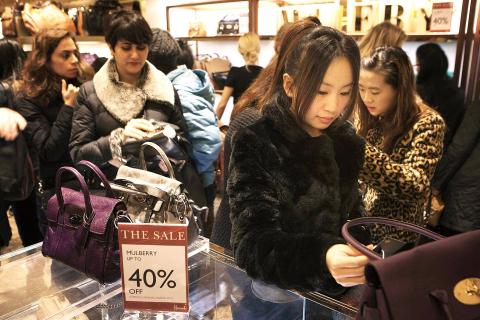
Photo: Reuters
The biggest push so far to this end has just finished, a promotional tour of Beijing and Shanghai led by the VisitBritain tourism organization. It included representatives from London’s Westfield shopping center, the luxury goods emporium at Bicester in Oxfordshire and even Gretna Green, which now has its own similar retail park, as well as Harrods and Selfridges.
At stake is a slice of a still relatively small, but fast-growing and high-spending tourism market. China accounted for just under 110,000 visits to Britain last year, a 23 percent annual increase. Of equal significance for retailers, the overall spend by Chinese nationals rose even faster, by 57 percent. The trend appears to be accelerating, with VisitBritain recording a near-doubling of the spend per Chinese tourist this year.
“The reason all these retailers came with us to China is that, at a time when domestic demand is, let’s say, soft, the Chinese market is expanding,” said Patricia Yates of VisitBritain, who led the mission. “If you’re a retailer looking at where growth is going to come from, then China is hugely important.”
A spokesman for Selfridges said sales to Chinese customers had in recent years “consistently achieved high double-digit growth numbers.”
“Chinese customers are of growing importance to Selfridges, have been for the past four to five years, and will remain so in the foreseeable future,” he said.
Even with annual growth still hovering near 10 percent, China remains significantly poorer overall than the UK, with average income little more than a fifth of the size, but the wealth is disproportionately based among an urban elite prone to conspicuous displays of economic status.
China’s 1.3 billion population makes it sizeable in absolute terms — one report earlier this year said the country has 960,000 people with at least £1 million (US$1.57 million) in assets. With luxury brands taxed at high rates in China, a trip abroad inevitably involves a fair degree of shopping.
The UK lags some way behind countries such as France in popularity. Aside from the draw of well-known brands, France offers a Schengen zone-wide visa, allowing travel within Europe.
With this in mind, UK shops are working all the harder to make Chinese shoppers welcome. A pioneer of this has been Bicester Village, where Mandarin-speaking “concierges” take groups round the shops, helping to explain mysteries such as UK clothes sizes. The complex is reaping the benefits, with takings from Chinese shoppers rising almost 80 percent year-on-year.
Chinese-speaking sales staff are common in some places, with Harrods alone employing more than 70, but there is another aspect, according to the association representing shops in London’s upmarket Bond Street.
“It’s not just about bringing in staff because they can speak Mandarin. They have to know about, say, the jewels and the mechanisms of a watch someone is buying. The Chinese tend to be very well informed. It’s also the small things, like the way they greet customers coming in, that they’re trained to take their credit cards with two hands, almost like a presentation. They have to know how to make customers feel at home,” a spokeswoman said.
When people are spending significant sums, they need to be parted from their money as efficiently as possible, which is where UnionPay comes in.
It is less than 18 months since the cards were first accepted in any UK shop. Now Selfridges, the pioneer in accepting it, has 75 UnionPay machines, while Harrods has 100.

An American scientist convicted of lying to US authorities about payments from China while he was at Harvard University has rebuilt his research lab in Shenzhen, China, to pursue technology the Chinese government has identified as a national priority: embedding electronics into the human brain. Charles Lieber, 67, is among the world’s leading researchers in brain-computer interfaces. The technology has shown promise in treating conditions such as amyotrophic lateral sclerosis and restoring movement in paralyzed people. It also has potential military applications: Scientists at the Chinese People’s Liberation Army have investigated brain interfaces as a way to engineer super soldiers by boosting

Indonesian police have arrested 13 people after shocking images of alleged abuse against small children at a daycare center went viral, sparking outrage across the nation, officials said on Monday. Police on Friday last week raided Little Aresha, a daycare center in Yogyakarta on Java island, following a report from a former employee. CCTV footage circulating on social media showed children, most younger than two, lying on the floor wearing only diapers, their hands and feet bound with rags. The police have confirmed that the footage is authentic. Police said they also found 20 children crammed into a room just 3m by 3m. “So

A highway bomb attack in a restive region of southwestern Colombia on Saturday killed 14 people and injured at least 38, the latest spate of violence ahead of next month’s presidential election. Authorities blamed the attack in the Cauca department — a conflict-ridden, coca-growing region — on dissidents of the now-disbanded FARC guerrilla army, who have been sowing violence across the country. “Those who carried out this attack ... are terrorists, fascists and drug traffickers,” Colombian President Gustavo Petro said on social media. “I want our very best soldiers to confront them,” he added. The leftist leader blamed the bombing
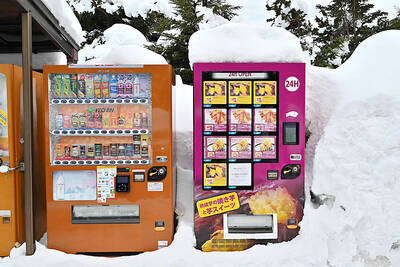
From post offices and parks to stations and even the summit of Mount Fuji, Japan’s vending machines are ubiquitous, but with the rapid pace of inflation cooling demand for their drinks, operators are being forced to rethink the business. Last month beverage giant DyDo Group Holdings announced it would remove about 20,000 vending machines — about 7 percent of their stock nationwide — by January next year, to “reconstruct a profitable network.” Pokka Sapporo Food & Beverage, based in Nagoya, also said last month it would sell its 40,000-machine operation to Osaka-based Lifedrink Co. “The strength of the vending machine


 RSS
RSS