


Traffic clogged roads out of the Thai capital yesterday, as tens of thousands of people fled ahead of a high tide expected to worsen floods that have inundated factories and prompted foreign governments to warn their citizens to stay away.
The main concern is that Bangkok’s Chao Phraya River will burst its banks over the weekend during the unusually high tide that began yesterday. Buildings across Bangkok have been sandbagged for protection, and some vulnerable streets were nearly deserted.
Thailand’s worst flooding in half a century, caused in part by unusually heavy monsoon rain, has killed 377 people since mid-July and disrupted the lives of nearly 2.2 million, until now mostly in the north and central provinces.
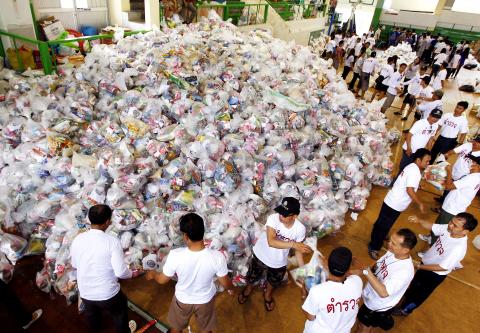
Photo: EPA
TV footage showed cars and trucks bumper-to-bumper leaving the city and the main airport’s departure lounges packed, but the traffic department said it could not put an exact figure on the size of the Bangkok exodus because much of its monitoring equipment was under water.
Thai Prime Minister Yingluck Shinawatra said she was considering a proposal to dig channels into some roads in eastern Bangkok to drain water into the Gulf of Thailand, an idea backed by the chairman of the Thailand unit of Toyota Motor Corp, whose factories have been badly flooded.
“We need to look into several details on whether it works,” Yingluck told reporters.
The Meteorological Department warned residents living along the Chao Phraya they could face rising waters. Roads around the Grand Palace are partially flooded along with some streets in densely populated Chinatown.
Yesterday morning, on a street in front of the Grand Palace normally bustling with tourists, a 2m snake was caught by a motorcycle taxi driver. Residents have also had to contend with crocodiles escaping from flooded farms.
While many of the inner-city streets of Bangkok remained dry, the suburbs continued to struggle.
In the riverside shantytown of Bang Phlad, small wooden homes were knee-deep in foul-smelling water with rubbish floating on the surface. Residents carried belongings above their heads, struggling against the current of water pumped back out to the river.
At the district’s Yanhee hospital, two dozen emergency room doctors and nurses shovelled sand into sacks to fortify a 1m wall protecting the building as water levels rose in a nearby canal brimming with trash.
In Nonthaburi Province bordering Bangkok, walls of sandbags were collapsing under the weight of surging floodwaters. A policeman dressed in shorts, flip-flops and a vest directed traffic on a megaphone as water gushed out of drains.
Yingluck’s government declared a five-day holiday from Thursday to allow people to leave. Roads out of the city to the flood-free south were jammed. Many were heading for the seaside town of Hua Hin and the eastern resort city of Pattaya, where hotel rooms and homes to rent were scarce.
The economic toll continued to pile up across Thailand, Southeast Asia’s biggest auto production hub and a major base for multinational firms, many of which face supply and production disruptions after the floods shuttered at least seven huge industrial estates north of Bangkok.
The Bank of Thailand nearly halved its projection of economic growth this year to 2.6 percent from July’s 4.1 percent estimate, and said the economy would shrink by 1.9 percent sequentially in the December quarter because of the floods.
Daihatsu Motor Co, which makes mini-vehicles for Toyota Motor Corp, said it would reduce work to produce Toyota-badged cars at two Japanese factories next week due to a shortage of parts from Thailand.
However, insured losses are likely to be at a manageable level and will not trigger widespread solvency problems, credit-ratings agency Fitch Ratings said.
Many Thais are uninsured and Japanese non-life insurers in Thailand will bear the brunt of losses at the factories.
Fitch, citing Thai insurance regulatory data, estimated the country faced about 140 billion baht (US$4.5 billion) in losses, including damage at the seven industrial estates. About 80 percent of that is covered by Japanese insurers, but they are unlikely to be badly affected with about 85 percent of their coverage ceded to foreign reinsurers, Fitch said.

‘CROSSING THE LINE’: China’s embassy in Seoul criticized US Forces Korea Commander General Xavier Brunson, asking if his ‘hostile’ remarks were authorized by Washington South Korea and the US are in talks over recent public remarks by the commander of US Forces Korea, Seoul’s presidential office said yesterday, after the comments drew sharp criticism from China. In a recent podcast interview, US Forces Korea Commander General Xavier Brunson described South Korea as “the dagger in the heart of Asia” from China’s east coast, prompting the Chinese embassy in Seoul to say that he had “truly crossed the line.” The interview came amid growing speculation that Washington might seek to expand the role of US Forces Korea in countering the growing regional influence of China, a key

SEEKING ORDER: Rodrigo Paz said that ‘anyone who wants to destroy the nation will have to deal with this president and the full force of the constitution’ Bolivian President Rodrigo Paz on Wednesday said that the nation was at a “breaking point” after nearly a month of protests that have caused shortages of food, fuel and medicine. Paz, who took office six months ago amid the worst economic crisis there in four decades, is battling a groundswell of fury over his policies. The political capital, La Paz, has been besieged by low-income workers and members of the indigenous majority calling for his resignation. “The country needs order and is reaching breaking point,” the 58-year-old said at a public event in La Paz, renewing his appeal for dialogue. On Tuesday, the Bolivian

Australian researchers have trained lab-grown brain cells on a silicon computer chip to play the 1990s shooter game Doom and said they are just scratching the surface of what the neurons could be capable of doing. It is the science-fiction work of biotech boffins at Cortical Labs, who researched and developed the technology that harnesses the workings of the brain’s networking system. Each so-called “biological computer” contains about 200,000 living human brain cells, grown from stem cells that were harvested from blood donations. Having mastered the simple computer game Pong, where a paddle is moved up and down to send a ball

Through the noise of rushing papers and whirring belts at a print factory in Kyoto, two creators watch their photo essay come to life in broadsheet form — part of an effort to win new audiences in the age of artificial intelligence (AI). Despite the decline of the publishing industry, self-publication and handmade “zine” magazines are growing in popularity in Japan, reflecting the nation’s enduring love of paper in the digital era. While speaking to Agence France-Presse at the plant, his hands black with ink, one of the creators, Kazuma Obara, said: “I think [paper] is a medium that engages all five


 RSS
RSS